Showing posts with label Blackburns. Show all posts

Friday, 19 August 2016

On the trail of the Blackburns

While in York this past June I went back to the church of All Saints North Street, the parish church of the Blackburn family, to photograph the windows they donated to the church. They donated two windows, the Corporal Acts of Mercy Window and the St Anne Window (also known as the Blackburn Family Window, for fairly obvious reasons). These medieval windows are among the most famous in York and provide some of the best evidence we have about the Blackburn family. From them we can work out that:

  • the Blackburns were a wealthy family - very much so 
  • they were not averse to having this wealth displayed - probably quite the opposite
  • they were probably a genuinely pious family, but they made jolly sure that this piety was of the visible kind. In this they are a typical medieval upper-middle-class citizens, practising what I call 'practical piety.'  
  • their favourite saints were St Anne, St Christopher and St John the Baptist
  • the Blackburn women were probably literate (though this was not as uncommon as is popularly thought) and wanted this to be known
  • they were important people in their local parish and in the wider city 

Stained glass and practical piety

The Blackburns' motivation for donating the windows was, at least primarily, a charitable one. But, from a worldly point of view, the windows ensured that their significant wealth and their substantial largesse were on public and very visible display. From a spiritual standpoint, the Blackburns would almost certainly have viewed their donation as helping to cement them in God's good graces - an attitude that was typical of the pre-Reformation mindset. Moreover, by having themselves depicted in the windows, the Blackburns ensured that they would be remembered after death. This was not so much from worldly vanity (though no doubt that came into it too) but rather so that people looking at the windows would be reminded to pray for the repose of the Blackburns' souls. Preoccupation with purgatory and the state of the soul after death is another medieval trait.

The windows

The Corporal Acts of Mercy Window I have already written about here. But here it is again, because the reds and blues in the glass are so pretty:


This is the St Anne Window. Currently this window forms the church's East Window, which, as it is directly behind the altar, is a church's most prominent and most important window. However, this is almost certainly not the original positioning of the window; probably it was initially in the Lady Chapel, in the north aisle of the quire. At some point it was moved to the altar, which unfortunately means that the altar candles and crucifix get in the way of a good photograph:

St Anne is in the centre light; on her left (the right as you look at the window) is St Christopher carrying the Christ Child, and on her right St John the Baptist. Directly below St Anne sits the risen Christ enthroned in glory, flanked on either side by Nicholas and Margaret Blackburn senior (to the right as you look at the window) and their son and heir Nicholas junior with his wife, also a Margaret, on the left.

Here is a better view of the saints in the three main lights:


And here are the Blackburns themselves, kneeling piously and reading diligently in the bottom corners of the window. These are the senior Blackburns; Nicholas is shown in armour, possibly a reference to his position as King's Admiral of the North. Note the shield with 'B' (for Blackburn) in the centre. The lettering along the bottom originally read 'Orate pro animabus Nicholai Blakeburn senoris quondam maioris civitatis Ebor. et Margarete uxoris eius' [Pray for the soul of Nicholas Blackburn, former mayor of the city of York, and for Margaret his wife].


And here are Nicholas and Margaret junior:


The Blackburn shield is repeated, as is the lettering along the bottom, which seems to be the same as that under the senior Blackburns except that the word senoris is replaced with junioris. The fact that both Margarets are shown reading from the Psalms (Margaret junior reads Psalm 6 [Vulgate numbeing] and Margaret senior Psalm 50) is probably intended to draw attention to their literacy as well as their piety. As mentioned above, women's literacy was not as uncommon as is sometimes thought, but did presuppose a certain level of familial wealth and prestige.

The Blackburns in Blackburn

The Blackburns were not originally a York family. They came from Lancashire, almost certainly from the area around what is now the city of Blackburn. Whether the Blackburns were named after the city or the city after the Blackburns is not clear.

On my last Sunday in England I visited Lancashire's Samlesbury Hall, and what did greet me in the Great Hall but - 

The Blackburn coat of arms is the second from the right.

- lo and behold, a Blackburn coat of arms, complete with helpful date. 

I know next to nothing of heraldry (clearly a deficiency in my education :D). But some preliminary research suggests that the black wavy line through the centre of the shield represents the stream or river, known as the Black Brook or Black Water, on the banks of which the town was built. The white background possibly refers to wool or cloth; the manufacture of this was the town's chief industry and one which we know the Blackburn family to have been involved in. The stars, which apparently are correctly termed mullets, are interesting because as far as I can make out they were quite rare in the Middle Ages. Apparently they signify something along the lines of 'favoured by God' - which would fit neatly with the family's evident desire to claim, and proclaim, piety and prosperity.

Looking at the Blackburn Borough Council coat of arms I think it is possible to trace the much older Blackburn family coat of arms in the design:

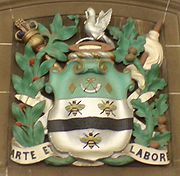
image in public domain, via


The design has obviously been added to over the years, but the central elements are strikingly similar to the medieval Blackburn coat of arms: the white background, the black wavy line, and the three stars or bees - two above the line and one below. The bees apparently signify industry and perseverance; their initial letter, 'B', is also the initial letter of the town.

Heraldic sources:

Thursday, 11 August 2016

One's first conference

Yours truly shall be heading off to Wellington next February for the eleventh biennial conference of the Australian and New Zealand Association for Medieval And Early Modern Studies (phew, what a mouthful, and even the shorter ANZAMEMS isn't much better). My proposal, on the family, faith and fortune of our old friends the Blackburns, has been accepted (hooray!) and now I shall have to give a fifteen minute presentation at a Real Conference in front of Real Academics (gulp). 

Margaret and Nicholas Blackburn junior, in the Blackburn family window, All Saints North Street, York

Friday, 29 July 2016

Colour and light: English stained glass

York Minster

When I was in York last year this was all that could be seen of the Minster's Great East Window...
But happily, conservation work on it is now almost completed and the window is once again on display.
The window, one of the largest surviving medieval windows in the country, tells the story of the beginning and end of the world, as well as incorporating various clerical figures connected with York and the north of England.

This is the St William window in York Minster, depicting William's rather eventful life and some of the miracles attributed to him. There is are more detailed pictures, and an article about the restoration of the window, here.
All Saints North Street

The St Anne window in All Saints North Street, donated by the Blackburn family. This window is now the East Window behind the altar, although this is probably not its original positioning. St Anne, to whom the Blackburns seem to have had a special devotion, is in the centre light, flanked by St John the Baptist on the left and St Christopher (also a favourite saint of the Blackburns) on the right.

And here are the junior Nicholas and Margaret Blackburn, kneeling piously in the bottom left corner of the window. Opposite them, in the bottom right corner [not shown here] are Nicholas and Margaret senior.

Church of St Mary Magdalene, Brampton
(Detailed historical and architectural information about this church, which dates back to the 13th century, can be found here.)

This window (not medieval!) shows, from left to right, St Fidelia, St Peter, St Stephen and St Perpetua (all early martyrs). The small bottom lights are memorials to the soldiers of World War I (detail below).

Ruth - who took my fancy because of the lovely red colouring of her dress, and because I have never seen her in any other window.
This is a tiny little window set low down into the chancel wall.
The West Window, above the West Door.

Tuesday, 29 March 2016

The Blackburns: Family Tree

During the research for my MA thesis I dug up - almost literally - the Blackburn family, who lived in York from the late fourteenth century and seem to have been one of the city's leading families. They proved very helpful to me because the family patriarch, Nicholas Blackburn senior, and his wife Margaret left detailed wills, which are available online (translated from the original Latin) here.

The wills are noticeable for the almost obsessive concern they display with churches and chantries. Indeed, the Blackburns' identity, and their relationship to the city of York, is defined not, as might be expected, by the land or property they owned, but through the churches they worshipped at. This became an important part of my thesis, but today I want to look at what else the wills can tell us about the history of the Blackburn family.

Starting with the wills but later scrounging around for other information I managed to produce a Blackburn family tree covering roughly a century. It is still a work in progress - unfortunately most birth and death dates are currently lacking - but the tree still shows the principal family relationships during the fourteenth and fifteenth centuries.

Although the Blackburns ended up as a very prominent York family their roots seem to lie not in Yorkshire at all but in Lancashire. They were a family of merchant traders, or mercers, meaning they dealt in cloth and textiles. At this they were obviously successful, since the wills show that they became very wealthy.

As to which part of Lancashire they came from, I would hazard a guess that it was the town of Blackburn or nearby. The evidence for this, such as it is, is two-fold: firstly the Blackburns' name (family names in the Middle Ages were often related to where a person lived); secondly, their occupation. Blackburn, which is old enough to be mentioned in the Domesday Book, was by the mid 1200s a textile manufacturing town. As we know that the Blackburns were mercers, it seems not unreasonable to suggest that they may originally have been linked with the town.

However, at some point they moved over the border into Yorkshire. Nicholas Blackburn senior, who became the head of the York family, was born around 1360 or thereabouts in Richmond, about fifty miles north of York. He married Margaret Ormeshead, the daughter of another prominent local merchant family. They had at least five children: John, Nicholas junior, William, Isabel and Alice. William seems to have been the black sheep of the family as he is scarcely mentioned in his parents' wills - so much so that at first I overlooked him and counted only four children.

By the late 1300s the family had moved to York, to North Street, home to the York Mercers. The parish church of both the Mercers' Guild and the Blackburn family was All Saints North Street. There is no evidence, however, to suggest one way or the other whether Nicholas Blackburn was a member of the Mercers' Guild. But he and his wife were certainly members of the Corpus Christi Guild, one of the most prestigious guilds in York; they joined in 1414, by which time they were clearly well-established members of the York community: in 1406 Nicholas had been made King's Admiral of the North and in 1412 Lord Mayor of York (a position also held by his son, Nicholas junior, in 1429).

Of the Blackburn children, John married twice but died prematurely in 1426 or 1427, leaving Nicholas junior (who like his father also married a Margaret, which is distinctly confusing) their father’s heir. I have found no mention of William marrying, but Isabel and Alice did; between them these four children seem to have supplied their parents with several grandchildren and great-grandchildren, though John's two sons seem to have predeceased him. Several Blackburns, Sandfords and Boltons are mentioned in the wills of Nicholas and Margaret - the descendants of, respectively, Nicholas, Isabel and Alice. The exact relations of the Sandfords to one another, however, are (at least at the moment) not clear, which is why I can only tentatively group them together in the family tree. Certainly they seem to have been a large family.

Nicholas and Margaret senior are buried together in York Minster - as Nicholas puts it in his will,  “under my marble stone which has been prepared on that spot for the purpose.” This is yet a further indication of their prominence and prestige within the York community, since at this time most people were buried within their parish church or its graveyard.

The Blackburns have become my pet project - although they were clearly important to York and particularly the All Saints North Street parish for at least the first third of the fifteenth century there is little information about them readily accessible. Most scholarly studies of the Blackburns relate to the stained glass windows they donated to All Saints North Street. Though the windows are important, they are surely not the only aspects of the Blackburns' lives worth investigating.

However, the evidence is there - in the wills, in the churches, and in the civic records - and I am trying to sift and sort this to build up a more detailed picture of the Blackburns' lives. Doing so offers a way into the complex, rich and detailed world of the faith of medieval York.

Monday, 24 August 2015

Corporal Acts of Mercy Window


This window is in the north aisle of All Saints North Street, one down from the Pricke of Conscience Window, and like the Pricke of Conscience window it is very famous. It shows the corporal acts (or works) of mercy by which medieval Catholics hoped to get to heaven. Oddly, however, it shows only six of the seven acts. (Perhaps the glazier thought that to show all seven would ruin the window's symmetry!)

The window was donated to the church in about 1410 by Nicholas Blackburn, who seems to have been one of York's most prominent citizens. Certainly he was an extremely wealthy merchant, since he donated not only the Corporal Acts of Mercy Window but also the Great East Window behind the altar.

Reading clockwise from the top left-hand panel, you can see the feeding of the hungry; giving drink to the thirsty; the shelter of the homeless; visiting the imprisoned (here shown in medieval stocks!); visiting the sick; and the clothing of the naked. (The seventh work, not shown, is to bury the dead.)

The man shown performing the works of mercy is probably intended to be Nicholas Blackburn himself. The window thus shows off not only his wealth but also his piety!

The bottom three panels, from left to right, show a kneeling monk or priest (possibly one endowed by Nicholas Blackburn to sing Masses for his soul); a floral (?) decoration; and a kneeling couple, probably Nicholas and his wife Margaret.

Visiting the poor unfortunates in the stock. Is the happy free gentleman on the left Nicholas Blackburn?


Nicholas Blackburn was a Mercer (merchant), but whether he was a member of the York Mercer's Guild is not known. The guild does have a link with the window, however, since their play in the Corpus Christi pageant was Doomsday or the Last Judgement. The corporal works of mercy feature prominently in the play; they are the means by which Christ separates the good souls from the bad. To the good souls He says,

Whenne I was hungery ȝe me fedde;
To slake my thirste youre harte was free;
Whanne I was clotheles ȝe me cledde,
Ȝe wolde no sorowe vpon me see.
In harde presse when I was stedde,
Of my penaunce ȝe hadde pitee.
Full seke when I was brought in bedde,
Kyndely ȝe come to coumforte me.

Whanne I was wille and werieste,
Ȝe herbered me full hartefully;
Full gladde þanne were ȝe of youre geste,
And pleyned my pouerte piteuously.


[When I was hungry you fed me;
To ease my thirst your heart was free;
When I was without clothes you clad me,
You would no sorrow upon me see.
When I was hard pressed,
You had pity on my distress,
When I was sick in bed,
Kindly you came to comfort me.

When I was wandering and weary
You harboured me full generously;
Full glad were you of your guest,
And commiserated with my poverty.]

And to the bad,

Whanne I had mistir of mete and drynke,
Caytiffs, ȝe cacched me fro youre gate.
Whanne ȝe were sette as sirs on benke,
I stode þeroute, werie and wette;
Was none of yowe wolde on me thynke,
Pyté to haue of my poure state,
Þerefore till hell I schall you synke,
Weele are ȝe worthy to go to þat gate.

Whanne I was seke and soriest
Ȝe visitte me noght, for I was poure;
In prisoune faste whan I was feste,
Was none of you loked howe I fore.
Whenne I wiste neuer where for to reste,
With dynts ȝe draffe me fro your dore.


 [When I had need of meat and drink,
Caitiffs, you drove me from your gate
When you were feasting and merrymaking
I stood without, cold and wet;
Not one of you thought of me,
Or had pity on my wretched state,
Therefore I shall sink you into Hell,
Well are you worthy to go to that gate.

When I was sick and sorriest,
You visited me not, for I was poor;
When I was held fast in prison,
None of you looked to see how I fared.
When I knew not where to rest,
With blows you drove me from your door.]

It is not known whether Nicholas was involved with the Mercers' play but his son (confusingly, also called Nicholas) was one of the station holders along the pageant route. This means that he paid for the plays to stop outside his door and was probably another sign of his wealth and prestige.


Maren Donley has produced an interesting, if rather involved, explanation of the links between the window, the Mercers, and Nicholas Blackburn. See Maren L. Donley, “Mercers, Mercantilism and the Maintenance of Power: the York Last Judgement and the York Register, Exemplar 18, no 2 (2006): 343ff.

Passages from the Last Judgement play in Richard Beadle, The York Plays: A Critical Edition of the York Corpus Christi Play as Recorded in British Library Additional MS 35290, volume I (Oxford: Oxford University Press, 2009), l.285-96, 325-38. Modern English translations my own.