
Showing posts with label Old English. Show all posts
Showing posts with label Old English. Show all posts
Tuesday, 29 November 2016

Sunday, 15 May 2016
Pentecost Sunday
_-_interior,_stained_glass,_Pentecost.jpg) |
| via |

Et emitte caelitus
Lucis tuae radium.
Veni, pater pauperum,
Veni, dator munereum,
Veni, lumen cordium.
Consolator optime,
Dulcis hospes animae,
Dulce refrigerium.
In labore requies,
In aestu temperies,
In fletu solatium.
O lux beatissima,
Reple cordis intima
Tuorum fidelium.
Pentecost Sunday, the feast of the Holy Ghost, is also known in England as Whitsunday, a term dating from the Norman Conquest. The word comes from late Old English; whit means white (hwitte in Old English; Hwita Sunnandæg = White Sunday or Whitsunday). What the white refers to is a matter of some debate; the most common explanation is that it refers to the white baptismal robes of those who were baptised during the feast's vigil. Another explanation links the Christian feast with a much older pagan one - the Mayday festivities, when young girls would wear white to mark the coming of summer.
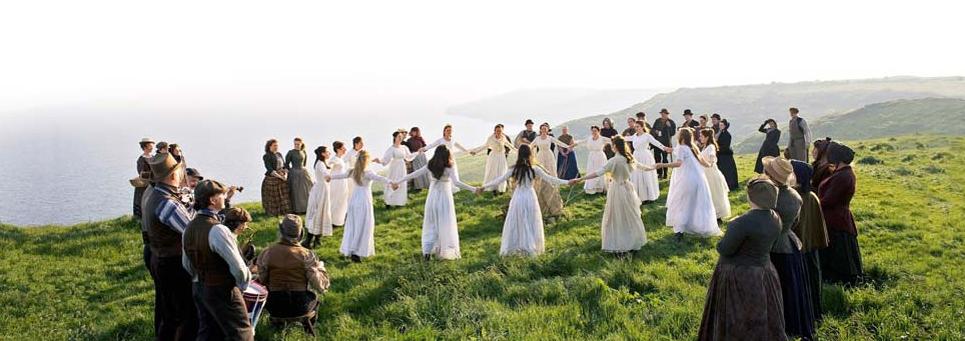 |
| The Mayday dance in the 2008 BBC Tess of the D'Urbervilles, via |
During the Middle Ages whit seems to have been (erroneously) confused with wit or wisdom, one of the seven gifts of the Holy Ghost. Thus:
þis day ys called Whitsonday, for bycause þat þe Holy Gost as þys day broʒt wyt and wysdome ynto all Cristes dyscyples
[this day is called Whitsunday, because the Holy Ghost on this day brought wit and wisdom to all Christ's disciples]
According to some versions of the King Arthur legend, Arthur married Guinevere on the feast of Pentecost, and in Malory's Le Morte d'Arthur it is on the feast of Pentecost that the Knights of the Round Table swear their oath of honour, chivalry and loyalty:
the kynge... charged them never to do outerage nothir morthir, and allwayes to fle treason, and to gyff mercy unto hym that askith mercy... and allwayes to do ladyes, damesels, and jantilwomen [socour] strenthe hem in hir ryghtes, and never to enforce them, upon payne of dethe. Also, that no man take no batayles in a wrongefull quarell for no love ne for no worldis goodis. So unto thys were all knyghtis sworne of the Table Rounde, both olde and yonge, and every yere so were the[y] sworne at the hygh feste of Pentecoste.
[the king... charged them never to do outrage nor murder, and always to flee treason, and to give mercy to those who asked for mercy... and also to give succour to ladies, damsels and gentlewomen, to defend their rights, and never to use force against them, upon pain of death. Also, that no man take go into battle for a wrongful cause, not for love nor for worldly goods. So to this were sworn all the knights of the Round Table, both old and young, and every year so were they sworn at the high feast of Pentecost.]
It is interesting that Malory uses the word Pentecost, not Whitsun, which was the more common term in England at the time. The use of Pentecost is presumably because the King Arthur stories were originally written in French. The French term for the feast is Pentecôte, so Mallory has translated it literally into English.
 |
| The Knights of the Round Table swear their oath at Pentecost, via |
Quote from Thomas Malory taken from Eugene Vinaver, ed., The Works of Sir Thomas Malory (London: Oxford University Press, 1968), 91.
Quote from John Mirk taken from Theodore Erbe, ed., Mirk's Festival: A Collection of Homilies (London: Kegan Paul et al., for the Early English Text Society, 1905), 159.
Veni Sancte Spiritus from the Sequence for the Mass of Pentecost.
Friday, 25 March 2016
Easter in the Middle Ages
✝
Syllic
wæs se sigebeam ~ Wondrous was that tree of victory.
[From The Dream of the Rood]
Recently I came across these two articles and thought them worth sharing:
"This doubtful day of feast or fast" - Good Friday this year falls on March 25th, the feast of the Annunciation (Lady Day, as it was called in the Middle Ages). This article (from the blog A Clerk of Oxford by Eleanor Parker) explores the medieval link between the two events.
Holy Week: The Triduum before the English Reformation - well, this article (from the blog Supremacy and Survival: The English Reformation by Stephanie A. Mann) does what it says in the title - explores the medieval Triduum (the three days of Maundy Thursday, Good Friday, and Easter morning).
It also notes that Margaret Clitherow was martyred 470 years ago today, Friday 25th March 1586. In that year as in this, Good Friday fell on the 25th March.
þūhte mē þæt ic
gesāwe syllicre
trēow
on lyft lædan
lēohte bewunden,
bēama beorhtost.
It seemed to me that I saw a very wondrous tree,
Suspended in the air, surrounded by light,
The brightest of trees.
You can read the whole poem, in both Old English and in a modern English translation, at this very useful website.
Subscribe to:
Posts (Atom)