Showing posts with label drama. Show all posts

Wednesday, 18 October 2017

Have you seen the York Mystery Plays?

Just received university ethics clearance for interviewing people involved with the York Mystery Plays. Now I need people to talk to! Please get in touch or help spread the word!


YORK EVOLVING: CHANGE AND PERMANENCE IN THE 
YORK MYSTERY PLAY CYCLE

CALL FOR INFORMATION

Eleanor Bloomfield, a PhD candidate at the University of Auckland, is researching modern revivals of the York mystery play cycle and is seeking first-hand accounts of the plays. Anyone who has seen, or been involved with, any performances of the York plays from 1951 to the present day, and is willing to be interviewed regarding their memories, impressions and experiences, please contact e.bloomfield@auckland.ac.nz or write to Eleanor Bloomfield, The University of Auckland (English, Drama and Writing Studies), 14A Symonds St, 206-646, Auckland 1010, New Zealand. Confidential interviews will be held in Britain between March and September 2018. Approved by the University of Auckland Human Participants Ethics Committee on 10th October 2017 for three years. Reference Number 020006.

Tuesday, 6 September 2016

York Minster Mystery Plays June 2016


'Have you come far?' 
- York Minster Mystery Plays volunteer to me

This post is rather late, given that we saw the plays on the 22nd June and it is now the beginning of September... still, better late than never! The reason for the delay is that I have been writing up a review of the plays as an academic paper, and my little brain does not like working on two things at once. Academia comes before blogging, so there you are. However, now that I have finished my paper, which is currently languishing in a long-suffering editor's inbox awaiting review, it is time to turn my attention to my rather neglected blog.

The Minster production of the mystery plays was the original inspiration for this year's English trip - their timing, just a few of months after handing in my MA thesis, was happily fortuitous and an excellent excuse for another trip back to Blighty. So back to Blighty I went, or more specifically back to York - this time with both my Grandmas, which made it even more special.

Despite being born a Lancashire rose I am very fond of the white rose county and of York in particular, which despite visiting only twice I have quite fallen in love with. So it was very nice to be back!

We went to a matinee performance of the plays, which turned out to be a good thing as the running time, billed at three and a half hours, ended up being nearer four. Thanks to jetlag, if we had gone in the evening I would probably have been gently snoozing long before Doomsday. On second thoughts, perhaps I wouldn't, as the Minster - all stone and shadow - was distinctly chilly.

By happy forethought, we had front row seats. It was a full house - testament to the popularity of the plays and this production in particular, which does seem to have been a fairly resounding success both with the critics and the general public. The Minster's nave had been converted into seating for around a thousand people - the third nearest the stage was flat but the back two-thirds was raked scaffolding, soaring up and back towards the West Window. 

The stage and set were huge, spread over four playing levels and linked by a series of wide, broad steps. Like the seating, the set reached upwards and backwards, almost to the top of the organ atop the quire screen. This kind of scale was of course the complete antithesis to the original performances of the play cycle, which were staged on small, mobile pageant wagons, but it worked well. Firstly, it evoked the scale and sweep of the cycle, which spans Biblical history from Creation to Doom, and secondly, well, such a big stage was necessary to accommodate the huge cast! This numbered roughly a hundred and forty, all except one (Philip McGinley, playing Christ) unpaid volunteers and many of them from the local community who have been performing in various productions of the plays for years (sometimes decades).

Out of so many characters, it is hard to pick favourites, but Philip McGinley was very good as Christ - though he puzzled me somewhat by making his first entrance clad rather incongruously in jeans and T-shirt but appearing thereafter in more conventional whitey-grey robes. Toby Gordon, as Lucifer, was (perhaps worryingly...) even better, but he reminded me of Dominic Cooper and once this thought had popped into my head it wouldn't pop out again. Ruby Baker as Mary and Mark Comer (one of the recurring devotees of the mystery plays) as Joseph were also excellent. Abraham I remember chiefly for the fact that he had to read his lines off a piece of paper hidden under his cloak (clearly someone was ill and he gamely stepped into the breach), Noah and Mrs Noah for their comic sparring, and Herod for his massive golden cape which spread over the entire stage and required an army of minions to manoeuver.

This version presented eighteen pageants (the original medieval play cycle has about forty-seven), though several of these consisted of two or three of the original short pageants run together into a longer section. The Middle English script had been 'lightly modernised,' retaining the alliterative rhythm of the original while introducing a few modern touches, such as Noah's 'Don't touch - the paint's not dry!' (said to God, inspecting the ark) and Lucifer's wail of 'It's not fair!' while being thrown into hell.

My two favourite episodes were the Creation and the Passion - the former for its colour, light and incredibly lifelike animal puppets, and the latter (which is really the heart of the entire cycle) for its solemn grandeur. Runners-up were the Nativity, for its tableaux effect, and the Entry into Jerusalem, for its movement and momentum.

No photographs of the actual performance - alas, this was not the free and easy Pop-Up Globe. But there are quite a few on the production's website, here.

Monday, 5 September 2016

2018: Summer of Mysteries

Not one but two productions of English mystery play cycles are planned for the summer of 2018: a wagon production of the (abridged) York cycle, and a version of the Chester plays.

Keep an eye on their respective websites (York Mystery Play Supporters Trust and Chester Mystery Plays).

‘It's not fair! You’ve not seen the last of me
Lucifer, The Last Judgement

Mike Poulton, The York Mystery Plays in a New Version (London: Nick Hern Books, 2016), 123.

Monday, 15 August 2016

The Revenger's Tragedy

Stray Theatre Company (the University of Auckland's student drama club) is performing the Jacobean Revenger's Tragedy this week Wednesday to Saturday, 7pm in the Arts 1 Drama Studio. Tickets $10 for students and $12.50 for adults through here.

                       Faith, give Revenge her due,
She's kept touch hitherto - be merry, merry,
Advance thee, oh thou terror to fat folks
To have their costly three-piled flesh worn off
As bare as this - for banquets, ease and laughter
Can make great men, as greatness goes by clay,
But wise men, little, are more great than they.

The Revenger's Tragedy I.1.43-49.

Thursday, 11 August 2016

The Hobbit in Lancashire

Found this while hunting up reviews of the York Mystery Plays and couldn't resist sharing it:


Namárië! Nai hiruvalyë Valimar.
Nai elyë hiruva. Namárië!

Tuesday, 9 August 2016

Richard III, the HandleBards, and Shakeshafte

This was one of the funniest things I have ever seen. I haven't laughed so much since Twelfth Night at the Pop-Up Globe.

The HandleBards tour the UK on bicycles, playing Shakespeare (usually outdoors) at various points along the route. They carry with them whatever props, costume and scenery they can squeeze onto their bikes (i.e. not much). There is a girls' group and a boys' group, each only four strong, and it was 'The Boys' we saw, performing Richard III in the grass courtyard of Lancashire's Hoghton Tower.

Richard III has a cast of forty-two. One of the HandleBards played Richard, and the other three took the remaining forty-one between them. As they helpfully pointed out, that is an average of 13.6 characters each. Needless to say, delightful chaos ensued; The Tragedy of King Richard III became The Farce of Richard and III Other Actors. What Shakespeare would have thought one can only guess, but one has a sneaking suspicion he might approve. It was fast, rowdy and fun.

Paring Shakespeare back to this extent, and treating the text and characters with a cheerful and reckless abandon, is brave, but it clearly paid off with a vengeance. The endless character swapping (done mostly by donning and doffing different hats) meant that the audience (and quite possibly the actors) was never quite sure who was playing whom at any given moment, and for those not familiar with the original play it probably boarded on the completely confusing (I know it reasonably well, and it was confusing enough to me). The whole thing was quite barmy and yet utterly hilarious. Only in England!

Richard III is Shakespeare's second-longest play (only Hamlet is longer) but they managed to squeeze it into about two hours. This was something of a mercy because it was open-air, and Lancashire's evening air, even in the height of summer, is apt to be rather parky. However, at least it didn't rain.

Hoghton Tower, via
Seeing Shakespeare at Hoghton Tower was particularly special because there is a local story that Shakespeare's so-called 'lost years' were spent in Lancashire, and that he lived for a while at Hoghton Tower as well as the homes of other prominent local families. The reasoning behind begins with the premise that Shakespeare was a Catholic and runs thus: several of the teachers at Shakespeare's Stratford school were Jesuit priests from Lancashire, which was a recusant stronghold during the Reformation; since he had connections in the area or at the very least people of his own faith, Shakespeare may therefore have headed up there when facing trouble at home (there is a story that he poached Thomas Lucy's deer, earning the wrath of that local lord). Once oop north, the story is that he lay low (Lancashire, surrounded by hills, is sometimes known as the 'hidden county;' the difficulty of passing the hills made the county a relatively safe one for Catholics during the Reformation) and tutored the children of the local Catholic gentry. 

The 1581 will of Alexander de Hoghton mentions a William Shakeshafte 'now dwelling with me,' requiring a Sir Thomas Hesketh either to take Shakeshafte into his service or to find him another 'master.' What kind of master is not specified, but the mention of Shakeshafte comes just after one of players, 'play clothes' [presumably costumes] and musical instruments, so the theory is that de Hoghton was seeking for the young actor Shakespeare the security of a patron. Shakespeare, the story goes, began his acting career in Lancashire, performing in the halls of the great houses there (apart from Hoghton Tower, Rufford Old Hall, the home of Sir Thomas Hesketh, also lays claim to harbouring Shakespeare). And the Shakeshafte bit? That was an alias, of course, because Thomas Lucy was still thirsting for William's blood. (It has been suggested that Shakeshafte was a variant of the family name used by William's grandfather.)

As with so many of the stories surrounding Shakespeare, this one is impossible to prove or disprove (many Shakespearean scholars would pooh-pooh it), but it makes for a jolly good yarn. One rather surprising subscriber to the story is the ex-Archbishop of Canterbury, Dr Rowan Williams, who has concluded that Shakespeare 'probably was Catholic!' (Wonders will never cease.) Furthermore, Dr Williams has actually written a play based on an imagined meeting between the Jesuit martyr Edmund Campion, who is known to have spent time in Lancashire, and William Shakespeare. If Shakespeare is Shakeshafte, then it is indeed possible that they may have met.

The historian Michael Wood also believes that Shakespeare spent time in Lancashire. The second episode of his series In Search of Shakespeare, which you can view here, examines the Lancashire connection and Alexander de Hoghton's will.

Other useful links:

 
Is this Shakespeare country?

Friday, 3 June 2016

2016 York Mystery Plays: reviews

via
The 2016 run of the York Mystery plays has opened to fairly resounding critical acclaim. I spent a happy half-hour reading through the various reviews:

The Guardian
York Press
Yorkshire Post
The Reviews Hub
York Mix
One & Other Creative: Theatre Review

... and am looking forward to writing my own review after seeing the plays on the 22nd June :)

Wednesday, 25 May 2016

'Firste when I this worlde hadde wroght' | Opening of the York Mystery Plays

The York Mystery Plays open tomorrow (Thursday 26th May), the feast of Corpus Christi - the day on which they were originally performed back in the Middle Ages.

This is a time-lapse video of the stage and seating being built inside York Minster:


Ego sum Alpha et O: vita, via, veritas, primus et novissimus.
I am gracious and great, God without beginning,
I am maker unmade, all might is in me;
I am life, and way unto wealth-winning,
I am foremost and first, as I bid shall it be.
My blessing of blee shall be blending,
And hielding, from harm to be hiding,
My body in bliss ay abiding,
Unending, without any ending.

Opening of The Fall of the Angels [the first pageant in the play cycle], from York Mystery Plays: A Selection in Modern Spelling, edited by Richard Beadle and Pamela King (Oxford: Oxford University Press, 2009).
 

Monday, 9 May 2016

Farewell to the Pop-Up Globe


Our revels now are ended. These our actors,                   
As I foretold you, were all spirits, and
Are melted into air, into thin air,
And, like the baseless fabric of this vision,
The cloud-capp'd towers, the gorgeous palaces,
The solemn temples, the great globe itself,
Yea, all which it inherit, shall dissolve,
And, like this insubstantial pageant faded,
Leave not a rack behind. We are such stuff
As dreams are made on, and our little life
Is rounded with a sleep.

- The Tempest IV.1.148-58.


With a full house, a standing ovation, deafening cheers and quite a few misty eyes, the Pop-Up Globe season came to an end last night. Deconstruction begins this morning and many people will be very sad to see their happy home disappear into air, into thin air.

I am not usually a huge fan of Dr Seuss (too glib for my taste) but one of his oft-quoted proverbs seems fitting here: Don't cry because it's over, smile because it happened. The three months of the Globe season have been magical. I will always remember them, and always feel privileged to have been a part of them.

 
As Miles Gregory said in his speech last night, that it happened at all is really quite amazing. Dumping a hundred tons of scaffolding in a car park is a crazy idea... but what a brilliant one!

The Globe may be coming down, but - at the risk of sounding clichéd - the memories remain. For me Twelfth Night will always stand out, for its infectious mirth, its light touch, its joy and its poignancy. By the end of the run I knew it by heart.

Over the course of the Globe journey, yours truly has

* seen 17 performances - Twelfth Night 9 times; Romeo and Juliet 5 times; Hamlet, Antony & Cleo, and The Tempest once each

* ushered for 12 of those - Twelfth Night x 6, Romeo and Juliet x 4, Hamlet x 1, Antony & Cleo x1

* sold about 40 programmes, which also meant

* learning how to operate an Eftpos machine - from the vendor's end!

* scanned about 250 tickets (very stressful, because I did it for the first time at the very last public performance and my machine kept jamming) 

* assisted four fainting groundlings

* broken one pane of glass in one of the Gentleman's Rooms, tidying up late one night after the performance (the picture frame was balanced precariously on the scaffolding and, whisking out the rubbish a little too efficiently, I caught it with my sleeve)

* handed out about 200 bars of chocolate as part of a Cadbury promotion 

* earned four complementary tickets, one Pop-Up Globe T-shirt, and one sketched portrait

* met many lovely people

* dealt with several people complaining about their seats, the stairs, scaffolding in their sight line, or Shakespeare generally (happily these were far outweighed by the hundreds of people who came out with beaming smiles saying, 'Thankyou, it was wonderful!')

* taken dozens of photographs (most of them terrible)

* by hook and by crook, persuaded all of my brothers to experience the Globe (sorry, Peter :P)


* published 22 blog posts with the label 'Pop-Up Globe' (sorry, dear readers)

* sung the praises of the Globe far and wide to anyone who would listen (sorry, folks)

* achieved fleeting fame by being the only person to toss a ball into a bucket wedged on the middle tier of the actors' tower (long story) on their first attempt (needless to say this was a complete fluke)

* sweltered in the heat of summer and shivered in the rain and wind of late autumn

* seen hundreds - thousands - of people having the time of their lives

So many memories... 


Farewell. Parting is such sweet sorrow...

Wednesday, 27 April 2016

Publication... of a kind...

Heresy! Dr Paul Moon argues in the NZ Herald that we should no longer bother with Shakespeare.

Today sees my first post-Master's 'publication,' in the form of a letter to the NZ Herald. Admittedly, not quite the Past and Present journal, and the Herald's impact factor is precisely nil, but still... young fledgling academics must start somewhere!

(Some are born great, some achieve greatness, some have greatness thrust upon them... and Master's students waiting for their exam results know that greatness is not for them.)

This article appeared in the paper on Monday: Dr Paul Moon | Is Shakespeare now irrelevant?

... prompting this response:


Saturday, 23 April 2016

Shakespeare and I

He was not of an age, but for all time!
~
 Ben Jonson

Frontispiece to the First Folio

Unless you live under a rock, you are probably aware that today is the 400th anniversary of Shakespeare's death. It is also, according to folklore, the 452nd anniversary of his birth. His actual birth date is, like so much of his life, a mystery, but we do know he was baptised on the 26th April; in the sixteenth century children were usually baptised around three days after birth, so by counting backwards we arrive at the 23rd. 

The 23rd April also happens to be St George's Day - despite never having set foot on English soil, St George is the country's patron saint. As with Shakespeare's life, the details of St George's are murky, comprised chiefly of folklore, myth and legend. Shakespeare, however, was at least English, and his plays - despite their huge variety of settings, from ancient Rome to the fictional Illyria - are saturated with the sights, scents and sounds of Elizabethan and Jacobean England.

I was introduced to Shakespeare at the age of eight, at a production of The Tempest at Huntingdon's George Inn. The George is a seventeenth-century coaching inn, with the four walls surrounding an inner courtyard:

via
It is thought that touring play companies in the sixteenth and seventeenth centuries used such courtyards as performance spaces, and the George still stages a play in this manner every summer:

via
This year, fifteen years after I first saw the play, it is the turn of The Tempest again, and I just happen to be visiting England in late June/early July, so... watch this space!

I understood very little (if any) of that first Tempest, but I remember three things very clearly: the shipwreck (which was rigged up - pardon the pun - at the back of the raked seating, so that the sailors came down through the audience onto the stage); Ariel's singing; and Caliban, who emerged from under a piece of sacking munching on a huge slice of watermelon. Even now, whenever I think of The Tempest that image of Caliban and watermelon is the first thing that comes into my head.

Similarly, The Merchant of Venice, which I saw at the George a couple of years after The Tempest, also left me with one over-riding image: Shylock approaching a bare-chested Antonio with a knife and a set of weighing scales to extract his pound of flesh, which frankly terrified me.

After that I could never garner much fondness of The Merchant of Venice, but "going to see Shakespeare" remained very much a part of my life. It has become a family tradition to go at least once a year to open-air summer productions, either at the Pumphouse or at Auckland University (or both!). I also remember going to see A Midsummer Night's Dream on a very cold and wet winter's night at the Dolphin Theatre, and The Winter's Tale on a similarly dreary winter's night at a tiny little theatre in Ellerslie.

Although I visited the London Globe in both 2002 and 2015, actually seeing a play there has so far eluded me (I will one day!). But this summer Auckland has hosted the Pop-Up Globe - a scaffolding replica, claimed to be accurate to within about an inch, of Shakespeare's second Globe. It is a good deal smaller than the London Globe, and sixteen-sided rather than twenty. Scholars have been arguing about the dimensions of the Globe for decades. The Pop-Up Globe boffins argue that theirs is the correct size (well, they would say that, wouldn't they!) and that the London Globe is too big. Needless to say, the scholars behind the London Globe are not too happy about this, but recent archeological excavations there do seem to suggest that it was built too large.
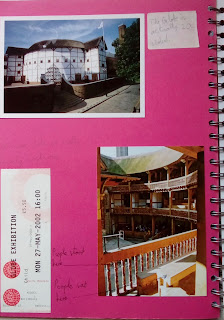
My scrapbook from 2002: visit to the London Globe


Me as a ten-year-old twinkie at the London Globe
As regular readers of this blog will know, I have spent many happy hours at the Pop-Up Globe as an usher, managing to see Romeo and Juliet, Twelfth Night, Hamlet, Antony and Cleopatra and (as a paying audience member) The Tempest. Twelfth Night is by far my favourite. So far I have seen it four times, and tonight will be the fifth :D

The Pop-Up Globe has been an enormous success in terms of tickets sold (most performances have been sold out or nearly so), but also (and arguably more importantly) in making Shakespeare accessible and enjoyable. One of the best things about working there has been watching the school children watch the plays. Very, very few of them have been bored or disinterested; most of them look as if they are having the time of their lives. 

Maria and Sir Toby Belch entertain school children at the Pop-Up Globe
So Shakespeare has certainly come to life for me this summer. As I overhead one small girl saying after a school matinee of Twelfth Night, "my life has been enriched!"  But although the plays are meant to be watched, not merely read, years of studying the plays, and working very closely with their language and text, has made watching them now even more enjoyable. I spent the three years of my high school exams working on Macbeth, Twelfth Night, Julius Caesar and Hamlet

My school copies of Hamlet and Twelfth Night. Yes, I like to scribble in my books.
Because I know them so well, these plays are among my favourites. At university I studied many more of the plays, but in too much of a hurry; in three 12-week courses we got through  Richard III, Antony and Cleopatra, Othello, King Lear, Much Ado About Nothing, All's Well That Ends Well, and The Comedy of Errors, mixed in with several other Elizabethan/Jacobean plays - the result being that I have a passing acquaintance with each of these texts but know none of them nearly as well as I would like. For what it's worth, I do think that university undergraduate English courses should teach fewer texts in more detail.

The Shakespeare section of my bookshelf
My favourite Shakespeare play? For years it was Hamlet, with Twelfth Night a close second... but the Pop-Up Globe has reminded me how much I love Twelfth Night, with the result that Hamlet is perilously close to being knocked off the top spot!

I love Shakespeare's works for their power, beauty and truth, and for the never-failing charm of the language's poetry and rhythm. I meant to include some of my favourite Shakespearean speeches, but this post is already far too long, so I will put them in another post.

My Shakespeare at the George bookmark - a souvenir of that first Tempest which has been with me all over the world.
We defy augury. There is a special providence in the fall of a sparrow. If it be now, 'tis not to come; if it be not to come, it will be now; if it be not now, yet it will come. The readiness is all. Since no man, of aught he leaves, knows aught, what is't to leave betimes. Let be. 
 ~
Hamlet V.2.204-8

Wednesday, 13 April 2016

Thoughts on Hamlet

Now cracks a noble heart...

Though the Lord Lackbeards' all-female version of Hamlet at the Pop-Up Globe was not my favourite version of the play, there were still many good things about it and much food for thought.

It was (mostly) a swift, clean production - some judicious cutting of the text reduced the play to just under three hours (including a fifteen minute interval). As is often the case, the whole Fortinbras sub-plot was cut, but they kept Rosenkrantz and Guildenstern (famously cut by Olivier in his 1948 film) and the Second Gravedigger, another character who is very often dispatched with. The cast was small, numbering only eight, but some clever doubling meant that I never really noticed this until they took their bows at the end. They did a good job of using the huge stage, relying mainly on the language and movement to fill the space rather than going overboard with props and non-diegetic music - which, after the musical overload of Antony and Cleopatra, was something of a relief and quite refreshing.

The performance dragged a little at the beginning but picked up speed after Act I - they suddenly appeared to realise that actors finishing a scene could exit by one stage door as those beginning the next entered via the opposite side of the stage. Doing this, rather leaving the stage bare between each scene, keeps the action moving along nicely (Romeo and Juliet and Twelfth Night have both got this down to a fine art). There was a very awkward pause in the action in the middle of the ghost scene - at "Go on, I'll follow thee," Hamlet and the ghost exited the theatre through the groundlings and then took a long while to re-appear! As I was right at the back of the upper gallery, where admittedly the view is not great, perhaps I missed something, but the rest of the audience seemed a bit bemused too.

The actor playing Hamlet, clad appropriately in inky black, looked to be about seven months' pregnant - which, predictably, drew quite a snigger at "How pregnant sometimes his replies are!" As previously mentioned, the doubling was neatly done - Claudius doubled as the ghost, which brought out nicely what Hamlet calls "The counterfeit presentment of two brothers." Horatio doubled as Guildenstern (or was it Rosenkrantz?) - one Hamlet's faithful friend, the other a faithless one. A pipe-smoking, newspaper-reading Polonius who rather stole the show re-appeared (sans pipe and newspaper) after his untimely demise as the priest who buries Ophelia. Since Polonius arguably helps drive Ophelia to madness and death, this seemed fitting too.

One problem with this production was that several of the actors were not very audible. This was probably partly because I was right at the top of the playhouse, in the upper gallery, but also because some of the actors' voices just did not carry as well as men's tend to. Nobody had any trouble hearing Polonius, and Hamlet was fine too, but some of the other characters were less than distinct.

Someone once said that Hamlet is actually a very funny play, and this is to some extent true - especially with Polonius, who in this production drew many a laugh. But, as with Romeo and Juliet, I did feel that the actors and director had chosen to emphasise the comedy at the expense of the tragedy. (One reason I like the production of Twelfth Night so much is that the poignancy of Sir Andrew Aguecheek and Malvolio is well brought out, confronted rather than glossed over. The first time I saw the production it did appear to be played more as a straight comedy, but now they seem to have found a good balance between the comedy and the pathos. At the school matinee yesterday the children seemed especially receptive to this and there was real sympathy for both characters. But I digress.)

The two gravediggers in Act V Scene I made a valiant effort to involve the groundlings during the argument over whether Ophelia drowned herself willingly or not. "Here lies the water," said the Second Gravedigger, pointing at one of the groundlings and gesticulating for her to mime 'water;' "here stands the man," pointing to another. The speech continues, "If the man go to this water and drown himself, it is, will he nill he, he goes, mark you that. But if the water come to him and drown him, he drowns not himself." Unfortunately it backfired somewhat, because, though the lady mimed water drowning the man with enthusiasm, he just stood there, refusing either to drown himself or to be drowned!

The fencing scene at the end of Act V, which is surely supposed to be the climax of the entire play, seemed oddly tame - possibly because it is not advisable to fence with gusto when one is in the last trimester of pregnancy...? Once everybody had died and then got up again, I did not really like the closing dance - I have read somewhere that this was common practice at the original Globe after all plays, including tragedies, but it just felt wrong for Hamlet... the crowning insult, however, was the stream of bubbles floating down from the playhouse roof to the stage and yard below. Bubbles! For Hamlet!! I think not.

Still, I am glad to have seen the play performed in a space similar to that in which it was originally staged. Although there was a brilliant stage version of Hamlet at the Musgrove theatre a few years ago (and, of course, the recent Benedict Cumberbatch production at the Barbican), it seems to be a play that tends to be filmed more often than staged, meaning that we are often presented with celebrity actors, sweeping vistas of Elsinor and an array of special effects for the ghost. Often - as with the Kenneth Branagh and Mel Gibson film versions (and perhaps also with the Barbican one*) - these become the focus and the play becomes too 'busy,' with the beauty of the language swamped or simply overlooked. (I like Olivier's film because he does not lose the language.) So it was good to see how, on a huge bare stage, the language has to be the driving force behind the play, and - even better - how it is entirely capable of doing so.

Good night, sweet prince,
And flights of angels sing thee to thy rest.

* Being in NZ, I could not see this live, but I did see a filmed version of a live performance. From what I heard and read of the production, a huge part of its success (in terms of tickets sold) was the simple fact that Cumberbatch was in it.

Monday, 11 April 2016

What next for the Pop-Up Globe?


The Globe's last performances are on April 24th and the theatre is set to be demolished after that. I for one will be very sorry to see it go! Apparently other people will be too - see


and


And here is an article by the Herald detailing just how much fake blood was spilt during Romeo and Juliet:


Today's ushering session is Hamlet, performed by the Lord Lackbeards Touring Company with an all-female cast, so that should be interesting... 

via

Thursday, 7 April 2016

Antony and Cleopatra

O, Antony!

The Pop-Up Globe continues to sweep all before it with all remaining shows almost completely sold out (groundling tickets are still available though, except for Twelfth Night on Friday 22nd when these tickets are sold out too). So it turns out ushering is not only an economic way to see the plays, but almost the only way...

That said, I probably saw less of yesterday's performance - Antony and Cleopatra, directed by Vanessa Byrnes - than any of the previous ones. It was the first time I had ushered for a performance open to the general public (all the others had been school matinees). Turns out adults need more babysitting than school children... there was a good deal of debate (even dispute) over allocated seats and several people were very late, so I missed most of the play's opening.

Probably because of this, the play seemed quite disjointed and even confusing in places. Also it had been heavily cut (both in length - to just over 2 hours - and in the number of characters), and as the director's programme notes admitted, they had "taken huge liberties with the text; characters are split into two, merged together, introduced as completely new personalites, and completely cut from the text." This did not help my comprehension either, although admittedly my working knowledge of Antony and Cleo is not nearly as good as some of the other plays... Then there was the scene where Octavia confronts Cleopatra. I had no recollection of this being in the play at all and was mighty relieved to read in the programme notes afterwards that this was actually inserted from another play (All For Love [1677], by John Dryden) and that my memory was not quite so sieve-like as I had feared! Throughout the play there was a good deal of music and singing - I suspect intended to hold the text together, but often just vaguely confusing.

As to the cast: Cleopatra was good, and seemed to get better as the play progressed. Antony I felt was not as noble as he should have been, though the director's notes did say that she had chosen to approach the characters "as real people who are flawed and fallible," so maybe this was deliberate. Still... O, Antony! Caesar managed to be both funny and creepy, often at the same time (he also reminded me of Charles Grey's  Blofeld, and once that image had got into my head I couldn't get it out again). Pompey was quite frankly perplexing. He (or rather she, since he was played by a she) and his piratical henchman (Menas and Menacrates) were played with very, very thick Scottish accents, for no reason on earth that I could think of... as Pompey was also dressed in greeny-brown and swathed around the head with loose scarves ("all tentacle-y") the effect reminded me of nothing so much as Davy Jones from the Pirates of the Caribbean films!

My photos from this show are very bad, partly because I was busy for much of the time, and partly because I was on the middle gallery again, where the scaffolding is not conducive to good photo-taking. Still, I managed to snatch one of Davy Jones. You will have to imagine the Scottish accent. 

Davy Jones, aka Pompey
Davy Jones almost stole the show (for me anyway), but the best bit was this part (Antony's death; Cleopatra is taking refuge in her 'monument'):

CLEO: ... But come, come, Antony - 
Help me, my women - we must draw thee up.
Assist, good friends.
[...]
[They begin lifting].

The question of how to make this stage business work - just how to 'draw up' Antony to the 'monument' - is a tricky one. Years ago I read somewhere that at the original Globe Cleopatra's 'monument' could have been one of the boxes or balconies above the stage, with the dying Antony somehow hoisted aloft by means of ropes - which sounds both difficult and dangerous. Yesterday at the Pop-Up Globe Cleopatra said her speech from the main stage floor, with Antony 'dying' at her feet in the yard, among the groundlings. This of course meant that at "assist, good friends," there were half-a-dozen groundlings ready and willing to bear a hand, lifting up Antony and rolling him onto the stage!

There are many deaths in the play (basically he dies, she dies, they all die, while poor old Pompey is dispatched by the end of Act III), but after the bloodbath of Romeo and Juliet they seemed a little tame; no fake blood and the 'dead' merely got up and walked off the stage - a lot quicker and easier than having them hauled off, but still, they were supposed to be dead...

Overall - an interesting production; rather hodge-podge, a little perplexing, but (despite the lack of gore) suitably dramatic, and the poetry was as superb as ever:

His legs bestrid the ocean; his reared arm
Crested the world; his voice was propertied
As all the tunéd spheres, and that to friends;
But when he meant to quail and shake the orb,
He was as rattling thunder. For his bounty,
There was no winter in't; an autumn 'twas
That grew the more by reaping. His delights 
Were dolphin-like; they showed his back above
The element they lived in. In his livery
Walked crowns and crownets; realms and islands were
As plates dropped from his pockets.

~

I am fire and air; my other elements I give to baser life.

Friday, 1 April 2016

Radio NZ | Theatre etiquette at the Pop-Up Globe

Radio New Zealand discusses the Pop-Up Globe with Dr. Miles Gregory and the Camelspace scaffolding company that build the theatre:

Drama at Romeo and Juliet

Juliet getting into the dramatic swing of things
As if the plot of Romeo and Juliet wasn't dramatic enough already, yesterday's school matinee performance was full of extra drama, starting with a very sick Romeo who very nearly did not make it on stage (he did though, and lasted the whole performance - no mean feat!). Then they got a little over-enthusiastic with the fake blood, which was sprayed not only all over the stage but over a fair proportion of the groundlings too. One boy had his crisp white school shirt covered in it (wonder how he explained that to his mother...). Then another schoolboy, apparently prompted by the gory happenings on stage, went into an epileptic fit and had to be carried away in an ambulance!


Yesterday I was stationed on the middle gallery, which, although safe from spraying blood, is a good deal more restricted in view than the yard or lower gallery:


The view would have been better from the seats (I was standing at the back of the gallery, behind all the seating). They have tried to ensure that the scaffolding doesn't run across in front of the seated sightline, but I still think you get a much better view (and much more involved with the action) from the yard. From the galleries you miss any action that goes on directly underneath (the actors make several entrances and exits through the groundlings in the yard) as well as anything happening directly above you (at one point in the play the Prince speaks from one of the bays in the upper gallery).

The school children yesterday were even more appreciative than those at the performance I saw a few weeks ago. This time, however, the loudest cheers were reserved not for Romeo and Juliet's kiss, but for the entrance of a shirtless Mercutio lusting for blood!

"Come, come, thou art as hot a Jack in thy mood as any in Italy, and as soon moved to be moody, and as soon moody to be moved."

Thursday, 24 March 2016

Maundy Thursday | The Last Supper

via
JESUS  & Pees be both be day and nyght
Untill this house and till all that is here.
Here will I holde as I have hight
The feeste of Paas with frendis in feere.

This is the opening of the York Last Supper play (performed, appropriately enough, by the York Baker's guild). Unfortunately, though the beginning and ending of the play survive intact, the manuscript page containing the central episode (where Christ says of the bread "This is My body," and of the wine, "This is My Blood") has mysteriously disappeared, presumably removed at the Reformation for adhering too closely to traditional Catholic doctrine. 

Probably this occurred in the early sixteenth century - the whole cycle of mystery plays was finally banned in 1569, but before this happened there were several years of 'tinkering' with the individual pageants to tone down more overtly Catholic aspects (this happened with several of the plays dealing with the Virgin Mary as well as with the Last Supper). 

With the page gone, there is of course no way of saying with certainty what it contained. But, given the closeness with which the other mystery plays follow their scriptural and liturgical counterparts, it is highly likely that the missing page, which occurs precisely where we would expect Christ’s performance of the transubstantiation to occur in the sequence of the play, ran along the lines of:

... this is My Body which shall be delivered for you; this do for the commemoration of Me... This chalice is the new testament in My blood; this do ye, as often as you shall drink, for the commemoration of Me. For as often as you shall eat this bread, and drink this chalice, you shall show the death of the Lord until He come. Therefore whosoever shall eat this bread, or drink of the chalice of the Lord unworthily, shall be guilty of the body and blood of the Lord...

which are the words of the Epistle for the Corpus Christi feast. The same words appear, with slight variations, in the Epistle for Maundy Thursday, and of course in the Canon of every Mass.

Sunday, 20 March 2016

Palm Sunday | The Entry Into Jerusalem

via

JESUS:   To me takis tent and giffis gud hede,
My dere discipulis that ben here,
I schall you telle that shal be indede;
My tyme to passe hense, it drawith nere,
And by this skill
Mannys sowle to save fro sorowes sere
That loste was ill.

From heven to erth whan I dyssende
Rawnsom to make I made promys,
The prophicie nowe drawes to ende;
My Fadirs wille forsoth it is
That sente me hedyr.
Petir, Phelippe, I schall you blisse
And go togedir

Unto yone castell that is you agayne,
Gois with gud harte and tarie noght,
My comaundement to do be ye bayne.
Also I you charge loke it be wrought
That schal ye fynde
An asse, this feste als ye had soght,
Ye hir unbynde

With hir foole, and to me hem bring
That I on hir may sitte a space
So the prophicy clere menyng
May be fulfilled here in this place:
“Doghtyr Syon,
Loo, thi Lorde comys rydand on an asse,
Thee to opon.” (The Entry Into Jerusalem l.1-28)


The York play of the Entry into Jerusalem was performed by the Skinners' Guild. The 'yon castell' referred to by Jesus is probably Clifford's Tower, which stands in the centre of the city, providing a well-known landmark. This fleeting moment both brings together historical and present time within the play and also hints at how inextricably the York play cycle as a whole was linked with the geography and architecture of the city.

The play concludes with the citizens of Jerusalem welcoming Christ into their city:

Hayll, domysman dredfull, þat all schall deme,
Hayll, [þat all] quyk and dede schall lowte,
Hayll, whom worschippe moste will seme,
Hayll, whom all thyng schall drede and dowte.
We welcome þe;
Hayll, and welcome of all abouwte,
To owre ceté. (l.538-44)
The structure of the play is, as Beadle and King point out, very close to a medieval royal welcome: 

the tableau at the end [of the play], with its ordered arrangement of formal greetings, suggests that the dramatist had in mind the conventions of the contemporary royal entry into the medieval town. In the last lines of the play, the local audience must have had a strong sense that the King of Heaven was being welcomed as much to medieval York as to the biblical Jerusalem.
(Beadle and King, introduction to The Entry Into Jerusalem, in York Mystery Plays: A Selection in Modern Spelling (Oxford: Oxford University Press, 2009), 106.) 

They also note that "Jesus must have ridden on the ass in the street amongst the audience, who were thus deftly drawn into the illusion of the play, and given a role as the crowd that lined the route into Jerusalem" (ibid.) As with the earlier reference to the castle, Biblical and contemporary time, the sacred (the subjects dealt with in the plays) and the secular (the city of York) are brought together. For the plays' original audiences, Biblical events, happenings and locations were blended with what was for them modern-day York, intertwining them until they became virtually indistinguishable.

Yf any man will you gaynesaye,
Say that youre Lorde has nede of tham
And schall restore thame this same day
Unto what man will tham clayme.