(Canadian readers note that, apparently, Canadian French is similar to medieval French! And you never told me ;) )

Showing posts with label Middle English. Show all posts
Showing posts with label Middle English. Show all posts
Monday, 28 November 2016
Origins of the English Language
Interesting piece here on, well, what it says in the title - the early history of the English language.

Tuesday, 1 November 2016
Al-hal-day (All Hallow's Day)
Today, 1st November, is traditionally All Hallow's Day, now more commonly known as All Saints' Day. Like many landmarks of the medieval year, it is mentioned in the Sir Gawain and the Green Knight poem (so many feastdays are mentioned in the poem that it functions almost as a calendar or guide to the medieval year).
Earlier I posted about Michaelmas Day, which heralds the onset of winter and reminds Gawain that he must leave the safety of Arthur's court and set out on his quest for the Green Knight (see my post here). However, Gawain procrastinates (well, who wouldn't, in his situation!) and does not leave Camelot until early November. On All Saints' Day Arthur provides in Gawain's honour a large and hearty feast, and, after much prolonged leave-taking, the knight leaves the next morning:
Yet quyl Al-hal-day with Arther he lenges,
And he made a fare on that fest, for the frekes sake,
With much revel and ryche of the Rounde Table.
Knyghts ful cortays and comlich ladies,
Al for luf of that lede in longynge thay were;
Bot never-the-lece ne the later thay nevened bot merthe,
Mony joyles for that jentyle japes ther maden.
For aftter mete with mournyng he meles to his eme,
And spekes of his passage, and pertly he sayde:
'Now, lege lorde of my lyf, leve I you ask.
Ye knowe the cost of this cace, kepe I ni more
To telle yow tenes therof, never bot trifel;
Bot I am boun to the bur barely to-morne,
To sech the gome of the grene, as God wyl me wisse.
Thenne the best of the burgh bowed togeder,
Aywan and Errik and other ful mony,
Sir Doddinaval de Savage, the duk of Clarence,
Launcelot and Lyonel and Lucan the gode,
Sir Boos and Sir Bydver, big men bothe,
And mony other menskful, with Mador de la Port.
Alle this compayny of court com the kyng nerre,
For to counseyl the knyght, with care at her hert.
There was much derne doel driven in the sale,
That so worthé as Wawan schulde wende on that ernde,
To dryye a delful dynt, and dele no more
wyth bronde.
The knyght mad ay god chere,
And sayde: 'Quat schuld I wonde?'
Of destinés derf and dere
What may mon do bot fonde?'
And to finish off - I know Halloween this year has been and gone, but this post (from the UK, a day behind NZ) landed in my email inbox this morning and I couldn't resist sharing it. It's an old post from the Medieval Manuscripts Blog, "Dress Up for Halloween, Medieval Style," a darkly humorous list of costume ideas based on the weird and wonderful creatures found in the margins of medieval manuscripts. And it does have some relevance to my post today, as it features woodwoses - the mythical tree-men also mentioned in SGGK.
 |
| Manuscript of Sir Gawain and the Green Knight, from the British Library via |

Monday, 31 October 2016
All Hallow's Eve and the Lyke-Wake Dirge
 |
| (empty) Roman sarcophagi in the Multiangular Tower, York |
To mark Halloween - or, in its older form, All Hallow's Eve - I found for your delight this cheery little medieval poem. Written in the dialect of north Yorkshire, it is a funeral dirge, thought to have been sung or chanted while keeping watch (wake) at the side of a corpse (lyke; this old word for corpse survives today in lychgate, the covered gateway into church grounds, where the bier would await the arrival of the priest conducting the funeral). The poem displays the typical medieval preoccupation both with Purgartory and with the Corporal Works of Mercy - well, three of them at least: to clothe the naked ("If ever thou gavest hosen and shoon"), to feed the hungry, and to give drink to the thirsty ("If ever thou gav'st meat or drink"). This leads into the pious hope that a life well lived will result in "Christ receiv[ing] thy saule."
This ae nighte, this ae nighte,
Every nighte and alle,
Fire and fleet and candle-lighte,
And Christe receive thy saule.
When thou from hence away art past,
Every nighte and alle,
To Whinny-muir thou com'st at last;
And Christe receive thy saule.
If ever thou gavest hosen and shoon,
Every nighte and alle,
Sit thee down and put them on;
And Christe receive thy saule.
If hosen and shoon thou ne'er gav'st nane
Every nighte and alle,
The whinnes sall prick thee to the bare bane;
And Christe receive thy saule.
From Whinny-muir whence thou may'st pass,
Every nighte and alle,
To Brig o' Dread whence thou may'st pass,
And Christe receive thy saule.
From Brig o' Dread whence thou may'st pass,
Every nighte and alle,
To Purgatory fire thou com'st at last;
And Christe receive thy saule.
If ever thou gav'st meat or drink,
Every nighte and alle,
The fire sall never make thee shrink;
And Christe receive thy saule.
If meat or drink thou ne'er gav'st nane,
Every nighte and alle,
The fire will burn thee to the bare bane;
And Christe receive thy saule.
This ae nighte, this ae nighte,
Every nighte and alle,
Fire and fleet and candle-lighte,
And Christe receive thy saule.
I do think middle English literature is much more fun read in the original, so I am not going to translate the poem. In any case, the language of this version isn't hard, especially when you simply drop the final e from many words. A few tricky words I have glossed below:
fleet ~ some say this should be sleet, as in frozen rain. Others say it should be slate, as in the roofing material. However, fleet appears to be an old word for home, or house. I prefer this, as it alliterates with fire.
saule ~ soul
hosen ~ clothes
shoon ~ shoes
whinnnes, Whinny-muir ~ whin = thorn and muir = moor
bane ~ bone
Brig ~ not a sailing ship; a bridge
The song has been set to music by Benjamin Britten. The band Pentangle (medieval buffs will know that the name comes from the five-pointed star emblazoned on Gawain's shield in Sir Gawain and the Green Knight) also released their own version, which you can listen to here:
Tuesday, 6 September 2016
York Minster Mystery Plays June 2016

'Have you come far?'
- York Minster Mystery Plays volunteer to me
This post is rather late, given that we saw the plays on the 22nd June and it is now the beginning of September... still, better late than never! The reason for the delay is that I have been writing up a review of the plays as an academic paper, and my little brain does not like working on two things at once. Academia comes before blogging, so there you are. However, now that I have finished my paper, which is currently languishing in a long-suffering editor's inbox awaiting review, it is time to turn my attention to my rather neglected blog.
The Minster production of the mystery plays was the original inspiration for this year's English trip - their timing, just a few of months after handing in my MA thesis, was happily fortuitous and an excellent excuse for another trip back to Blighty. So back to Blighty I went, or more specifically back to York - this time with both my Grandmas, which made it even more special.
Despite being born a Lancashire rose I am very fond of the white rose county and of York in particular, which despite visiting only twice I have quite fallen in love with. So it was very nice to be back!
We went to a matinee performance of the plays, which turned out to be a good thing as the running time, billed at three and a half hours, ended up being nearer four. Thanks to jetlag, if we had gone in the evening I would probably have been gently snoozing long before Doomsday. On second thoughts, perhaps I wouldn't, as the Minster - all stone and shadow - was distinctly chilly.
By happy forethought, we had front row seats. It was a full house - testament to the popularity of the plays and this production in particular, which does seem to have been a fairly resounding success both with the critics and the general public. The Minster's nave had been converted into seating for around a thousand people - the third nearest the stage was flat but the back two-thirds was raked scaffolding, soaring up and back towards the West Window.
The stage and set were huge, spread over four playing levels and linked by a series of wide, broad steps. Like the seating, the set reached upwards and backwards, almost to the top of the organ atop the quire screen. This kind of scale was of course the complete antithesis to the original performances of the play cycle, which were staged on small, mobile pageant wagons, but it worked well. Firstly, it evoked the scale and sweep of the cycle, which spans Biblical history from Creation to Doom, and secondly, well, such a big stage was necessary to accommodate the huge cast! This numbered roughly a hundred and forty, all except one (Philip McGinley, playing Christ) unpaid volunteers and many of them from the local community who have been performing in various productions of the plays for years (sometimes decades).
Out of so many characters, it is hard to pick favourites, but Philip McGinley was very good as Christ - though he puzzled me somewhat by making his first entrance clad rather incongruously in jeans and T-shirt but appearing thereafter in more conventional whitey-grey robes. Toby Gordon, as Lucifer, was (perhaps worryingly...) even better, but he reminded me of Dominic Cooper and once this thought had popped into my head it wouldn't pop out again. Ruby Baker as Mary and Mark Comer (one of the recurring devotees of the mystery plays) as Joseph were also excellent. Abraham I remember chiefly for the fact that he had to read his lines off a piece of paper hidden under his cloak (clearly someone was ill and he gamely stepped into the breach), Noah and Mrs Noah for their comic sparring, and Herod for his massive golden cape which spread over the entire stage and required an army of minions to manoeuver.
This version presented eighteen pageants (the original medieval play cycle has about forty-seven), though several of these consisted of two or three of the original short pageants run together into a longer section. The Middle English script had been 'lightly modernised,' retaining the alliterative rhythm of the original while introducing a few modern touches, such as Noah's 'Don't touch - the paint's not dry!' (said to God, inspecting the ark) and Lucifer's wail of 'It's not fair!' while being thrown into hell.
My two favourite episodes were the Creation and the Passion - the former for its colour, light and incredibly lifelike animal puppets, and the latter (which is really the heart of the entire cycle) for its solemn grandeur. Runners-up were the Nativity, for its tableaux effect, and the Entry into Jerusalem, for its movement and momentum.
No photographs of the actual performance - alas, this was not the free and easy Pop-Up Globe. But there are quite a few on the production's website, here.
Monday, 5 September 2016
2018: Summer of Mysteries
Not one but two productions of English mystery play cycles are planned for the summer of 2018: a wagon production of the (abridged) York cycle, and a version of the Chester plays.
Keep an eye on their respective websites (York Mystery Play Supporters Trust and Chester Mystery Plays).
‘It's not fair! You’ve not seen the last of me —’
Lucifer, The Last Judgement
Mike Poulton, The York Mystery Plays in a New Version (London: Nick Hern Books, 2016), 123.
Thursday, 1 September 2016
Springtime
Bot thenne the weder of the worlde wyth wynter hit threpes,
Schyre schedes the rayn in schowres ful warme,
Falles upon fayre flat, flowres there schewen.
Both groundes and the greves grene ar her wedes,
Bryddes busken to bylde, and bremlych syngen
For solace of the softe somer that sues therafter
bi bonk;
And blossumes bolne to blow
Bi rawes rych and ronk,
Then notes noble innoghe
Ar erde in wod so wlonk.
Modern English translation by moi:
But then the weather of the world with winter it contends,
Cold shrinks down, clouds drift away,
Brightly falls the rain in showers full warm,
Falling on fair fields, flowers there growing.
Both ground and groves, green are their weeds
Birds begin to build, and bravely sing
For solace in the soft summer that follows thereafter
on every bank
And blossoms swell to bloom
In the hedgerows rich and rank;
Then many notes noble enough
Are heard in the wood so glorious.
Sir Gawain and the Green Knight l.504-515, in ed. A. C. Crawley Pearl, Sir Gawain and the Green Knight (Everyman, London 1970).

Sunday, 15 May 2016
Pentecost Sunday
_-_interior,_stained_glass,_Pentecost.jpg) |
| via |

Et emitte caelitus
Lucis tuae radium.
Veni, pater pauperum,
Veni, dator munereum,
Veni, lumen cordium.
Consolator optime,
Dulcis hospes animae,
Dulce refrigerium.
In labore requies,
In aestu temperies,
In fletu solatium.
O lux beatissima,
Reple cordis intima
Tuorum fidelium.
Pentecost Sunday, the feast of the Holy Ghost, is also known in England as Whitsunday, a term dating from the Norman Conquest. The word comes from late Old English; whit means white (hwitte in Old English; Hwita Sunnandæg = White Sunday or Whitsunday). What the white refers to is a matter of some debate; the most common explanation is that it refers to the white baptismal robes of those who were baptised during the feast's vigil. Another explanation links the Christian feast with a much older pagan one - the Mayday festivities, when young girls would wear white to mark the coming of summer.
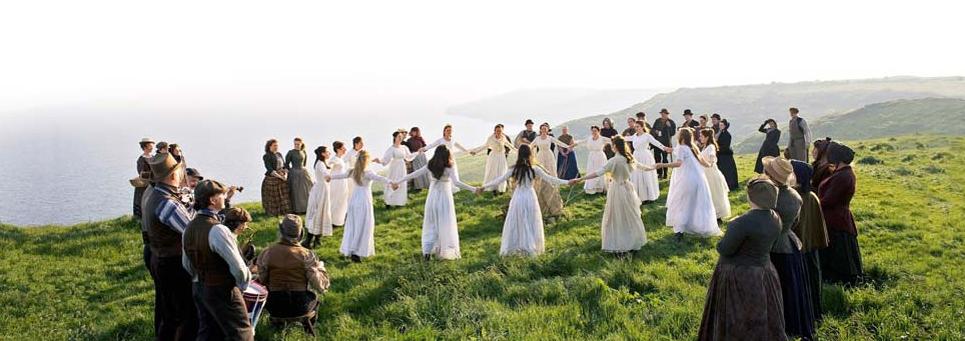 |
| The Mayday dance in the 2008 BBC Tess of the D'Urbervilles, via |
During the Middle Ages whit seems to have been (erroneously) confused with wit or wisdom, one of the seven gifts of the Holy Ghost. Thus:
þis day ys called Whitsonday, for bycause þat þe Holy Gost as þys day broʒt wyt and wysdome ynto all Cristes dyscyples
[this day is called Whitsunday, because the Holy Ghost on this day brought wit and wisdom to all Christ's disciples]
According to some versions of the King Arthur legend, Arthur married Guinevere on the feast of Pentecost, and in Malory's Le Morte d'Arthur it is on the feast of Pentecost that the Knights of the Round Table swear their oath of honour, chivalry and loyalty:
the kynge... charged them never to do outerage nothir morthir, and allwayes to fle treason, and to gyff mercy unto hym that askith mercy... and allwayes to do ladyes, damesels, and jantilwomen [socour] strenthe hem in hir ryghtes, and never to enforce them, upon payne of dethe. Also, that no man take no batayles in a wrongefull quarell for no love ne for no worldis goodis. So unto thys were all knyghtis sworne of the Table Rounde, both olde and yonge, and every yere so were the[y] sworne at the hygh feste of Pentecoste.
[the king... charged them never to do outrage nor murder, and always to flee treason, and to give mercy to those who asked for mercy... and also to give succour to ladies, damsels and gentlewomen, to defend their rights, and never to use force against them, upon pain of death. Also, that no man take go into battle for a wrongful cause, not for love nor for worldly goods. So to this were sworn all the knights of the Round Table, both old and young, and every year so were they sworn at the high feast of Pentecost.]
It is interesting that Malory uses the word Pentecost, not Whitsun, which was the more common term in England at the time. The use of Pentecost is presumably because the King Arthur stories were originally written in French. The French term for the feast is Pentecôte, so Mallory has translated it literally into English.
 |
| The Knights of the Round Table swear their oath at Pentecost, via |
Quote from Thomas Malory taken from Eugene Vinaver, ed., The Works of Sir Thomas Malory (London: Oxford University Press, 1968), 91.
Quote from John Mirk taken from Theodore Erbe, ed., Mirk's Festival: A Collection of Homilies (London: Kegan Paul et al., for the Early English Text Society, 1905), 159.
Veni Sancte Spiritus from the Sequence for the Mass of Pentecost.
Friday, 25 March 2016
Good Friday
 |
| The Deposition: detail from the Passion and Resurrection sequence [late fourteenth century], All Saints Pavement, York |
At þe tyme of none iesu gun cry;
he wytte his saul to his fadyr, [Eli].
A knyght smat him to þe hert, had he no mercy;
pe sone be-gane to wax myrk qwen iesu gun dy.
lord out of þi syd ran a ful fayre flud
As clere as well water our rannson bi þi blode.
(From the York Hours of the Cross, in The Lay Folks Mass Book (London: Oxford University Press for the Early English Text Society, 1968), 82-87.)
Easter in the Middle Ages
✝
Syllic
wæs se sigebeam ~ Wondrous was that tree of victory.
[From The Dream of the Rood]
Recently I came across these two articles and thought them worth sharing:
"This doubtful day of feast or fast" - Good Friday this year falls on March 25th, the feast of the Annunciation (Lady Day, as it was called in the Middle Ages). This article (from the blog A Clerk of Oxford by Eleanor Parker) explores the medieval link between the two events.
Holy Week: The Triduum before the English Reformation - well, this article (from the blog Supremacy and Survival: The English Reformation by Stephanie A. Mann) does what it says in the title - explores the medieval Triduum (the three days of Maundy Thursday, Good Friday, and Easter morning).
It also notes that Margaret Clitherow was martyred 470 years ago today, Friday 25th March 1586. In that year as in this, Good Friday fell on the 25th March.
þūhte mē þæt ic
gesāwe syllicre
trēow
on lyft lædan
lēohte bewunden,
bēama beorhtost.
It seemed to me that I saw a very wondrous tree,
Suspended in the air, surrounded by light,
The brightest of trees.
You can read the whole poem, in both Old English and in a modern English translation, at this very useful website.
Thursday, 24 March 2016
Maundy Thursday | The Last Supper
 |
| via |
This is the opening of the York Last Supper play (performed, appropriately enough, by the York Baker's guild). Unfortunately, though the beginning and ending of the play survive intact, the manuscript page containing the central episode (where Christ says of the bread "This is My body," and of the wine, "This is My Blood") has mysteriously disappeared, presumably removed at the Reformation for adhering too closely to traditional Catholic doctrine.
Probably this occurred in the early sixteenth century - the whole cycle of mystery plays was finally banned in 1569, but before this happened there were several years of 'tinkering' with the individual pageants to tone down more overtly Catholic aspects (this happened with several of the plays dealing with the Virgin Mary as well as with the Last Supper).
With the page gone, there is of course no way of saying with certainty what it contained. But, given the closeness with which the other mystery plays follow their scriptural and liturgical counterparts, it is highly likely that the missing page, which occurs precisely where we would expect Christ’s performance of the transubstantiation to occur in the sequence of the play, ran along the lines of:
... this is My Body which shall be delivered for you; this do for the commemoration of Me... This chalice is the new testament in My blood; this do ye, as often as you shall drink, for the commemoration of Me. For as often as you shall eat this bread, and drink this chalice, you shall show the death of the Lord until He come. Therefore whosoever shall eat this bread, or drink of the chalice of the Lord unworthily, shall be guilty of the body and blood of the Lord...
... this is My Body which shall be delivered for you; this do for the commemoration of Me... This chalice is the new testament in My blood; this do ye, as often as you shall drink, for the commemoration of Me. For as often as you shall eat this bread, and drink this chalice, you shall show the death of the Lord until He come. Therefore whosoever shall eat this bread, or drink of the chalice of the Lord unworthily, shall be guilty of the body and blood of the Lord...
which are the words of the Epistle for the Corpus Christi feast. The same words appear, with slight variations, in the Epistle for Maundy Thursday, and of course in the Canon of every Mass.
Tuesday, 22 March 2016
The Lay Folks Mass Book
After spending more than a year working with the university library's well-loved (read: decrepit and dog-eared) copy of the Lay Folks [no, there is no apostrophe] Mass Book, I finally have my own new and beautiful edition, in celebration of having finished my thesis:

The Lay Folks Mass Book, usually abbreviated to LFMB, is probably the most well-known of the medieval treatises on the Mass. Several of these treatises were produced in order to help the lay congregation follow the progression of the rite.
The LFMB was most likely translated into English from French in the latter half of the twelfth century. The text is important not only for what it reveals about the devotions of lay people at Mass but because it may have a local connection with York. Thomas Simmons, the original 1879 editor of the LFMB, decided that the text was originally translated into a northern English dialect (then, later, into Midland and Southern forms) and that the "Dan Jeremy" mentioned as author in two of the manuscripts may be the Jeremy who was Archdeacon of Cleveland (in the York diocese) by 1171. Unfortunately this theory can never be proved, but it is not unreasonable.
Unlike modern missals, the LFMB is not a translation or explanation of the Mass prayers and rubrics. Instead it is a set of vernacular prayers which encourage the reader to meditate on the benefits of the Mass and the Crucifixion. The basic structure of the Mass is traceable - I was quite easily able to follow a modern-day Tridentine Mass (the form in which the Mass was celebrated throughout the Middle Ages) using the LFMB as people today use a missal. The Confiteor, Gloria, Creed and Pater Noster are given in the text as (slightly corrupted) translations of their Latin versions, but the other prayers, though their intentions do roughly match those offered by the priest, are not translations of the Latin Mass prayers. Much of the book is taken up with identifying the priest’s actions, which function as cues either for private meditation (usually on the Crucifixion) or for the saying of private prayers, conveniently provided.

The LFMB tends to become rather
repetitive, as it reduces the continuous action of the Mass to specific,
easily identifiable points in the liturgy. These serve as triggers for
recalling the congregation to contemplation of Christ’s Passion, and as
reminders for the people to say the appropriate prayer - nothing more.
It does not encourage the people to progress beyond this basic level of
response to the liturgy.
However,
that the book exists at all suggests that there was some expectation to
involve the congregation with the Mass - to give them a role, or, at the very least, a set of signals through which they
could follow what was happening at the altar. It indicates a medieval
concern over how to include the congregation - or audience - and how to
shape their experience. As these are issues that also concern a
playwright, these cues, which do function rather in the manner of stage directions, are what gave me the idea that the Mass rite can be examined from a dramatic viewpoint, and therefore compared and contrasted with conventional drama. Since the Passion plays of the York mystery cycle are very closely aligned (in form, structure and language) with the liturgy and with the Mass, I started to look more closely at where and how the two are linked, and where and how they differ. This was the starting point of my thesis.
Some of the important 'cues' pin-pointed in the LFMB are:
- the movement of the priest (or deacon) to the left-hand side of the altar for the reading of the Gospel, a signal for the congregation to “speke... noght/bot thenk on him that dere the boght” [speak not,/But think on Him (Christ) that thee dearly bought]
- the Elevation of the Host, signalled by "a litel belle men oyse to ryng" [a little bell men use to ring]. The correct response to this signal was to "knelande holde vp both þi handes, /And so þo leuacioun þou be-halde" [kneeling, hold up both thy hands,/And so behold the elevation]
- The priest's "spred[ing] of his arms on brade" [in the form of a cross], recalled not only the Crucifixion but also signified the “tyme to praye for the dede” [the time to pray for the dead]
- The Pater Noster said by the priest, indicating that the Kiss of Peace was approaching, when the congregation kissed the pax (a little plaque of ivory or metal) handed round to them at the altar rails. [The medieval Kiss of Peace has an interesting and somewhat chequered history, but this shall be saved for another post!]
Sunday, 20 March 2016
Palm Sunday | The Entry Into Jerusalem
 |
| via |
| JESUS: To me takis tent and giffis gud hede, My dere discipulis that ben here, I schall you telle that shal be indede; My tyme to passe hense, it drawith nere, And by this skill Mannys sowle to save fro sorowes sere That loste was ill. From heven to erth whan I dyssende Rawnsom to make I made promys, The prophicie nowe drawes to ende; My Fadirs wille forsoth it is That sente me hedyr. Petir, Phelippe, I schall you blisse And go togedir Unto yone castell that is you agayne, Gois with gud harte and tarie noght, My comaundement to do be ye bayne. Also I you charge loke it be wrought That schal ye fynde An asse, this feste als ye had soght, Ye hir unbynde With hir foole, and to me hem bring That I on hir may sitte a space So the prophicy clere menyng May be fulfilled here in this place: “Doghtyr Syon, Loo, thi Lorde comys rydand on an asse, Thee to opon.” (The Entry Into Jerusalem l.1-28) |
The York play of the Entry into Jerusalem was performed by the Skinners' Guild. The 'yon castell' referred to by Jesus is probably Clifford's Tower, which stands in the centre of the city, providing a well-known landmark. This fleeting moment both brings together historical and present time within the play and also hints at how inextricably the York play cycle as a whole was linked with the geography and architecture of the city.
The play concludes with the citizens of Jerusalem welcoming Christ into their city:
Hayll, domysman dredfull, þat all schall deme,
Hayll, [þat all] quyk and dede schall lowte,
Hayll, whom worschippe moste will seme,
Hayll, whom all thyng schall drede and dowte.
We welcome þe;
Hayll, and welcome of all abouwte,
To owre ceté. (l.538-44)
Hayll, domysman dredfull, þat all schall deme,
Hayll, [þat all] quyk and dede schall lowte,
Hayll, whom worschippe moste will seme,
Hayll, whom all thyng schall drede and dowte.
We welcome þe;
Hayll, and welcome of all abouwte,
To owre ceté. (l.538-44)
The structure of the play is, as Beadle and King point out, very close to a medieval royal welcome:
the tableau at the end [of the play], with its ordered arrangement of formal greetings, suggests that the dramatist had in mind the conventions of the contemporary royal entry into the medieval town. In the last lines of the play, the local audience must have had a strong sense that the King of Heaven was being welcomed as much to medieval York as to the biblical Jerusalem.
the tableau at the end [of the play], with its ordered arrangement of formal greetings, suggests that the dramatist had in mind the conventions of the contemporary royal entry into the medieval town. In the last lines of the play, the local audience must have had a strong sense that the King of Heaven was being welcomed as much to medieval York as to the biblical Jerusalem.
(Beadle and King, introduction to The Entry Into Jerusalem, in York Mystery Plays: A Selection in Modern Spelling (Oxford: Oxford University Press, 2009), 106.)
They also note that "Jesus must have ridden on the ass in the street amongst the audience, who were thus deftly drawn into the illusion of the play, and given a role as the crowd that lined the route into Jerusalem" (ibid.) As with the earlier reference to the castle, Biblical and contemporary time, the sacred (the subjects dealt with in the plays) and the secular (the city of York) are brought together. For the plays' original audiences, Biblical events, happenings and locations were blended with what was for them modern-day York, intertwining them until they became virtually indistinguishable.
Tuesday, 1 March 2016
Quiz: do you belong in the Middle Ages?
We had a lot of fun with the Could you survive a Master's degree? quiz, so here is another.
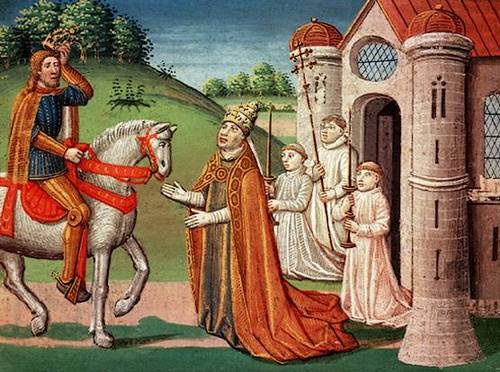
Do you belong in the Middle Ages? Take the quiz and find out!
1. Your knowledge of Middle English is
A. Non-existent. You think Middle English is ancient Greek.
B. Fair. You can recognise all the crude, vulgar and bawdy words, because these haven't changed at all from the fourteenth century to this.
C. Undergraduate level. You are aware that can in Middle English does not mean "is able to" but rather "knows," and for the rest, well, you'll just take a guess at it.
D. Expert. You can say the Rosary in Middle English.
2. The letter þ in the Old and Middle English alphabet is called
A. How the heck should I know?
B. It's a p in a funny font.
C. Thorn. You know this because you are a rabid JRR Tolkien fan.
D. Thorn, of course.
3. Middle English has no rules for spelling, grammar or punctuation. True or false?
A. True.
B. False.
C. Well... it's complicated.
4. You perceive the people of the Middle Ages as
A. Saints.
B. Sinners.
C. A beguiling mixture of both.
D. Just people.
5. You think an anchoress is
A. Part of a ship.
B. A kind of female hermit.
6. You are a tourist in an unfamiliar city trying to get your bearings. The first thing you locate is
A. The shrine of the local saint.
B. The local tavern.
C. It's a tie.
7. You find old churches
A. Fascinating. You can estimate the age of the stained glass on sight.
B. Boring. One church is just like another!
8. Speaking of which, a kirk is
A. That chap from Spartacus
B. The Middle English northern dialect word for a church, of course.
9. You tell the time by
A. Church bells.
B. A clock.
C. Time doesn't matter to you.
D. Your Apple smartwatch.
10. Someone says to you, "Middle English? Oh... like Shakespeare?" Your reaction is:
A. Exasperated.
B. You patiently try to put them right.
C. You couldn't care less.
Answers:
1. A = 1 point, B = 2 points, C = 3 points, D = 4 points
2. A = 1 point, B = 2 points, C = 3 points, D = 4 points
3. A, B = 1 point, C = 2 points
4. A, B = 1 point, C = 2 points, D = 3 points
5. A = 1 point, B = 2 points
6. A, B = 1 point, C = 2 points
7. A = 2 points, B = 1 point
8. A = 1 point, B = 2 points
9. A = 4 points, B = 3 points, C = 2 points, D = 1 point
10. A = 3 points, B = 2 points, C = 1 point
Results:
22 - 28 points: Haill, frende!!
14 - 21 points: You are quite fond of Robin Hood, but otherwise the Middle Ages are still a mystery.
under 14 points: For you, history begins with Star Wars.
Do you belong in the Middle Ages? Take the quiz and find out!
 |
| via |
1. Your knowledge of Middle English is
A. Non-existent. You think Middle English is ancient Greek.
B. Fair. You can recognise all the crude, vulgar and bawdy words, because these haven't changed at all from the fourteenth century to this.
C. Undergraduate level. You are aware that can in Middle English does not mean "is able to" but rather "knows," and for the rest, well, you'll just take a guess at it.
D. Expert. You can say the Rosary in Middle English.
2. The letter þ in the Old and Middle English alphabet is called
A. How the heck should I know?
B. It's a p in a funny font.
C. Thorn. You know this because you are a rabid JRR Tolkien fan.
D. Thorn, of course.
3. Middle English has no rules for spelling, grammar or punctuation. True or false?
A. True.
B. False.
C. Well... it's complicated.
4. You perceive the people of the Middle Ages as
A. Saints.
B. Sinners.
C. A beguiling mixture of both.
D. Just people.
5. You think an anchoress is
A. Part of a ship.
B. A kind of female hermit.
6. You are a tourist in an unfamiliar city trying to get your bearings. The first thing you locate is
A. The shrine of the local saint.
B. The local tavern.
C. It's a tie.
7. You find old churches
A. Fascinating. You can estimate the age of the stained glass on sight.
B. Boring. One church is just like another!
8. Speaking of which, a kirk is
A. That chap from Spartacus
B. The Middle English northern dialect word for a church, of course.
9. You tell the time by
A. Church bells.
B. A clock.
C. Time doesn't matter to you.
D. Your Apple smartwatch.
10. Someone says to you, "Middle English? Oh... like Shakespeare?" Your reaction is:
A. Exasperated.
B. You patiently try to put them right.
C. You couldn't care less.
Answers:
1. A = 1 point, B = 2 points, C = 3 points, D = 4 points
2. A = 1 point, B = 2 points, C = 3 points, D = 4 points
3. A, B = 1 point, C = 2 points
4. A, B = 1 point, C = 2 points, D = 3 points
5. A = 1 point, B = 2 points
6. A, B = 1 point, C = 2 points
7. A = 2 points, B = 1 point
8. A = 1 point, B = 2 points
9. A = 4 points, B = 3 points, C = 2 points, D = 1 point
10. A = 3 points, B = 2 points, C = 1 point
Results:
22 - 28 points: Haill, frende!!
14 - 21 points: You are quite fond of Robin Hood, but otherwise the Middle Ages are still a mystery.
under 14 points: For you, history begins with Star Wars.
Tuesday, 23 February 2016
Middle English Collective Nouns
Recently I have been reading Chloe Rhodes' little gem of a book, An Unkindness of Ravens: A Book of Collective Nouns (London: Michael O'Mara Books Ltd, 2014).
Apparently most collective nouns - both those we are familiar with today and many more that have fallen into obscurity - date from the Middle Ages. Like the rest of the Middle English vocabulary, these forgotten collective nouns are often vivid, pithy and downright funny.
Some of my favourite:
a goring of butchers
a gaggle of gossips
a draught of butlers
a rascal of boys
a worship of writers [because they would flatter their rich patrons]
an eloquence of lawyers
a hastiness of cooks
a tabernacle of bakers [tabernacle (original meaning 'tent' or 'little hut') being the stall the backer would set up in the marketplace and from which he would sell his wares]
Apparently most collective nouns - both those we are familiar with today and many more that have fallen into obscurity - date from the Middle Ages. Like the rest of the Middle English vocabulary, these forgotten collective nouns are often vivid, pithy and downright funny.
Some of my favourite:
a goring of butchers
a gaggle of gossips
a draught of butlers
a rascal of boys
a worship of writers [because they would flatter their rich patrons]
an eloquence of lawyers
a hastiness of cooks
a tabernacle of bakers [tabernacle (original meaning 'tent' or 'little hut') being the stall the backer would set up in the marketplace and from which he would sell his wares]
Wednesday, 3 February 2016
Tuesday, 2 February 2016
Feast of the Purification
 |
| via |
The odour of thy goodnes reflars to vs all.
Haill, moost happy to great and to small,
For our weyll.
Haill, ryall roose, moost ruddy of hewe,
Haill, flour vnfadyng, both freshe ay and newe,
Haill, the kyndest in comforth that ever man knewe,
For grete heyll.
[...]
Harke, Mary, I shall tell þe truth or I goo.
This was putt here to welde vs fro [wo],
In redempcion of many and recover also,
I the say.
And the sworde of sorro thy hart shal thyrll,
Whan thowe shall se sothly thy son soffer yll
For the well of all wrytches, þat shall be his wyll
Here in fay.
Simeon's speech from The Purification of the Virgin, l. 366-73, 437-44, in The York Plays: A Critical Edition of the York Corpus Christi Play as recorded in British Library Additional MS 35290 (Oxford: Oxford University Press for the Early English Text Society, 2009).
Sorry, I don't have time to translate it - a little matter of finishing my thesis, don't y'know :P
Friday, 1 January 2016
Happy New Year!
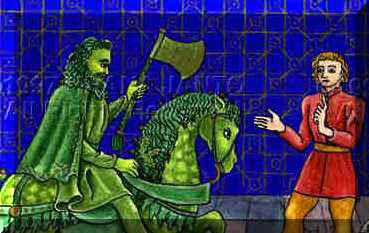 |
| "But my dear sir, you are interrupting our New Year's dinner!" Sir Gawain tries to chivvy away the Green Knight. via |
Wyle Nw Yer was so yep that hit was nwe cummen,
That day doubble on the dece was the douth served,
Fro the kyng was cummen with knyghtes into the halle,
The chauntré of the chapel cheved to an ende.
Loude crye was ther kest of clerkes and other,
Nowel nayted onewe, nevened ful ofte;
And sythen riche forth runnen to reche hondeselle,
Yeyed yeres yiftes on high, yelde him bi hond,
Debated busyly aboute tho giftes.
Ladies laghed ful loude, thogh thay lost hadden,
And he that wan was not wrothe, that may ye wel trawe.
Alle this mirthe thay maden to the mete tyme.
When thay had waschen worthyly thay wenten to sete,
The best burne ay abof, as hit best semed;
When Guenore, ful gay, graythed in the myddes,
Dressed on the dere des, dubbed al aboute -
Smal sendal bisides, a selure hir over
Of tryed Tolouse, of Tars tapites innoghe,
That were enbrawded and beten with the best gemmes
That myght be preved of prys with penyes to bye
in daye.
The comlokest to discrye
Ther glent with yyen gray;
A semloker that ever he syye,
Soth moght no mon say.
Pearl, Sir Gawain and the Green Knight, edited by A.C. Cawley (London: Everyman, 1970), l.60-84.
Translation according to moi, with some help from my trusty Everyman edition:
While New Year was so young that was newly come,
That day double portions of food were served on the dias,
After the King came with his knights into the halle,
Once the singing of Mass in the chapel had come to an end.
Loud cried then the clerics and others,
'Noel' celebrated anew, named full oft;
And then noble knights ran forward to give presents,
Announced their gifts, offered them by hand,
And debated busily about their presents.
Ladies laughed full loudly, even if they lost,
And he who won was not angry, you may be sure.
All this mirth they made until the meal time.
When they had washed they went to their seats,
The best mam in a higher seat, as it seemed;
Queen Guinevere, full gay, seated in the midst,
Seated on the highest dais, bedecked all around -
Fine silk curtains beside her, a canopy over her
Of costly Toulouse silk, and many hangings from Turkestan,
That were embroidered and set with the best gems,
That money could buy
in any day.
The fairest to behold
She glanced with eyes grey;
One more fair that ever he saw
Truly could no man say.
 |
| The Green Knight interrupts New Year festivities at Camelot. via |
Monday, 28 December 2015
Feast of the Holy Innocents: Coventry Carol
Many people know the Coventry Carol, but most do not realise that it comes from one of the Middle English mystery play cycles - not the York cycle, but a now-lost Coventry cycle (not to be confused with the Ludus Coventriae cycle, which is now thought to come from East Anglia). It appears in the play known as the Shearmen and Tailors' pageant - one of the only two plays from the cycle to survive (the other is the Weavers').
The Shearmen and Tailors' play tells the story of the nativity, but this song is not a joyful carol welcoming the birth of Christ; instead it is a lament for the innocent children killed by Herod.
When sung today the words are modernised, but the Middle English words to the carol are:
Lulla, lulla, thow littell tine child,
By, by, lully, lullay, thow littell tyne child,
 |
| via |
By, by, lully, lullay!
O sisters too, how may we do
For to preserve this day
This pore yongling for whom we do singe
By, by, lully, lullay?
Herod, the king, in his raging,
Chargid he hath this day
His men of might in his owne sight
All yonge children to slay, -
That wo is me, pore child, for thee,
And ever morne and may
For thi parting nether say nor singe,
By, by, lully, lullay.
The part of Herod seems to have been played as a raving, maniacal bully; there is a stage direction in the York Slaughter of the Innocents play to the effect of now shall Herod descend [from the pageant wagon] and rage in the streets. When Shakespeare was writing Hamlet, by which time the mystery cycles had long been banned for being too Catholic, the part of Herod was still a by-word for blustering, over-theatrical behaviour: "O, it offends me to the soul," laments the Melancholy Dane, "to hear a robustious periwig-pated fellow tear a passion to tatters, to very rags, to split the ears of the groundlings, who for the most part are capable of nothing but inexplicable dumbshows and noise: I would have such a fellow whipped for o'erdoing Termagant; it out-herods Herod: pray you, avoid it."
Coventry is not very far from Stratford-Upon-Avon so several scholars have suggested that Shakespeare may have seen the mystery plays when a boy.
.JPG) | |||
| Rubens' Massacre of the Innocents, via |

Friday, 25 December 2015
Happy Christmas!
 |
| via |
MARY: This has he ordained of his grace,
My son so young,
A star to be shining a space
At his bearing.
For Balaam told full long before
How that a star should rise full high,
And of a maiden should be born
A son that shall our saving be
From cares keen.
Forsooth, it is my son so free
By whom Balaam gan mean.
JOSEPH: Now welcome, flower fairest of hue,
I shall thee mensk [worship] with main and might.
Hail, my maker, hail Christ Jesu,
Hail, royal king, root of all right,
Hail, saviour.
Hail, my Lord, learner of light,
Hail, blessed flower.
MARY: Now, Lord, that all this world shll win,
To thee, my son is that I say,
Here is no bed to lay thee in.
Therefore, my dear son, I thee pray,
Since it is so,
Here in this crib I might thee lay
Between these beasts two.
And I shall hap thee, mine own dear child,
With such clothes as we have here.
JOSEPH: Oh, Mary, behold these beasts mild,
They make lofing in their manner
As they were men.
Forsooth, it seems well by their cheer
Their Lord they ken.
From The Nativity, l.95-126, in York Mystery Plays: A Selection in Modern Spelling, edited by Richard Beadle and Pamela King (Oxford: Oxford University Press, 2009).
Saturday, 19 December 2015
Christmas at Camelot
This kyng lay at Camylot upon Kyristmasse
With mony luflych lorde, ledes of the best,
Rekenly of the Rounde Table all tho rich brether,
With rych revel oryght and rechles merthes.
Ther tournayed tulkes by tymes ful mony,
Justed ful jolilé thise gentyle knightes,
Sythen kayred to the court, caroles to make.
For ther the fest was ilyche ful fiften dayes,
With alle the mete and the mirthe that men couthe avyse;
Such glaum ande gle glorious to here
Dere dyn upon day, daunsing on nyghtes;
Al was hap upon heghe in halles and chambres
With lordes and lades, as levest him thoght.
With all the wele of the worlde thay woned ther samen,
The most kyd knights under Krystes selven,
And the lovelokkest ladies that ever lif haden,
And he the comlokest kyng that the court haldes.
Pearl, Sir Gawain and the Green Knight, edited by A.C. Cawley (London: Everyman, 1970), l.37-53.
This is part of Sir Gawain and the Green Knight, describing the festive atmosphere at Camelot just before the Green Knight so dramatically appears on the scene and puts rather a dampner on things.
Christmas at King Arthur's court must have been rather fun - at least, if it really was anything like that described in the poem. Roughly translated, the lines mean:
This King [Arthur] lay at Camelot at Christmas time
With many noble lords, men of the best,
All courteous brethren of the Round Table,
With rich revelry and carefree [or reckless?] mirth.
There travelled very many knights -
They jousted full jollily, these noble knights,
Then rode to the court, carols to make.
For there the feast was the same full fifteen days,
With all the meat and mirth that men could devise;
Such noise and merriment glorious to hear,
Day upon day, dancing by night;
All was high happiness in the halls and chambers
Among the lords and ladies, as they preferred.
With all the joy of the world they lived there together,
The most renowned knights under Christ Himself,
And the loveliest ladies that ever had life,
And the comeliest king that the court could hold.
With mony luflych lorde, ledes of the best,
Rekenly of the Rounde Table all tho rich brether,
With rych revel oryght and rechles merthes.
Ther tournayed tulkes by tymes ful mony,
Justed ful jolilé thise gentyle knightes,
Sythen kayred to the court, caroles to make.
For ther the fest was ilyche ful fiften dayes,
With alle the mete and the mirthe that men couthe avyse;
Such glaum ande gle glorious to here
Dere dyn upon day, daunsing on nyghtes;
Al was hap upon heghe in halles and chambres
With lordes and lades, as levest him thoght.
With all the wele of the worlde thay woned ther samen,
The most kyd knights under Krystes selven,
And the lovelokkest ladies that ever lif haden,
And he the comlokest kyng that the court haldes.
Pearl, Sir Gawain and the Green Knight, edited by A.C. Cawley (London: Everyman, 1970), l.37-53.
This is part of Sir Gawain and the Green Knight, describing the festive atmosphere at Camelot just before the Green Knight so dramatically appears on the scene and puts rather a dampner on things.
Christmas at King Arthur's court must have been rather fun - at least, if it really was anything like that described in the poem. Roughly translated, the lines mean:
This King [Arthur] lay at Camelot at Christmas time
With many noble lords, men of the best,
All courteous brethren of the Round Table,
With rich revelry and carefree [or reckless?] mirth.
There travelled very many knights -
They jousted full jollily, these noble knights,
Then rode to the court, carols to make.
For there the feast was the same full fifteen days,
With all the meat and mirth that men could devise;
Such noise and merriment glorious to hear,
Day upon day, dancing by night;
All was high happiness in the halls and chambers
Among the lords and ladies, as they preferred.
With all the joy of the world they lived there together,
The most renowned knights under Christ Himself,
And the loveliest ladies that ever had life,
And the comeliest king that the court could hold.
 |
| I doubt this is an authentic medieval Christmas song, but never mind :D via |
Subscribe to:
Posts (Atom)