Showing posts with label feastdays. Show all posts

Wednesday, 25 October 2017

This day...


... is call'd the feast of Crispian:
He that outlives this day, and comes safe home,
Will stand a tip-toe when the day is named,
And rouse him at the name of Crispian.
He that shall live this day, and see old age,
Will yearly on the vigil feast his neighbours,
And say, 'Tomorrow is Saint Crispian:'
Then will he strip his sleeve and show his scars,
And say, 'These wounds I had on Crispin's day.'
Old men forget: yet all shall be forgot, 
But he'll remember with advantages
What feast he did that day: then shall our names,
Familiar in their mouths as household words –
Harry the king, Bedford and Exeter,
Warwick and Talbot, Salisbury and Gloster, –
Be in their flowing cups freshly remember'd.
This story shall the good man teach his son;
And Crispin Crispian shall ne'er go by,
From this day to the ending of the world,
But we in it shall be remembered, –
We few, we happy few, we band of brothers;
For he to-day that sheds his blood with me
Shall be my brother; be he ne'er so vile,
This day shall gentle his condition:
And gentlemen in England now a-bed
Shall think themselves accurs't they were not here;
And hold their manhoods cheap whiles any speaks
That fought with us upon Saint Crispin's day.

Wednesday, 1 March 2017

Ash Wednesday

via

Exaudi nos, Domine, quoniam benigna est misericordia tua: secundum multitudinem miserationem tuarum respice nos, Domine. Salvum me fac, Deus: quoniam intraverunt aquae usque ad animam meam.  
~ Blessing of ashes

Friday, 11 November 2016

Armistice Day


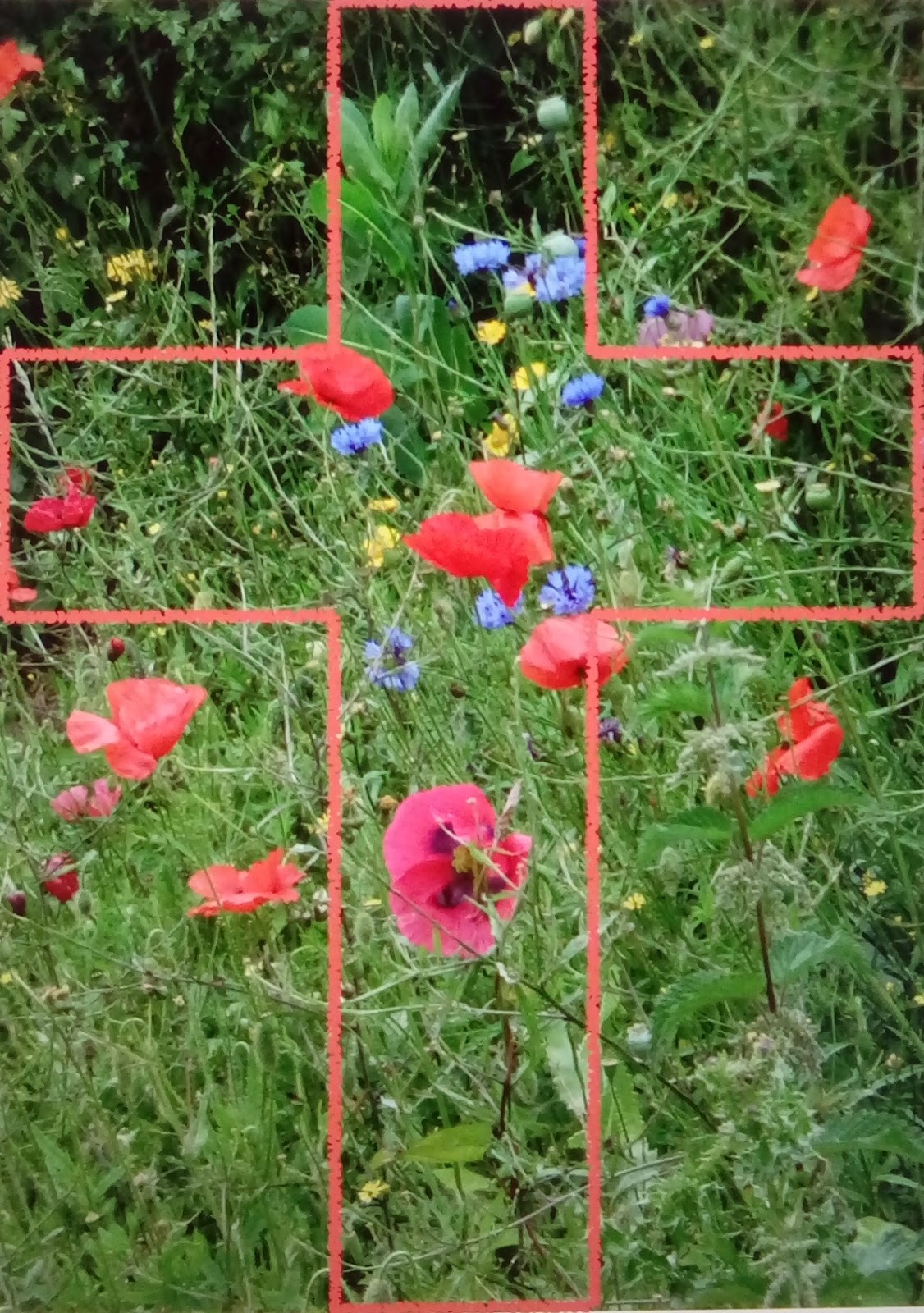
In Flanders fields the poppies blow
Between the crosses, row on row,
That mark our place; and in the sky
The larks, still bravely singing, fly
Scarce heard amid the guns below.

We are the Dead. Short days ago
We lived, felt dawn, saw sunset glow,
Loved and were loved, and now we lie
In Flanders fields.

Take up our quarrel with the foe:
To you with failing hands we throw
The torch; be yours to hold it high.
If ye break faith with us who die
We shall not sleep, though poppies grow
In Flanders fields.

John McCrae, "In Flanders Fields" in In Flanders Fields and Other Poems of the First World War, edited by Brian Busby (London: Arcturus Publishing, 2005), 128.

Tuesday, 1 November 2016

Al-hal-day (All Hallow's Day)

Today, 1st November, is traditionally All Hallow's Day, now more commonly known as All Saints' Day. Like many landmarks of the medieval year, it is mentioned in the Sir Gawain and the Green Knight poem (so many feastdays are mentioned in the poem that it functions almost as a calendar or guide to the medieval year).

Earlier I posted about Michaelmas Day, which heralds the onset of winter and reminds Gawain that he must leave the safety of Arthur's court and set out on his quest for the Green Knight (see my post here). However, Gawain procrastinates (well, who wouldn't, in his situation!) and does not leave Camelot until early November. On All Saints' Day Arthur provides in Gawain's honour a large and hearty feast, and, after much prolonged leave-taking, the knight leaves the next morning:

Yet quyl Al-hal-day with Arther he lenges,
And he made a fare on that fest, for the frekes sake,
With much revel and ryche of the Rounde Table.
Knyghts ful cortays and comlich ladies,
Al for luf of that lede in longynge thay were;
Bot never-the-lece ne the later thay nevened bot merthe,
Mony joyles for that jentyle japes ther maden.
For aftter mete with mournyng he meles to his eme,
And spekes of his passage, and pertly he sayde:
'Now, lege lorde of my lyf, leve I you ask.
Ye knowe the cost of this cace, kepe I ni more
To telle yow tenes therof, never bot trifel;
Bot I am boun to the bur barely to-morne,
To sech the gome of the grene, as God wyl me wisse.
Thenne the best of the burgh bowed togeder,
Aywan and Errik and other ful mony,
Sir Doddinaval de Savage, the duk of Clarence,
Launcelot and Lyonel and Lucan the gode,
Sir Boos and Sir Bydver, big men bothe,
And mony other menskful, with Mador de la Port.
Alle this compayny of court com the kyng nerre,
For to counseyl the knyght, with care at her hert.
There was much derne doel driven in the sale,
That so worthé as Wawan schulde wende on that ernde,
To dryye a delful dynt, and dele no more
              wyth bronde.
The knyght mad ay god chere,
And sayde: 'Quat schuld I wonde?'
 Of destinés derf and dere
What may mon do bot fonde?'

And to finish off - I know Halloween this year has been and gone, but this post (from the UK, a day behind NZ) landed in my email inbox this morning and I couldn't resist sharing it. It's an old post from the Medieval Manuscripts Blog, "Dress Up for Halloween, Medieval Style," a darkly humorous list of costume ideas based on the weird and wonderful creatures found in the margins of medieval manuscripts. And it does have some relevance to my post today, as it features woodwoses - the mythical tree-men also mentioned in SGGK.

Manuscript of Sir Gawain and the Green Knight, from the British Library via

Thursday, 26 May 2016

Corpus Christi

                             Laudus thema specialis,                             
Panus vivus et vitalis
Hodie proponitur.
Quem in sacrae mensa caenae,
Turbae fratrum duodenae
Datum non ambigitur.
Sit laus plena, sit sonora,
Sit jucunda, sit decora
Mentis jubilatio.
Dies enim solemnis agitur,
In quae mensae prima recolitur
Hujus institutio.

From Lauda Sion (sequence for Corpus Christi Mass), written by Thomas Aquinas c. 1264.

Today is Corpus Christi, the feast of Christ's Body and Blood. This feast is not a fixed one but varies with the date of Easter; it is celebrated on the Thursday after Trinity Sunday and therefore falls between late May and late June.

During the English Middle Ages this feast was one of the most important on the liturgical calendar, probably because it falls very close to Midsummer, when people are in the mood for festival and celebration. English weather being what it is, this is also most likely why it was the feastday with which the mystery play cycles - performed outdoors and needing sixteen or more hours of daylight - came to be associated. York, Chester and Coventry all had play cycles which were performed every year on, or very close to, the Corpus Christi feast.

Pope Urban IV had established the feast in 1264, but it was first celebrated in England only in the early fourteenth century. When it did arrive, however, the feast seems very quickly to have been incorporated into medieval English religious and even national identity. (Even today the feast is still one of England's traditional Holy Days of Obligation.)

Throughout the Middle Ages, devotion to the body of Christ - both as Eucharist and the human body which suffered on the cross - was intense. This devotion to Christ’s body and the significance which it held as metaphor, symbol and Eucharistic reality in (most of) medieval English society has been well documented by scholars including Miri Rubin, Sarah Beckwith and Tony Corbett. The idea of the body as a metaphor for a unified society goes back to Aristotle, but was enthusiastically adopted by what Beckwith has called “medieval political theorists.”1
This image brings together the two aspects of the Body of Christ that so fascinated the Middle Ages - the Eucharist, consecrated here by the priest at Mass, and the human body of Christ which suffered on the cross. As the priest holds up the Host towards the Crucifix, the two are visually linked, a powerful image which was repeated during every Mass at the Elevation of the Host. At the Elevation, the Lay Folks Mass Book instructs the people to "knelande holde vp both þi handes,/And so þo leuacioun pou be-halde,/for þat is he þat iudas salde,/and sithen was scourged & don on rode"2 - an instruction which explicitly describes the relationship between the Crucifixion and the Host. Image via

The image of the body of Christ was invoked and “presented by the official church of the late Middle Ages as a unifying symbol;”3 Christ Himself was seen as “the bringer of unity.”4 Yet, paradoxically, Christ’s body was at the same time yet a source of conflict and discord, “the arena where social identity was negotiated, where the relationship of self and society, subjectivity and social process found a point of contact and conflict.”5 The metaphor of Christ’s body for the wholeness of society was fractured and splintered by different groups who each sought to claim Christ as their own. The Peasants’ Revolt, for example, “was based around identification with the figura of Christ, seeing in him a poor peasant like them.”6

Throughout the York mystery play cycle, the fracturing of Christ’s body, both metaphorically and literally, happens again and again: the Corpus Christi is the cycle’s overarching concern, holding it together as a united entity, but the different pageants of the various guilds focus on how one particular aspect of it relates to each guild’s own (worldly) identity, interests and concerns. Thus the Mercers’ Doomsday is concerned with buying and selling; in the Bakers’ Last Supper the guild’s commercial product, bread, is linked none-too-subtly with the consecrated bread of the Last Supper and of the Mass; the Pinners’ Crucifixio has the guild members, in their roles as the soldiers nailing Christ to the cross, performing and discussing their own craft, tools and materials. 

Given that the Corpus Christi feast centres on transubstantiation, the most important tenet of Catholic belief and the essential difference between Catholicism and Protestantism, the feast was (unsurprisingly) attacked during the English Reformation. Under Edward IV the feast was abolished in 1548. The York Corpus Christi plays managed to survive until 1569, albeit with censorship; many of the pageants focusing the Virgin Mary were censored or repressed, and those dealing with explicitly Catholic doctrine were also selectively 'edited.' This happened with the York Last Supper pageant - the manuscript leaf containing the play's central episode is now mysteriously missing! With the page gone, there is of course no way of saying with certainty what it contained. But, given the closeness with which the other pageants in the cycle follow their scriptural and liturgical counterparts, it is highly likely that the missing page, which occurs precisely where we would expect Christ’s performance of the transubstantiation to occur in the sequence of the play, ran along the lines of:

... this is My Body which shall be delivered for you; this do for the commemoration of Me... This chalice is the new testament in My blood; this do ye, as often as you shall drink, for the commemoration of Me. For as often as you shall eat this bread, and drink this chalice, you shall show the death of the Lord until He come. Therefore whosoever shall eat this bread, or drink of the chalice of the Lord unworthily, shall be guilty of the body and blood of the Lord

 - which are the words of the Epistle in the Corpus Christi feastday Mass.

Footnotes
1. Sarah Beckwith, Christ’s Body: Identity, Culture, and Society in Late Medieval Writings (London, New York: Routledge, 1993), 27.
2. "Kneeling, hold up both thy hands,/And so behold the elevation,/For that is He that Judus sold,/and after was scourged and died on the cross [rood]."
3. Tony Corbett, The Laity, the Church and the Mystery Plays: A Drama of Belonging (Dublin: Four Courts Press, 2009), 199.
4. Ibid., 201.
5. Beckwith, Christ’s Body, 22.
6. Corbett, The Laity, the Church, and the Mystery Plays, 198.

This post contains material adapted from Chapter 1.2 of my MA thesis.

Sunday, 15 May 2016

Pentecost Sunday

via
Veni, Sancte Spiritus,
Et emitte caelitus
Lucis tuae radium.

Veni, pater pauperum,
Veni, dator munereum,
Veni, lumen cordium.

Consolator optime,
Dulcis hospes animae,
Dulce refrigerium.

In labore requies,
In aestu temperies,
In fletu solatium.

O lux beatissima,
Reple cordis intima
Tuorum fidelium.
 

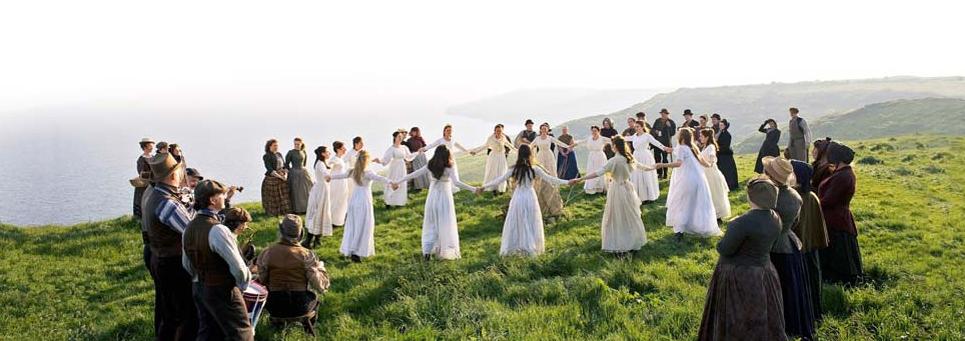
Pentecost Sunday, the feast of the Holy Ghost, is also known in England as Whitsunday, a term dating from the Norman Conquest. The word comes from late Old English; whit means white (hwitte in Old English; Hwita Sunnandæg = White Sunday or Whitsunday). What the white refers to is a matter of some debate; the most common explanation is that it refers to the white baptismal robes of those who were baptised during the feast's vigil. Another explanation links the Christian feast with a much older pagan one - the Mayday festivities, when young girls would wear white to mark the coming of summer.

The Mayday dance in the 2008 BBC Tess of the D'Urbervilles, via

During the Middle Ages whit seems to have been (erroneously) confused with wit or wisdom, one of the seven gifts of the Holy Ghost. Thus:

þis day ys called Whitsonday, for bycause þat þe Holy Gost as þys day broʒt wyt and wysdome ynto all Cristes dyscyples

[this day is called Whitsunday, because the Holy Ghost on this day brought wit and wisdom to all Christ's disciples]

- from the Augustinian Canon John Mirk (c.1382-1414).

According to some versions of the King Arthur legend, Arthur married Guinevere on the feast of Pentecost, and in Malory's Le Morte d'Arthur it is on the feast of Pentecost that the Knights of the Round Table swear their oath of honour, chivalry and loyalty:

the kynge... charged them never to do outerage nothir morthir, and allwayes to fle treason, and to gyff mercy unto hym that askith mercy... and allwayes to do ladyes, damesels, and jantilwomen [socour] strenthe hem in hir ryghtes, and never to enforce them, upon payne of dethe. Also, that no man take no batayles in a wrongefull quarell for no love ne for no worldis goodis. So unto thys were all knyghtis sworne of the Table Rounde, both olde and yonge, and every yere so were the[y] sworne at the hygh feste of Pentecoste.

[the king... charged them never to do outrage nor murder, and always to flee treason, and to give mercy to those who asked for mercy... and also to give succour to ladies, damsels and gentlewomen, to defend their rights, and never to use force against them, upon pain of death. Also, that no man take go into battle for a wrongful cause, not for love nor for worldly goods. So to this were sworn all the knights of the Round Table, both old and young, and every year so were they sworn at the high feast of Pentecost.]

It is interesting that Malory uses the word Pentecost, not Whitsun, which was the more common term in England at the time. The use of Pentecost is presumably because the King Arthur stories were originally written in French. The French term for the feast is Pentecôte, so Mallory has translated it literally into English.

The Knights of the Round Table swear their oath at Pentecost, via

Quote from Thomas Malory taken from Eugene Vinaver, ed., The Works of Sir Thomas Malory (London: Oxford University Press, 1968), 91.
Quote from John Mirk taken from Theodore Erbe, ed., Mirk's Festival: A Collection of Homilies (London: Kegan Paul et al., for the Early English Text Society, 1905), 159.
Veni Sancte Spiritus from the Sequence for the Mass of Pentecost.

Sunday, 27 March 2016

Easter Day

via


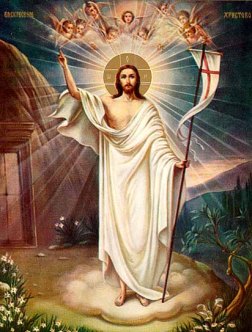
Christus resurgens ex mortuis, jam non moritur, mors ili ultra non dominabitur. 
Quod enim mortuus est peccato, mortuus est semel, quod autem vivit, vivit Deo,
Alleluia.
Mortuus est enim propter delicta nostra: et resurrexit propter justifcationem nostram,
Quod autem vivit Deo,
Alleluia.

(Christus Resurgens, Peter Phillips, 1612.)


A very happy Easter to one and all!

Friday, 25 March 2016

Good Friday

The Deposition: detail from the Passion and Resurrection sequence [late fourteenth century], All Saints Pavement, York

At þe tyme of none iesu gun cry;
he wytte his saul to his fadyr, [Eli].
A knyght smat him to þe hert, had he no mercy;
pe sone be-gane to wax myrk qwen iesu gun dy.
lord out of þi syd ran a ful fayre flud
As clere as well water our rannson bi þi blode.

(From the York Hours of the Cross, in The Lay Folks Mass Book (London: Oxford University Press for the Early English Text Society, 1968), 82-87.)

Easter in the Middle Ages

 
Syllic wæs se sigebeam ~ Wondrous was that tree of victory.
[From The Dream of the Rood]

Recently I came across these two articles and thought them worth sharing:

"This doubtful day of feast or fast" - Good Friday this year falls on March 25th, the feast of the Annunciation (Lady Day, as it was called in the Middle Ages). This article (from the blog A Clerk of Oxford by Eleanor Parker) explores the medieval link between the two events.

Holy Week: The Triduum before the English Reformation - well, this article (from the blog Supremacy and Survival: The English Reformation by Stephanie A. Mann) does what it says in the title - explores the medieval Triduum (the three days of Maundy Thursday, Good Friday, and Easter morning).
It also notes that Margaret Clitherow was martyred 470 years ago today, Friday 25th March 1586. In that year as in this, Good Friday fell on the 25th March.


þūhte mē þæt ic gesāwe syllicre trēow
on lyft lædan lēohte bewunden,
bēama beorhtost.

From the Anglo-Saxon poem The Dream of the Rood, which describes the Crucifixion. Translated, the lines read:

It seemed to me that I saw a very wondrous tree,
Suspended in the air, surrounded by light,
The brightest of trees. 

You can read the whole poem, in both Old English and in a modern English translation, at this very useful website.

Sunday, 20 March 2016

Palm Sunday | The Entry Into Jerusalem

via

JESUS:   To me takis tent and giffis gud hede,
My dere discipulis that ben here,
I schall you telle that shal be indede;
My tyme to passe hense, it drawith nere,
And by this skill
Mannys sowle to save fro sorowes sere
That loste was ill.

From heven to erth whan I dyssende
Rawnsom to make I made promys,
The prophicie nowe drawes to ende;
My Fadirs wille forsoth it is
That sente me hedyr.
Petir, Phelippe, I schall you blisse
And go togedir

Unto yone castell that is you agayne,
Gois with gud harte and tarie noght,
My comaundement to do be ye bayne.
Also I you charge loke it be wrought
That schal ye fynde
An asse, this feste als ye had soght,
Ye hir unbynde

With hir foole, and to me hem bring
That I on hir may sitte a space
So the prophicy clere menyng
May be fulfilled here in this place:
“Doghtyr Syon,
Loo, thi Lorde comys rydand on an asse,
Thee to opon.” (The Entry Into Jerusalem l.1-28)


The York play of the Entry into Jerusalem was performed by the Skinners' Guild. The 'yon castell' referred to by Jesus is probably Clifford's Tower, which stands in the centre of the city, providing a well-known landmark. This fleeting moment both brings together historical and present time within the play and also hints at how inextricably the York play cycle as a whole was linked with the geography and architecture of the city.

The play concludes with the citizens of Jerusalem welcoming Christ into their city:

Hayll, domysman dredfull, þat all schall deme,
Hayll, [þat all] quyk and dede schall lowte,
Hayll, whom worschippe moste will seme,
Hayll, whom all thyng schall drede and dowte.
We welcome þe;
Hayll, and welcome of all abouwte,
To owre ceté. (l.538-44)
The structure of the play is, as Beadle and King point out, very close to a medieval royal welcome: 

the tableau at the end [of the play], with its ordered arrangement of formal greetings, suggests that the dramatist had in mind the conventions of the contemporary royal entry into the medieval town. In the last lines of the play, the local audience must have had a strong sense that the King of Heaven was being welcomed as much to medieval York as to the biblical Jerusalem.
(Beadle and King, introduction to The Entry Into Jerusalem, in York Mystery Plays: A Selection in Modern Spelling (Oxford: Oxford University Press, 2009), 106.) 

They also note that "Jesus must have ridden on the ass in the street amongst the audience, who were thus deftly drawn into the illusion of the play, and given a role as the crowd that lined the route into Jerusalem" (ibid.) As with the earlier reference to the castle, Biblical and contemporary time, the sacred (the subjects dealt with in the plays) and the secular (the city of York) are brought together. For the plays' original audiences, Biblical events, happenings and locations were blended with what was for them modern-day York, intertwining them until they became virtually indistinguishable.

Yf any man will you gaynesaye,
Say that youre Lorde has nede of tham
And schall restore thame this same day
Unto what man will tham clayme.
 

Thursday, 17 March 2016

The 17th March...

... is, as we all know,

ST PATRICK'S DAY!!!


St Patrick (of course) - St Patrick's Cathedral, Auckland, NZ

Here is a fifteenth-century image of St Pat:

via

And, because I just love my stained glass, here is another Irish saint for good measure:

St Brigid, in the chapel of the Irish saints (St Patrick's Cathedral, Melbourne, Australia)

HAPPY ST PADDY'S DAY!!

Tuesday, 2 February 2016

Feast of the Purification

via
Haill, floscampy and flower vyrgynall,
The odour of thy goodnes reflars to vs all.
Haill, moost happy to great and to small,
For our weyll.
Haill, ryall roose, moost ruddy of hewe,
Haill, flour vnfadyng, both freshe ay and newe,
Haill, the kyndest in comforth that ever man knewe,
For grete heyll.

[...]

Harke, Mary, I shall tell þe truth or I goo.

This was putt here to welde vs fro [wo],
In redempcion of many and recover also,
I the say.
And the sworde of sorro thy hart shal thyrll,
Whan thowe shall se sothly thy son soffer yll
For the well of all wrytches, þat shall be his wyll
Here in fay.

Simeon's speech from The Purification of the Virgin, l. 366-73,  437-44, in The York Plays: A Critical Edition of the York Corpus Christi Play as recorded in British Library Additional MS 35290 (Oxford: Oxford University Press for the Early English Text Society, 2009).

Sorry, I don't have time to translate it - a little matter of finishing my thesis, don't y'know :P

Monday, 28 December 2015

Feast of the Holy Innocents: Coventry Carol


Many people know the Coventry Carol, but most do not realise that it comes from one of the Middle English mystery play cycles - not the York cycle, but a now-lost Coventry cycle (not to be confused with the Ludus Coventriae cycle, which is now thought to come from East Anglia). It appears in the play known as the Shearmen and Tailors' pageant - one of the only two plays from the cycle to survive (the other is the Weavers').

The Shearmen and Tailors' play tells the story of the nativity, but this song is not a joyful carol welcoming the birth of Christ; instead it is a lament for the innocent children killed by Herod.

When sung today the words are modernised, but the Middle English words to the carol are:

Lulla, lulla, thow littell tine child,
By, by, lully, lullay, thow littell tyne child,
via

By, by, lully, lullay!

O sisters too, how may we do
For to preserve this day
This pore yongling for whom we do singe  
By, by, lully, lullay?

 Herod, the king, in his raging,
Chargid he hath this day
His men of might in his owne sight
All yonge children to slay, - 

That wo is me, pore child, for thee,
And ever morne and may
For thi parting nether say nor singe,
By, by, lully, lullay.


The part of Herod seems to have been played as a raving, maniacal bully; there is a stage direction in the York Slaughter of the Innocents play to the effect of now shall Herod descend [from the pageant wagon] and rage in the streets. When Shakespeare was writing Hamlet, by which time the mystery cycles had long been banned for being too Catholic, the part of Herod was still a by-word for blustering, over-theatrical behaviour: "O, it offends me to the soul," laments the Melancholy Dane, "to hear a robustious periwig-pated fellow tear a passion to tatters, to very rags, to split the ears of the groundlings, who for the most part are capable of nothing but inexplicable dumbshows and noise: I would have such a fellow whipped for o'erdoing Termagant; it out-herods Herod: pray you, avoid it."

Coventry is not very far from Stratford-Upon-Avon so several scholars have suggested that Shakespeare may have seen the mystery plays when a boy.

Rubens' Massacre of the Innocents, via


Saturday, 19 December 2015

Christmas at Camelot

This kyng lay at Camylot upon Kyristmasse
With mony luflych lorde, ledes of the best,
Rekenly of the Rounde Table all tho rich brether,
With rych revel oryght and rechles merthes.
Ther tournayed tulkes by tymes ful mony,
Justed ful jolilé thise gentyle knightes,
Sythen kayred to the court, caroles to make.
For ther the fest was ilyche ful fiften dayes,
With alle the mete and the mirthe that men couthe avyse;
Such glaum ande gle glorious to here
Dere dyn upon day, daunsing on nyghtes;
Al was hap upon heghe in halles and chambres
With lordes and lades, as levest him thoght.
With all the wele of the worlde thay woned ther samen,
The most kyd knights under Krystes selven,
And the lovelokkest ladies that ever lif haden,
And he the comlokest kyng that the court haldes.
Pearl, Sir Gawain and the Green Knight, edited by A.C. Cawley (London: Everyman, 1970), l.37-53.

This is part of Sir Gawain and the Green Knight, describing the festive atmosphere at Camelot just before the Green Knight so dramatically appears on the scene and puts rather a dampner on things.

Christmas at King Arthur's court must have been rather fun - at least, if it really was anything like that described in the poem. Roughly translated, the lines mean:

This King [Arthur] lay at Camelot at Christmas time
With many noble lords, men of the best,
All courteous brethren of the Round Table,
With rich revelry and carefree [or reckless?] mirth.
There travelled very many knights -
They jousted full jollily, these noble knights,
Then rode to the court, carols to make.
For there the feast was the same full fifteen days,
With all the meat and mirth that men could devise;
Such noise and merriment glorious to hear,
Day upon day, dancing by night;
All was high happiness in the halls and chambers
Among the lords and ladies, as they preferred.
With all the joy of the world they lived there together,
The most renowned knights under Christ Himself,
And the loveliest ladies that ever had life,
And the comeliest king that the court could hold.

 
I doubt this is an authentic medieval Christmas song, but never mind :D via

Sunday, 6 December 2015

Nikolaustag

via
6th December is St Nicholas' Day, or Nikolaustag in Germany, Austria and Switzerland. In these countries Nikolaustag is an anticipation of Christmas. Customs vary between countries and even between regions. In parts of Germany children leave their shoes outside their doors on the evening of the 5th; by the next morning St Nikolaus will have filled them with fruit and sweets (let us hope the shoes are not over-old...).

In other areas, St Nikolaus comes to find out whether children have been good enough for him to dole out presents. On these visits he is accompanied by the Krampus (this is the Austrian name: in Germany he is Knecht Ruprecht and in Switzerland Schmutzli). The Krampus is as scary as St Nikolaus is benign; he is an ugly, troll-like figure, trailing clanking chains and carrying a switch and a big sack. If children have been good, St Nikolaus will reward them with fruits and sweet treats, but naughty children get a spanking by the Krampus. Really naughty children get put in the sack and carted off to the Black Forest!

Draussen weht es bitterkalt,
Wer kommt da durch den Winterwald?
Stipp stapp, stipp stapp und huckepack
- Knecht Ruprecht ist's mit seinem Sack.
Was ist denn in dem Sack drin?
Äpfel, Mandeln und Rosin' und schöne Zuckerrosen,
auch Pfeffernüss fürs gute Kind;
die andern, die nicht artig sind,
die klopft er auf die Hosen!


Outside it is blowing bitter cold,
Who comes there through the winter forest?
Stipp stapp, stipp stapp and piggy-back
- It is the Krampus with his sack.
What then is inside the sack?
Apples, almonds, raisins and beautiful sugar roses
and Pfeffernüsse for the good child;
the others who are not good
get spanked on the seat of the trousers!

St Nikolaus is based on a historical (according to some) or legendary (according to others) figure, Nicholas, Bishop of Myra, who is thought to have lived in the second half of the third century AD in modern-day Turkey (did he know St Barbara, I wonder?). He is the patron of children, sailors, students, teachers and merchants, but is best known for being very generous, giving readily to those in need. Somehow this became the basis of the Christmas present-giving tradition.

Friday, 4 December 2015

Barbaratag

via

4th December is the feast day of St Barbara, known in German as Barbaratag. Barbara is thought to have lived in what is now Turkey. She died around 306, martyred by her own father after converting to Catholicism. 

Her father, Dioscorus, apparently kept her locked up in a tower when he was away from home so that his daughter's virtue would remain unsullied. You can see the tower, and just make out its three windows, in the picture above; legend has it that it originally had only two windows and that Barbara added the extra one after her conversion, as a symbol of the Trinity.

Dioscorus, coming home to find the extra window and his daughter a Christian, was not happy. He had her tortured and eventually executed. After burning her failed (the torches were apparently miraculously extinguished as soon as they came near her), Dioscorus himself beheaded her. However, his triumph was cut short; on his way home he was struck dead by lightening!

St Barbara is one of the Fourteen Holy Helpers, and (presumably due to the method of her father's premature but hardly untimely end) is also invoked against thunderstorms. Because of her association with fire, she is also the patron of firemen and those who handle explosives, including miners and artillerymen. Her name comes from the Greek, meaning 'foreign' or 'stranger.'


Der Barbarazweig
via


An old German tradition attached to Barbaratag is the Barbarazweig (Barbara branch). According to legend, while locked in her cell waiting execution, Barbara watered a stick of cherry with her drinking water (what the branch was doing there is not recorded!) The branch blossomed, comforting her with its beautiful flowers.

The German tradition sees cherry branches, or other fruit trees such as apple, peach or pear, brought into the house on St Barbara's Day. The idea is that the branch blossoms in time for Christmas, thus recalling the "Flos Carmeli... Radix Jesse, germinans flosculum" [Flower of Carmel, stem of Jesse, who bore one bright flower] - i.e. Mary and her Son.

Sunday, 1 November 2015

All Saints' Day

The East Window of All Saints Pavement, York (19th century) - see key below

Gaudeamus omnes in Domino, diem festum celebrantes sub honore Sanctorum omnium: de quorum solemnitate gaudent Angeli, et collaudent Filium Dei. Exsultate, justi, in Domino: rectos decet collaudatio.

Introit of the Mass of All Saints


York has two churches named All Saints - one in North Street and one on the Pavement. Both have beautiful stained glass but that of All Saints North Street is particularly famous, mainly because of the Pricke of Conscience Window and the Corporal Acts of Mercy Window, but also because of the Great East Window (also known as the Blackburn Window, after its donors) and the Nine Orders of Angels Window:

The Nine Orders of Angels Window (c.1410-20) in All Saints North Street, York

 (The nine orders, or choirs, are angels, archangels, thrones, dominations, principalities, powers, virtues, cherubim and seraphim.)

 
This panel shows a man wearing medieval spectacles! This is very unusual (and very uncomfortable they look too...)


Key to the All Saints Pavement East Window:

Moses, Abraham, Noah                            Risen Christ             St Lawrence, St Agnes, St Stephen

Isiah(?), St David, John the Baptist  Mary Magdalene, BVM, St John   St Paul, St Peter, St Andrew

St Catherine, St Margaret               St Augustine, St Ambrose       St Hieronymus, St Benedict

Aidan, Wilfrid, Paulinus          Oswald, Alban, St George       V. Bede, William of York, St Cuthbert 

The nine saints in the bottom row were popular English saints throughout the Middle Ages, and (apart from St George, who despite being England's patron saint from the very early Middle Ages never set foot on this damp and foggy island) all have close links with Yorkshire or York in particular.

Sunday, 25 October 2015

St Crispian's Day

    This day is call'd the feast of Crispian.
    He that outlives this day, and comes safe home,
    Will stand a tip-toe when this day is nam'd,
    And rouse him at the name of Crispian.
    He that shall live this day, and see old age,
    Will yearly on the vigil feast his neighbours,
    And say 'To-morrow is Saint Crispian.'
    Then will he strip his sleeve and show his scars,
    And say 'These wounds I had on Crispian's day.'
    Old men forget; yet all shall be forgot,
    But he'll remember, with advantages,
    What feats he did that day. Then shall our names,
    Familiar in his mouth as household words-
    Harry the King, Bedford and Exeter,
    Warwick and Talbot, Salisbury and Gloucester-
    Be in their flowing cups freshly rememb'red.
    This story shall the good man teach his son;
    And Crispin Crispian shall ne'er go by,
    From this day to the ending of the world,
    But we in it shall be remembered-
    We few, we happy few, we band of brothers;
    For he to-day that sheds his blood with me
    Shall be my brother; be he ne'er so vile,
    This day shall gentle his condition;
    And gentlemen in England now-a-bed
    Shall think themselves accurs'd they were not here,
    And hold their manhoods cheap whiles any speaks
    That fought with us upon Saint Crispin's day.


Henry's speech to his men before the Battle of Agincourt, from Henry V IV.2.

Kenneth Branagh's rendition:


Henry's rousing speech is fictional (although jolly good poetry), but the Battle of Agincourt was real enough. It took place as part of the Hundred Years' War on Friday 25th October 1415 - six hundred years ago today. The English, outnumbered by the French, were ultimately victorious.

Legend has it that the rude two-fingered salute originates from the battle. Before it began, the French boasted that they would cut off the two arrow fingers from any captured English archers. After the English won, thanks largely to the range and effectiveness of the longbow, they mockingly waved their intact fingers at the defeated French!

Sunday, 30 August 2015

St Margaret Clitherow

https://upload.wikimedia.org/wikipedia/commons/2/23/Margaret_Clitherow.png


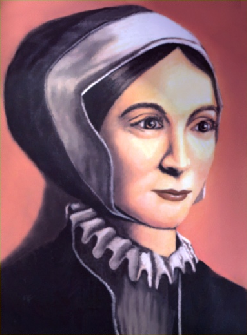
Today (30th August) is the feast of St Margaret Clitherow, 'the Pearl of York,' executed in 1586 for sheltering Catholic priests in her home. She is honoured as one of the Reformation's 'Forty Martyrs of England and Wales.'

She was executed near the Ouse bridge by the gruesome method of being 'pressed to death:'

https://s-media-cache-ak0.pinimg.com/originals/eb/f2/96/ebf296300566d400e188a15c6eb0620b.jpg


She was married to John Clitherow, one of the York Butchers (did his ancestors play in the Corpus Christi 'Death of Christ' play, which was the responsibility of the Butchers?), and had three children with him. Originally a Protestant, Margaret converted to Catholicism three years after her marriage. John, however, remained a Protestant, which must have led to some interesting marital dynamics, especially when Margaret started helping Catholic priests.

Their home was in the Shambles (the home of the York Butchers) and it was here that Margaret hid Catholic priests from the Elizabethan police. What was thought to be her house was turned into a shrine:


Unfortunately the shrine is actually in the wrong house; Margaret's home is really a few doors down and is now a shop selling cufflinks!

However the shrine is still a peaceful place to pop into for a few minutes, away from all the hurry and bustle of the Shambles outside.


Tuesday, 18 August 2015

St Helen

Today is the feast day of St Helen (c. 250 - 330), most famous for finding the True Cross and for being the mother of the Emperor Constantine... and marginally less famous for being the patron saint of yours truly!!

Christ and Cross - York Minster