

Showing posts with label research. Show all posts
Showing posts with label research. Show all posts
Tuesday, 20 March 2018

Wednesday, 18 October 2017
Have you seen the York Mystery Plays?
Just received university ethics clearance for interviewing people involved with the York Mystery Plays. Now I need people to talk to! Please get in touch or help spread the word!
Eleanor Bloomfield, a PhD candidate at the University of Auckland, is researching modern revivals of the York mystery play cycle and is seeking first-hand accounts of the plays. Anyone who has seen, or been involved with, any performances of the York plays from 1951 to the present day, and is willing to be interviewed regarding their memories, impressions and experiences, please contact e.bloomfield@auckland.ac.nz or write to Eleanor Bloomfield, The University of Auckland (English, Drama and Writing Studies), 14A Symonds St, 206-646, Auckland 1010, New Zealand. Confidential interviews will be held in Britain between March and September 2018. Approved by the University of Auckland Human Participants Ethics Committee on 10th October 2017 for three years. Reference Number 020006.
YORK EVOLVING: CHANGE AND PERMANENCE IN THE
YORK MYSTERY PLAY CYCLE
CALL FOR INFORMATION
Eleanor Bloomfield, a PhD candidate at the University of Auckland, is researching modern revivals of the York mystery play cycle and is seeking first-hand accounts of the plays. Anyone who has seen, or been involved with, any performances of the York plays from 1951 to the present day, and is willing to be interviewed regarding their memories, impressions and experiences, please contact e.bloomfield@auckland.ac.nz or write to Eleanor Bloomfield, The University of Auckland (English, Drama and Writing Studies), 14A Symonds St, 206-646, Auckland 1010, New Zealand. Confidential interviews will be held in Britain between March and September 2018. Approved by the University of Auckland Human Participants Ethics Committee on 10th October 2017 for three years. Reference Number 020006.
Thursday, 1 June 2017
PhD update: six months in
When I started this blog its avowed purpose was to be a forum for my research and academic work. Looking back over my posts from the last few months, it seems to have turned into more of a Pop-up Globe photo fest. (Sorry-not-sorry; je ne regrette rien.) So, without further ado, here is a brief roundup of my recent much ado about nothings; or, my accomplishments in academia since starting my PhD.
- writing and presenting my first conference paper; attending my first conference
- presenting at the university's School of Humanities PhD students' seminar series
- writing up my Blackburn conference presentation as a paper and submitting it to the Cerae journal (it made it past the desk-reject stage and is currently under review)
- being invited to contribute a chapter proposal to an edited collection of essays on the family networks of medieval/early modern merchants (go the Blackburns!)
- writing to This England magazine with a plea to those who have seen any productions of the York Mystery Plays since the 1950s, asking them to get in touch if willing to share any memories or information. (NB this request still stands, so anyone reading this who has been involved in any way with the mystery plays and has stories to share, please leave a comment!) So far this has yielded email contact from two lovely people who have sent me information about the Hastings mystery plays, a Times article reporting the £500,000 loss made on the 2016 York Minster production of the plays (what a shame), a copy of the 1957 York Festival Programme, a copy of the Exodus pageant performed in that production, and one very grateful PhD student with a renewed faith in the kindness of strangers.
- applying to, and being accepted for, the University of York's visiting PhD student programme for a year; then balking at the prospect of paying £16,000 in tuition fees and having to decline the offer!
- volunteering as a reader/reviewer for the Hortulus journal
- attempting to learn French, which is pretty much indispensable for working with Middle English; and also, as it turns out, with early 20th century avant-garde drama. Alas, so far this has not been an unqualified success. My working knowledge of the French language is still largely restricted to what I have picked up from watching Henry V at the Globe. Couper la gorge!
And looking ever onwards and upwards, here are my goals-still-in-progress:
- passing my provisional year review (eek).
- getting to York for the 2018 production of the mystery plays, and to explore the archives and city records there and at Lancaster and Bristol, as a 'visiting academic' (no fees required) as opposed to a 'visiting student' (large fees required).
- ditto getting to Toronto University, where productions of the full cycle were staged in the 1970s and '90s.
- submitting a paper proposal to the 2018 International Medieval Congress (IMC) in Leeds – and being accepted!
Sunday, 29 January 2017
PhD thesis | Preliminary research proposal
Having explored the performance of piety in medieval York for my MA thesis, my doctoral research will expand on this by examining how and why the city’s cycle of medieval mystery plays has been revived in (and for) the present day, becoming an integral part of modern-day York’s identity and culture. I aim to identify the cultural need which has looked to revive and sustain the York play cycle for modern and local purposes, working towards a fuller understanding of the enduring attraction of the mystery plays, and their apparent resilience, or adaptability, to huge changes in culture, language and religious belief.
An important aspect of modern revivals is dealing with the cycle’s overt Christianity. In a multi-cultural, increasingly secular society, the medieval idea of ‘the plays as piety’ no longer holds true. Nor does the cycle’s medieval function as a vehicle for religious expression and a medium for working through religious and theological tensions and concerns. Why, then, do the plays continue to capture the imaginations of both directors and audiences? Modern productions of the plays typically place emphasis on the cycle’s communal and social aspect as well as its importance to York’s cultural and social heritage. Arguably, these were roles also performed by the plays in the Middle Ages. Nevertheless, the cycle’s religious heritage is undeniable; directors must find a way to balance this with the beliefs (or lack thereof) and expectations of modern audiences.
Paying particular attention to the 1951 Festival of Britain revival (the first large-scale production of the plays since the Middle Ages) and subsequent productions, consideration will also be given to the logistics of staging modern productions of the play cycle and the many decisions any director must make - which text or script should be used? Should the language be modernised or the Middle English retained? Which sections of the cycle should be included and which left out, or should a performance of the entire cycle be attempted? How can these medieval religious plays be presented in a way that makes them accessible and relatable to a modern audience? Should the plays be staged in the ‘traditional’ manner on pageant wagons, or on a fixed-place stage? To what extent should the audience be involved in the performance?
Watch this space...
Friday, 9 September 2016
All in a day's work...
Yesterday I wrote a letter to Dame Judi Dench:


You may (or may not) know that Dame Judi took part in the earliest modern revivals of the York mystery plays throughout the 1950s. She was an angel in the 1951 Festival of Britain revival and played the Virgin Mary (one of her first professional roles) in 1957.
So on the off-chance that she might reply, I wrote asking what it was like to be part of those early performances, how the play cycle fitted into a post-war society, and how it was viewed by the people of York at the time.
Friday, 19 August 2016
On the trail of the Blackburns
While in York this past June I went back to the church of All Saints North Street, the parish church of the Blackburn family, to photograph the windows they donated to the church. They donated two windows, the Corporal Acts of Mercy Window and the St Anne Window (also known as the Blackburn Family Window, for fairly obvious reasons). These medieval windows are among the most famous in York and provide some of the best evidence we have about the Blackburn family. From them we can work out that:
- the Blackburns were a wealthy family - very much so
- they were not averse to having this wealth displayed - probably quite the opposite
- they were probably a genuinely pious family, but they made jolly sure that this piety was of the visible kind. In this they are a typical medieval upper-middle-class citizens, practising what I call 'practical piety.'
- their favourite saints were St Anne, St Christopher and St John the Baptist
- the Blackburn women were probably literate (though this was not as uncommon as is popularly thought) and wanted this to be known
- they were important people in their local parish and in the wider city
Stained glass and practical piety
The Blackburns' motivation for donating the windows was, at least primarily, a charitable one. But, from a worldly point of view, the windows ensured that their significant wealth and their substantial largesse were on public and very visible display. From a spiritual standpoint, the Blackburns would almost certainly have viewed their donation as helping to cement them in God's good graces - an attitude that was typical of the pre-Reformation mindset. Moreover, by having themselves depicted in the windows, the Blackburns ensured that they would be remembered after death. This was not so much from worldly vanity (though no doubt that came into it too) but rather so that people looking at the windows would be reminded to pray for the repose of the Blackburns' souls. Preoccupation with purgatory and the state of the soul after death is another medieval trait.
The windows
The Corporal Acts of Mercy Window I have already written about here. But here it is again, because the reds and blues in the glass are so pretty:

This is the St Anne Window. Currently this window forms the church's East Window, which, as it is directly behind the altar, is a church's most prominent and most important window. However, this is almost certainly not the original positioning of the window; probably it was initially in the Lady Chapel, in the north aisle of the quire. At some point it was moved to the altar, which unfortunately means that the altar candles and crucifix get in the way of a good photograph:

St Anne is in the centre light; on her left (the right as you look at the window) is St Christopher carrying the Christ Child, and on her right St John the Baptist. Directly below St Anne sits the risen Christ enthroned in glory, flanked on either side by Nicholas and Margaret Blackburn senior (to the right as you look at the window) and their son and heir Nicholas junior with his wife, also a Margaret, on the left.
Here is a better view of the saints in the three main lights:

And here are the Blackburns themselves, kneeling piously and reading diligently in the bottom corners of the window. These are the senior Blackburns; Nicholas is shown in armour, possibly a reference to his position as King's Admiral of the North. Note the shield with 'B' (for Blackburn) in the centre. The lettering along the bottom originally read 'Orate pro animabus Nicholai Blakeburn senoris quondam maioris civitatis Ebor. et Margarete uxoris eius' [Pray for the soul of Nicholas Blackburn, former mayor of the city of York, and for Margaret his wife].

And here are Nicholas and Margaret junior:

The Blackburn shield is repeated, as is the lettering along the bottom, which seems to be the same as that under the senior Blackburns except that the word senoris is replaced with junioris. The fact that both Margarets are shown reading from the Psalms (Margaret junior reads Psalm 6 [Vulgate numbeing] and Margaret senior Psalm 50) is probably intended to draw attention to their literacy as well as their piety. As mentioned above, women's literacy was not as uncommon as is sometimes thought, but did presuppose a certain level of familial wealth and prestige.
The Blackburns in Blackburn
The Blackburns were not originally a York family. They came from Lancashire, almost certainly from the area around what is now the city of Blackburn. Whether the Blackburns were named after the city or the city after the Blackburns is not clear.
On my last Sunday in England I visited Lancashire's Samlesbury Hall, and what did greet me in the Great Hall but -
 |
| The Blackburn coat of arms is the second from the right. |
- lo and behold, a Blackburn coat of arms, complete with helpful date.
I know next to nothing of heraldry (clearly a deficiency in my education :D). But some preliminary research suggests that the black wavy line through the centre of the shield represents the stream or river, known as the Black Brook or Black Water, on the banks of which the town was built. The white background possibly refers to wool or cloth; the manufacture of this was the town's chief industry and one which we know the Blackburn family to have been involved in. The stars, which apparently are correctly termed mullets, are interesting because as far as I can make out they were quite rare in the Middle Ages. Apparently they signify something along the lines of 'favoured by God' - which would fit neatly with the family's evident desire to claim, and proclaim, piety and prosperity.
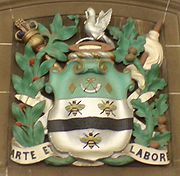
Looking at the Blackburn Borough Council coat of arms I think it is possible to trace the much older Blackburn family coat of arms in the design:

 |
| image in public domain, via |
The design has obviously been added to over the years, but the central elements are strikingly similar to the medieval Blackburn coat of arms: the white background, the black wavy line, and the three stars or bees - two above the line and one below. The bees apparently signify industry and perseverance; their initial letter, 'B', is also the initial letter of the town.
Heraldic sources:
Thursday, 11 August 2016
One's first conference
Yours truly shall be heading off to Wellington next February for the eleventh biennial conference of the Australian and New Zealand Association for Medieval And Early Modern Studies (phew, what a mouthful, and even the shorter ANZAMEMS isn't much better). My proposal, on the family, faith and fortune of our old friends the Blackburns, has been accepted (hooray!) and now I shall have to give a fifteen minute presentation at a Real Conference in front of Real Academics (gulp).
 |
| Margaret and Nicholas Blackburn junior, in the Blackburn family window, All Saints North Street, York |
Tuesday, 29 March 2016
The Blackburns: Family Tree
During the research for my MA thesis I dug up - almost literally - the Blackburn family, who lived in York from the late fourteenth century and seem to have been one of the city's leading families. They proved very helpful to me because the family patriarch, Nicholas Blackburn senior, and his wife Margaret left detailed wills, which are available online (translated from the original Latin) here.
The wills are noticeable for the almost obsessive concern they display with churches and chantries. Indeed, the Blackburns' identity, and their relationship to the city of York, is defined not, as might be expected, by the land or property they owned, but through the churches they worshipped at. This became an important part of my thesis, but today I want to look at what else the wills can tell us about the history of the Blackburn family.
Starting with the wills but later scrounging around for other information I managed to produce a Blackburn family tree covering roughly a century. It is still a work in progress - unfortunately most birth and death dates are currently lacking - but the tree still shows the principal family relationships during the fourteenth and fifteenth centuries.
Although the Blackburns ended up as a very prominent York family their roots seem to lie not in Yorkshire at all but in Lancashire. They were a family of merchant traders, or mercers, meaning they dealt in cloth and textiles. At this they were obviously successful, since the wills show that they became very wealthy.
As to which part of Lancashire they came from, I would hazard a guess that it was the town of Blackburn or nearby. The evidence for this, such as it is, is two-fold: firstly the Blackburns' name (family names in the Middle Ages were often related to where a person lived); secondly, their occupation. Blackburn, which is old enough to be mentioned in the Domesday Book, was by the mid 1200s a textile manufacturing town. As we know that the Blackburns were mercers, it seems not unreasonable to suggest that they may originally have been linked with the town.
However, at some point they moved over the border into Yorkshire. Nicholas Blackburn senior, who became the head of the York family, was born around 1360 or thereabouts in Richmond, about fifty miles north of York. He married Margaret Ormeshead, the daughter of another prominent local merchant family. They had at least five children: John, Nicholas junior, William, Isabel and Alice. William seems to have been the black sheep of the family as he is scarcely mentioned in his parents' wills - so much so that at first I overlooked him and counted only four children.
By the late 1300s the family had moved to York, to North Street, home to the York Mercers. The parish church of both the Mercers' Guild and the Blackburn family was All Saints North Street. There is no evidence, however, to suggest one way or the other whether Nicholas Blackburn was a member of the Mercers' Guild. But he and his wife were certainly members of the Corpus Christi Guild, one of the most prestigious guilds in York; they joined in 1414, by which time they were clearly well-established members of the York community: in 1406 Nicholas had been made King's Admiral of the North and in 1412 Lord Mayor of York (a position also held by his son, Nicholas junior, in 1429).
Of the Blackburn children, John married twice but died prematurely in 1426 or 1427, leaving Nicholas junior (who like his father also married a Margaret, which is distinctly confusing) their father’s heir. I have found no mention of William marrying, but Isabel and Alice did; between them these four children seem to have supplied their parents with several grandchildren and great-grandchildren, though John's two sons seem to have predeceased him. Several Blackburns, Sandfords and Boltons are mentioned in the wills of Nicholas and Margaret - the descendants of, respectively, Nicholas, Isabel and Alice. The exact relations of the Sandfords to one another, however, are (at least at the moment) not clear, which is why I can only tentatively group them together in the family tree. Certainly they seem to have been a large family.
Nicholas and Margaret senior are buried together in York Minster - as Nicholas puts it in his will, “under my marble stone which has been prepared on that spot for the purpose.” This is yet a further indication of their prominence and prestige within the York community, since at this time most people were buried within their parish church or its graveyard.
The Blackburns have become my pet project - although they were clearly important to York and particularly the All Saints North Street parish for at least the first third of the fifteenth century there is little information about them readily accessible. Most scholarly studies of the Blackburns relate to the stained glass windows they donated to All Saints North Street. Though the windows are important, they are surely not the only aspects of the Blackburns' lives worth investigating.
However, the evidence is there - in the wills, in the churches, and in the civic records - and I am trying to sift and sort this to build up a more detailed picture of the Blackburns' lives. Doing so offers a way into the complex, rich and detailed world of the faith of medieval York.
Tuesday, 22 March 2016
The Lay Folks Mass Book
After spending more than a year working with the university library's well-loved (read: decrepit and dog-eared) copy of the Lay Folks [no, there is no apostrophe] Mass Book, I finally have my own new and beautiful edition, in celebration of having finished my thesis:

The Lay Folks Mass Book, usually abbreviated to LFMB, is probably the most well-known of the medieval treatises on the Mass. Several of these treatises were produced in order to help the lay congregation follow the progression of the rite.
The LFMB was most likely translated into English from French in the latter half of the twelfth century. The text is important not only for what it reveals about the devotions of lay people at Mass but because it may have a local connection with York. Thomas Simmons, the original 1879 editor of the LFMB, decided that the text was originally translated into a northern English dialect (then, later, into Midland and Southern forms) and that the "Dan Jeremy" mentioned as author in two of the manuscripts may be the Jeremy who was Archdeacon of Cleveland (in the York diocese) by 1171. Unfortunately this theory can never be proved, but it is not unreasonable.
Unlike modern missals, the LFMB is not a translation or explanation of the Mass prayers and rubrics. Instead it is a set of vernacular prayers which encourage the reader to meditate on the benefits of the Mass and the Crucifixion. The basic structure of the Mass is traceable - I was quite easily able to follow a modern-day Tridentine Mass (the form in which the Mass was celebrated throughout the Middle Ages) using the LFMB as people today use a missal. The Confiteor, Gloria, Creed and Pater Noster are given in the text as (slightly corrupted) translations of their Latin versions, but the other prayers, though their intentions do roughly match those offered by the priest, are not translations of the Latin Mass prayers. Much of the book is taken up with identifying the priest’s actions, which function as cues either for private meditation (usually on the Crucifixion) or for the saying of private prayers, conveniently provided.

The LFMB tends to become rather
repetitive, as it reduces the continuous action of the Mass to specific,
easily identifiable points in the liturgy. These serve as triggers for
recalling the congregation to contemplation of Christ’s Passion, and as
reminders for the people to say the appropriate prayer - nothing more.
It does not encourage the people to progress beyond this basic level of
response to the liturgy.
However,
that the book exists at all suggests that there was some expectation to
involve the congregation with the Mass - to give them a role, or, at the very least, a set of signals through which they
could follow what was happening at the altar. It indicates a medieval
concern over how to include the congregation - or audience - and how to
shape their experience. As these are issues that also concern a
playwright, these cues, which do function rather in the manner of stage directions, are what gave me the idea that the Mass rite can be examined from a dramatic viewpoint, and therefore compared and contrasted with conventional drama. Since the Passion plays of the York mystery cycle are very closely aligned (in form, structure and language) with the liturgy and with the Mass, I started to look more closely at where and how the two are linked, and where and how they differ. This was the starting point of my thesis.
Some of the important 'cues' pin-pointed in the LFMB are:
- the movement of the priest (or deacon) to the left-hand side of the altar for the reading of the Gospel, a signal for the congregation to “speke... noght/bot thenk on him that dere the boght” [speak not,/But think on Him (Christ) that thee dearly bought]
- the Elevation of the Host, signalled by "a litel belle men oyse to ryng" [a little bell men use to ring]. The correct response to this signal was to "knelande holde vp both þi handes, /And so þo leuacioun þou be-halde" [kneeling, hold up both thy hands,/And so behold the elevation]
- The priest's "spred[ing] of his arms on brade" [in the form of a cross], recalled not only the Crucifixion but also signified the “tyme to praye for the dede” [the time to pray for the dead]
- The Pater Noster said by the priest, indicating that the Kiss of Peace was approaching, when the congregation kissed the pax (a little plaque of ivory or metal) handed round to them at the altar rails. [The medieval Kiss of Peace has an interesting and somewhat chequered history, but this shall be saved for another post!]
Saturday, 20 February 2016
Hubberholme medieval rood screen

This is one of only two surviving medieval rood screens and rood lofts in the north of England (the other is at Flamborough, East Yorkshire). All pre-Reformation churches had a rood screen running across the top of the nave, thus separating the nave (where the congregation gathered) from the chancel (where the altar is). During the Reformation the screens were seen as a barrier preventing the people from participating fully in the rituals occurring on the altar and were all systematically destroyed.
Rood screens are a late medieval development; before the rood screen was the chancel screen, which developed as a form of protection for the Blessed Sacrament after the Fourth Lateran council (1215) declared this to be truly the Body and Blood of Christ. A medieval rood screen
consisted of three levels. The lowest was formed of solid panels, used normally for the exhibition of religious pictures. At Bignor, Cherry Hinton [both in southern England] and elsewhere, the panels were pierced by apertures; these probably allowed kneeling children to view the ritual in the chancel. The middle level was a row of open and usually traceried windows. These, too, afforded parishioners in the nave a sight of the high altar. [...] The uppermost level... supported the rood loft. (Robert Whiting, The Reformation of the English Parish Church (Cambridge: Cambridge University Press, 2010), 9.
'Rood' is simply the Old English word for a crucifix, the most important furnishing in any medieval church. This was originally hung from the chancel arch but over time became incorporated into the chancel screen, which then became known as the rood screen.
 |
| Close up view of the rood loft, which would originally have incorporated an full and almost life-size Crucifixion scene |
People in the Middle Ages never did anything by halves, so the crucifix would have been almost life-size and usually flanked by the figures of the Sorrowful Mother and St John. The figures at Hubberholme have long been lost, but they would have looked something like this:
 |
| This is the 19th-century reconstructed rood screen in All Saints North Street, York |
 |
| Hubberholme rood loft from the chancel side |
The Hubberholme rood loft (medieval equivalent of a choir loft) now lacks its floor boards ('elf and safety would never approve!).
The church, named St Michael and All Angels (not to be confused with the two other churches in the near vicinity unimaginatively named St Michael and All Angels too), is also famous (locally at least) for having the graveyard where JB Priestly's ashes were buried, and for housing some of the handiwork of Robert Thompson, the "Mouseman of Kilburn." He was the wood carver who made the church pews; his 'signature' was a little mouse:


Photographs of Hubberholme church by Peter and Sebastian.
Church website: http://www.achurchnearyou.com/hubberholme-st-michael-all-angels/
Wednesday, 21 October 2015
Naming The Theatre
This piece is adapted from work submitted as part of the assessment for English 783: Studies in English Renaissance Drama, Semester 2, 2014. It represents my contribution to a group assignment whose brief was to write the encyclopedia entry for The Theatre in the Map of Early Modern London (MoEML) Agas Map project (http://mapoflondon.uvic.ca/index.htm). The entry is currently being edited and revised for publication. In June Radio New Zealand ran a brief story on the mapping project, which you can listen to here.
As Elizabethan England’s first purpose-built playhouse, the Theatre could take that name without fear of confusion with other London playhouses - which were always referred to in common speech as ‘playhouses,’ not as ‘theatres.’ To Elizabethans the word ‘theatre’ had a wider and richer connotation than has come down to us today. The owner and builder of the Theatre, James Burbage, must have been aware of this. The decision to name his building the Theatre was bold, perhaps even provocative.
Origin and Etymology
The word theatre comes into English from the Latin theātrum. The Latin word comes in turn from the Greek θέᾱτρον, meaning “a place for viewing.” The Greek noun is related to the verb θεᾶσθαι, “to behold,” and also to θέα “sight, view” and θεατής “spectator.” The English word theatre has been in the lexicon since the Middle Ages (first recorded use c. 1374 in Chaucer’s translation of De Consolatione Philosophiae). It retains the sense of looking, viewing, and spectatorship, although in current usage its meaning is restricted to the performing arts and the physical buildings in which they are performed. At the time the Theatre was constructed, the Latin theātrum was used to mean not only a physical space and the action performed in that space, but also much more generally, indicating something worthy of display and to be looked at.
Roman Theatres in Britain
Origin and Etymology
The word theatre comes into English from the Latin theātrum. The Latin word comes in turn from the Greek θέᾱτρον, meaning “a place for viewing.” The Greek noun is related to the verb θεᾶσθαι, “to behold,” and also to θέα “sight, view” and θεατής “spectator.” The English word theatre has been in the lexicon since the Middle Ages (first recorded use c. 1374 in Chaucer’s translation of De Consolatione Philosophiae). It retains the sense of looking, viewing, and spectatorship, although in current usage its meaning is restricted to the performing arts and the physical buildings in which they are performed. At the time the Theatre was constructed, the Latin theātrum was used to mean not only a physical space and the action performed in that space, but also much more generally, indicating something worthy of display and to be looked at.
Roman Theatres in Britain
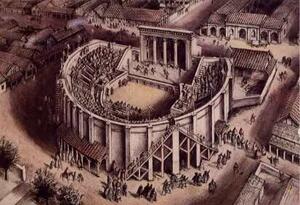
Though it was the first permanent Elizabethan theatre, the Theatre was not the first to be built in England. The ruins of twenty Roman amphitheatres have been found scattered throughout Britain by modern archeologists, including one at London. The amphitheatres were used “to stage spectacle:” gladiator fights, beast fights, and criminal executions. Of particular interest is the Roman theatre at Verulamium (now St Albans). It is the only known example of a Roman theatre in Britain with a thrust stage rather than an arena. This indicates that theatrical performances were staged there, although the building could still have been used for fights (both animal and gladiatorial) as well.
An artist’s impression of the Verulamium theatre, based on the excavated groundplan, is strikingly similar to conjectural reconstructions of Elizabethan playhouses. Similarly, we know that several London playhouses also served two functions, being used both for theatrical performances and for bear bating. There is no evidence, however, that the Theatre had such a dual purpose.
By the end of the fourth century AD the Verulamium theatre was no longer in use as a venue for the performing arts (it actually became the town’s rubbish site). The amphitheatres also fell into ruin after the Roman withdrawal from Britain. There is no evidence, or records of any kind, for any amphitheatres surviving to the Elizabethan period. We thus have no way of knowing whether Burbage and his contemporaries would have been aware of their former existence. However, the Elizabethans were devoted to the Greek and Roman classics. Even if they were not aware that Britain had had its own amphitheatres, knowledge of the Roman theatres, their appearance and function probably survived.
 |
| Artist's impression of the Verulamium theatre, via |
The Classical Tradition
Burbage may have wished to evoke the classical Roman tradition of theatre, both in the Theatre’s almost circular shape (clearly comparable to the Roman amphitheatres) and in its name. As Andrew Gurr has put it: “His choice of a Roman name and the circular design suggests that he may have had grandiose ambitions to provide London with a copy of one of Rome’s great inventions. Its name affirms that it was not just another converted innyard” (The Shakespearian Playing Companies 189). But if Burbage hoped that this would lend an aura of respectability to his theatre and the performance of plays in it, he was to be disappointed. The Puritans, following the wake of early church fathers such as Tertullian and Augustine, continued to condemn the practice of theatre going and performance as occasions of gambling, drunkenness, prostitution and general moral degradation.
Theatrum Mundi: books
The word theātrum is of course closely associated with the phrase theātrum mundi (theatre of the world), a concept which is especially associated with the Renaissance and the Baroque style. The concept is most familiar to us today as Shakespeare expresses it in As You Like It:
All the world’s a stage
And all the men and women merely players;
They have their exits and their entrances,
And one man in his time plays many parts... (As You Like It, 3.1.139)
But the concept of theātrum mundi was by no means limited to the stage and a literal theatre. Several book roughly contemporary with the Theatre contain the word theātrum in their titles:
Theatrum Vitae Humanum c. 1565 (an early encyclopedia)
A Theatre for Worldlings 1569 (religious treatise)
Theatrum Orbis Terrarum 1570 (considered to be the first modern atlas)
Gynaeceum, sive Theatrum mulierum 1586 (encyclopedia of women’s national dress)
Theatrum de veneficis 1586 (treatise on black magic)
Theatrum Mundi, et Temporis 1588 (maps of star constellations)
Theatrum artis scribendi 1594 (treatise on handwriting)
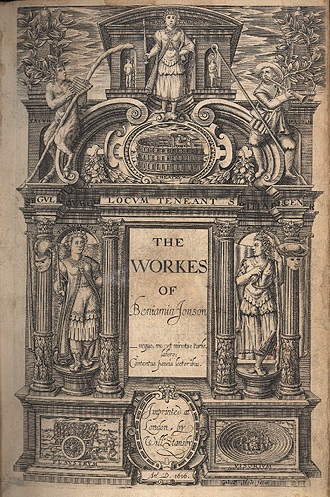
The frontispieces of these and other Elizabethan books are highly detailed and richly symbolic. Several include representations of the physical world, many contain some reference to the theatre (such as, famously, Benjamin Jonson’s 1616 folio frontispiece image) and almost all incorporate a physical structure of some kind - usually a stone arch or monument. This last is important, because the purpose of frontispieces was not merely to provide decoration. Instead they were designed to “epitomise the book and glorify its author and his work” (Corbett and Lightbrown, The Comely Frontispiece 46). Burbage may have intended the Theatre to be his monument, a physical testimony to his life and work, more impressive and imposing than a mere page in a book.
 |
| Frontispiece to 1616 Jonson portfolio, via |
Theatrum Mundi: Kunstkammern and ‘Cabinets of Curiosities’
Throughout the sixteenth century the royal Habsburgs compiled miscellaneous objects of value or beauty - jewellry, artifacts, curiosities, relics, paintings, objects from the natural world, carvings and sculptures - and housed them in collections known as Kunstkammern. One of the most important of these collections was that of Archduke Ferdinand II of Tyrol (1529-1595), whose Kunst- und Wunderkammer [chamber of art and natural wonders] was “a reflection of the cosmos and thus of contemporary knowledge about the world” (Haag, “A History of the Kunstkammer Wien”). Kunstkammern and similar collections were described by Samuel Quiccheberg in his 1565 Inscriptiones vel tituli theatri amplissimi as theātri mundi, “theatre[s] conceived in the broadest possible terms, containing genuine materials and accurate reproductions of the whole universe”(Friehs, “Art and Junk”).
Kunnstkammern first appeared in England as ‘cabinets of curiosities’ around the turn of the sixteenth century - slightly later than their European counterparts. The earliest significant English collection is the Tradescant collection, first referred to in 1634. By this time the collection was already “encyclopaedic,” so Tradescant must have been collecting for some time. Consequently, even though the first record of the collection comes considerably later than the construction of the Theatre, it seems not unreasonable to assume that the idea of Kunnstkammern as theātri mundi filtered back to England much earlier. Burbage may well have had this in mind when naming the Theatre.
 |
| Cabinet of Curiosities, via |
Show and Spectacle
So in the Renaissance period the idea of a theātrum, or theatre, extended far beyond a physical space. The underlying concept of a theātrum was to present and showcase the universe in manageable form for study and spectatorship. Whether in the pages of a book or in a Kunnstkammer, the aim was to present “in a small space... an all embracing image of the world” (Haag, “A History of the Kunstkammer Wien”). We still think of the theatre as doing this: for many, one of the purposes of the theatre is how life is reflected in art. For the Elizabethan playgoers, the image of heaven, earth and the cosmos was incorporated into the physical structure of the theatre building. We know that the underside of the tiring-house roof in several of the playhouses was painted to represent the heavens, including depictions of the sun, moon, stars and the signs of the zodiac. The stage represented earth and the hollow area beneath it hell. Thus the whole cosmos was represented in the physical structure of the stage. There is unfortunately no surviving evidence of how the Theatre’s stage looked, but also no reason to assume that it varied greatly from this basic model.
Conclusion
In naming the Theatre, Burbage assigned his playhouse a markedly different status from that of the inn-yards previously used for performances. By evoking the ancient Roman theatres, he claimed for it dignity and prestige. The name also links into contemporary notions of theatre, show and spectacle.
BIBLIOGRAPHY: WORKS CITED OR CONSULTED
Allen, Mia. The Tradescants: Their Plants, Gardens and Museum, 1570 - 1662. London: M. Joseph, 1964.
Corbett, Margery, and Ronald Lightbrown. The Comely Frontispiece: The Emblematic Title Page in England, 1550 - 1660. London; Boston: Routledge and Paul, 1979.
Friehs, Julia Teresa. “Art and Junk: The Habsburgs and Their Cabinets of Art and Curiosities.” The World of the Habsburgs. Accessed August 18, 2014. http://www.habsburger.net/en/stories/art-and-junk-habsburgs-and-their-cabinets-art-and-curiosities
“Frontispiece.” Oxford English Dictionary Online. Accessed August 18, 2014. http://www.oed.com.ezproxy.auckland.ac.nz/view/Entry/74941? rskey=ZX5RJQ&result=1&isAdvanced=false#eid
Gurr, Andrew. The Shakespearian Playing Companies. Oxford: Clarendon Press; New York: Oxford University Press, 1996.
------- The Shakespearean Stage 1574 - 1642. Cambridge: Cambridge University Press, 2013.
Haag, Sabine. “A History of the Kunstkammer Wien.” Kunst Historisches Museum Wien. Accessed August 18, 2014. http://www.kkhm.at/fileadmin/content/KHM/kkhm/Presse/ History_of_the_Kunstkammer.pdf
Kenyon, Kathleen. “The Roman Theatre of Verulamium: Reprinted From the St Albans and Hertfordshire Architectural and Archeological Society’s Transactions, 1934.” Accessed September 10, 2014. http://www.infotextmanuscripts.org/webb/webb_roman_t.pdf
Stern, Tiffany. “‘This Wide and Universal Theatre’: The Theatre As Prop in Shakespeare’s Metadrama.” In Shakespeare’s Theatres and the Effects of Performance, edited by Farah Karim-Cooper and Tiffany Stern, 11-32. London: Arden Shakespeare, 2013.
“Theatre.” Oxford English Dictionary Online. Accessed August 18, 2014. http://www.oed.com.ezproxy.auckland.ac.nz/view/Entry/200227?rskey=2gyziM&result=1&isAdvanced=false#eid
“The Tradescant Collection.” Ashmolean Museum. Accessed August 19, 2014. http://www.ashmolean.org/ash/amulets/tradescant/tradescant03.html
The Roman Theatre of Verulamium. Accessed September 10, 2014. http://www.romantheatre.co.uk
Wilmot, Tony. “Roman Amphitheatres, Theatres and Circuses.” English Heritage. Accessed September 10, 2014. https://www.english-heritage.org.uk/publications/iha-roman-amphitheatres-theatres-circuses/amphitheatres.pdf
Allen, Mia. The Tradescants: Their Plants, Gardens and Museum, 1570 - 1662. London: M. Joseph, 1964.
Corbett, Margery, and Ronald Lightbrown. The Comely Frontispiece: The Emblematic Title Page in England, 1550 - 1660. London; Boston: Routledge and Paul, 1979.
Friehs, Julia Teresa. “Art and Junk: The Habsburgs and Their Cabinets of Art and Curiosities.” The World of the Habsburgs. Accessed August 18, 2014. http://www.habsburger.net/en/stories/art-and-junk-habsburgs-and-their-cabinets-art-and-curiosities
“Frontispiece.” Oxford English Dictionary Online. Accessed August 18, 2014. http://www.oed.com.ezproxy.auckland.ac.nz/view/Entry/74941? rskey=ZX5RJQ&result=1&isAdvanced=false#eid
Gurr, Andrew. The Shakespearian Playing Companies. Oxford: Clarendon Press; New York: Oxford University Press, 1996.
------- The Shakespearean Stage 1574 - 1642. Cambridge: Cambridge University Press, 2013.
Haag, Sabine. “A History of the Kunstkammer Wien.” Kunst Historisches Museum Wien. Accessed August 18, 2014. http://www.kkhm.at/fileadmin/content/KHM/kkhm/Presse/ History_of_the_Kunstkammer.pdf
Kenyon, Kathleen. “The Roman Theatre of Verulamium: Reprinted From the St Albans and Hertfordshire Architectural and Archeological Society’s Transactions, 1934.” Accessed September 10, 2014. http://www.infotextmanuscripts.org/webb/webb_roman_t.pdf
Stern, Tiffany. “‘This Wide and Universal Theatre’: The Theatre As Prop in Shakespeare’s Metadrama.” In Shakespeare’s Theatres and the Effects of Performance, edited by Farah Karim-Cooper and Tiffany Stern, 11-32. London: Arden Shakespeare, 2013.
“Theatre.” Oxford English Dictionary Online. Accessed August 18, 2014. http://www.oed.com.ezproxy.auckland.ac.nz/view/Entry/200227?rskey=2gyziM&result=1&isAdvanced=false#eid
“The Tradescant Collection.” Ashmolean Museum. Accessed August 19, 2014. http://www.ashmolean.org/ash/amulets/tradescant/tradescant03.html
The Roman Theatre of Verulamium. Accessed September 10, 2014. http://www.romantheatre.co.uk
Wilmot, Tony. “Roman Amphitheatres, Theatres and Circuses.” English Heritage. Accessed September 10, 2014. https://www.english-heritage.org.uk/publications/iha-roman-amphitheatres-theatres-circuses/amphitheatres.pdf
Tuesday, 29 September 2015
Why do we tell stories?
Distinguished Professor Brian Boyd (University of Auckland) on stories and storytelling:
Wednesday, 9 September 2015
The Mercers' Pageant Documents
 |
| Trudging through these thick, heavy and very red books (the collection of all the extant records relating to medieval drama in York) is a daunting task... but can reveal such unexpectedly vibrant, colourful, crazy gems as angels running about in heaven and God ascending to heaven on a swing. Who says Middle English drama lacked special effects?! |
The Mercers are beloved by students of the mystery plays because they kept detailed records - particularly in 1433, when they helpfully produced a list of all the scenery and props used in their play. These records are enormously helpful in working out how their play was staged and what it looked like. By extension, some of the information gleaned from the Mercers' pageant records can be tentatively applied to other plays as well. For example, the Mercers probably used a two-storey wagon, which modern productions (especially the groundbreaking 1998 York/Toronto production, which performed all forty-seven plays in order across a single day) have proved to be feasible and not necessarily dangerously top-heavy as was previously thought. Other guilds, therefore, may well have used these double-decker wagons as well, giving themselves more playing space - a pageant wagon is not very big, so all available space would have been utilised, as well as the area in the street around the wagon.
The Mercers' play was the Doomsday or Last Judgement, which gives lots of scope for show and spectacle. The most famous prop listed in the play records is the hell mouth, which would have been underneath the wagon top, allowing the Bad Souls to tumble symbolically from the playing space down into hell. The red-painted devils could also have come up through the mouth to drag off their victims.
The hell mouth (probably in the shape of a dragon's head and painted in fiery colours) would have been counterbalanced visually by heaven, which appears to have been a kind of canopy or balcony over the wagon floor. At any rate, "iiij Irens to bere vppe heuen" [four iron poles/bars to bear up heaven] are called for. Heaven itself is "of Iren With a naffe of tre ij peces of rede cloudes & sternes of gold langing to heuen ij peces of blu cloudes... iij peces of rede cloudes With sunne bemes of golde" [of iron with a roof (?) of wood (? possibly leafy branches), two pieces of red clouds and stars of gold hanging from heaven, two pieces of blue clouds and three pieces of red clouds with sunbeams of gold].
My favourite prop is the "brandeth of Iren þat god sall sitte vppon when he sall sty vppe to heuen" [a swing of iron that God shall sit upon when he shall ascend up to heaven]. Obviously there was some kind of pulley system that hauled the actor playing God up from the floor of the pageant wagon to heaven up above. Sadly, no one seems to have utilised such a wonderful piece of visual imagery in any modern production.
All that iron must have made the wagon incredibly heavy. How the poor people who had to push the wagon did it we have no way of knowing, as scenery in modern productions is made out of rather more practical materials!
The list of scenery and props is highly detailed, sometimes peculiarly so - the pageant wagon, for example, is listed with the specification that it must have four wheels! (Just in case someone got stingy and decided it would be cheaper to have only three, presumably...)
Among details of various props and costumes are such gems as "A lang small corde" [a long small cord] which was something to do with "þe Aungels" that "renne aboute in þe heuen" [the angels that run about (yes, that is the translation) in heaven]. What the cord (or rope) was actually used for is not specified. As a leash, perhaps, for God to control the angels in case their running about got a little too lively? What a glorious image!
Also listed are "vij grete Aungels halding þe passion of god" [seven great/big angels holding the instruments of the Passion]. This means that the angels would have been holding the Arma Christi to illustrate the speech where Christ calls on the audience to look at the wounds inflicted for their redemption:
Here may ye see my wounds wide,
The which I tholed for your misdeed.
Through heart and head, foot, hand, and hide,
Not for my guilt, but for your need.
Behold both body, back, and side,
How dear I bought your brotherhead.
These bitter pains would I abide -
To you buy you bliss thus would I bleed.
My body was scourged without skill,
As thief full throly was I threat;
On cross they hanged me, on a hill,
Bloody and blo, as I was beat,
With crown of thorn thrusten full ill.
This spear unto my side was set -
Mine heart-blood spared they not for to spill;
Man, for thy love would I not let.
The actor playing Christ wore "a Sirke wounded" - a shirt (probably more like a long robe-like garment) that had been torn or slashed and then spattered with red to represent Christ's wounds.
All quotes from Mercers' Pageant documents [1433] from Records of Early English Drama, edited by Alexandra Johnson and Margaret Rogerson (Manchester: Manchester University Press, 1979), 55. Translations in square brackets my own. Christ's speech from the Last Judgment from The York Mystery Plays: A Selection in Modern Spelling, edited by Richard Beadle and Pamela King (Oxford: Oxford University Press, 2009), p. 275-6, l.245-60.
Monday, 7 September 2015
One's first academic poster
According to the good old UoA, yours truly is now an 'early career academic.' Ha!
Early career academics (and middle and late career academics, for that matter) are expected to engage in the vague and dubious pastime of "getting one's research out there." To this end I have been having a great deal ofstrife fun lately trying to design a research poster to be entered in the Faculty of Arts Exposure competition. After two weeks of frustration and foot stamping, behold the finished result in all its glory:
Please also note a couple of do's and don't's I wish someone had pointed out to me before I started. (But then, perhaps it's just as well they didn't, or I never would have started.)
DO NOT make the mistake of thinking that designing a poster is a nice, easy, fun little project taking a couple of days at most. Ha!
DO NOT be so foolish as to assume that the colours of your poster when printed will look anything like the colours on your computer screen.
DO be aware that the process involves endless tweaking, fiddling and frustration as well as umpteen trips to the printer... but also a certain amount of satisfaction at the end of it :)
The poster is printed at A1 size but I have a great many spare half-size (A3) mock-ups (see above re umpteen trips to the printer). I never want to see an A3 mock-up again but they are all really quite pretty and would look lovely adorning your wall. If you would like one, let me know. I'll even autograph it for you :)
Early career academics (and middle and late career academics, for that matter) are expected to engage in the vague and dubious pastime of "getting one's research out there." To this end I have been having a great deal of
 |
| The quality isn't great because I had to convert it to a PNG file in order to upload it to the blog. To find out how you can acquire your very own higher-quality copy, read on! |
Please also note a couple of do's and don't's I wish someone had pointed out to me before I started. (But then, perhaps it's just as well they didn't, or I never would have started.)
DO NOT make the mistake of thinking that designing a poster is a nice, easy, fun little project taking a couple of days at most. Ha!
DO NOT be so foolish as to assume that the colours of your poster when printed will look anything like the colours on your computer screen.
DO be aware that the process involves endless tweaking, fiddling and frustration as well as umpteen trips to the printer... but also a certain amount of satisfaction at the end of it :)
The poster is printed at A1 size but I have a great many spare half-size (A3) mock-ups (see above re umpteen trips to the printer). I never want to see an A3 mock-up again but they are all really quite pretty and would look lovely adorning your wall. If you would like one, let me know. I'll even autograph it for you :)
Tuesday, 16 June 2015
Mapping London Story on Radio NZ
 |
| http://www.nationalarchives.gov.uk/education/tudorhackney/images/agas1559sh.jpg |
'Ello my dearly beloved 'earers!
The link to the Agas Map referred to in the story is http://mapoflondon.uvic.ca/index.htm
Subscribe to:
Posts (Atom)