(Canadian readers note that, apparently, Canadian French is similar to medieval French! And you never told me ;) )

Showing posts with label language. Show all posts
Showing posts with label language. Show all posts
Monday, 28 November 2016
Origins of the English Language
Interesting piece here on, well, what it says in the title - the early history of the English language.

Monday, 31 October 2016
All Hallow's Eve and the Lyke-Wake Dirge
 |
| (empty) Roman sarcophagi in the Multiangular Tower, York |
To mark Halloween - or, in its older form, All Hallow's Eve - I found for your delight this cheery little medieval poem. Written in the dialect of north Yorkshire, it is a funeral dirge, thought to have been sung or chanted while keeping watch (wake) at the side of a corpse (lyke; this old word for corpse survives today in lychgate, the covered gateway into church grounds, where the bier would await the arrival of the priest conducting the funeral). The poem displays the typical medieval preoccupation both with Purgartory and with the Corporal Works of Mercy - well, three of them at least: to clothe the naked ("If ever thou gavest hosen and shoon"), to feed the hungry, and to give drink to the thirsty ("If ever thou gav'st meat or drink"). This leads into the pious hope that a life well lived will result in "Christ receiv[ing] thy saule."
This ae nighte, this ae nighte,
Every nighte and alle,
Fire and fleet and candle-lighte,
And Christe receive thy saule.
When thou from hence away art past,
Every nighte and alle,
To Whinny-muir thou com'st at last;
And Christe receive thy saule.
If ever thou gavest hosen and shoon,
Every nighte and alle,
Sit thee down and put them on;
And Christe receive thy saule.
If hosen and shoon thou ne'er gav'st nane
Every nighte and alle,
The whinnes sall prick thee to the bare bane;
And Christe receive thy saule.
From Whinny-muir whence thou may'st pass,
Every nighte and alle,
To Brig o' Dread whence thou may'st pass,
And Christe receive thy saule.
From Brig o' Dread whence thou may'st pass,
Every nighte and alle,
To Purgatory fire thou com'st at last;
And Christe receive thy saule.
If ever thou gav'st meat or drink,
Every nighte and alle,
The fire sall never make thee shrink;
And Christe receive thy saule.
If meat or drink thou ne'er gav'st nane,
Every nighte and alle,
The fire will burn thee to the bare bane;
And Christe receive thy saule.
This ae nighte, this ae nighte,
Every nighte and alle,
Fire and fleet and candle-lighte,
And Christe receive thy saule.
I do think middle English literature is much more fun read in the original, so I am not going to translate the poem. In any case, the language of this version isn't hard, especially when you simply drop the final e from many words. A few tricky words I have glossed below:
fleet ~ some say this should be sleet, as in frozen rain. Others say it should be slate, as in the roofing material. However, fleet appears to be an old word for home, or house. I prefer this, as it alliterates with fire.
saule ~ soul
hosen ~ clothes
shoon ~ shoes
whinnnes, Whinny-muir ~ whin = thorn and muir = moor
bane ~ bone
Brig ~ not a sailing ship; a bridge
The song has been set to music by Benjamin Britten. The band Pentangle (medieval buffs will know that the name comes from the five-pointed star emblazoned on Gawain's shield in Sir Gawain and the Green Knight) also released their own version, which you can listen to here:
Sunday, 15 May 2016
Pentecost Sunday
_-_interior,_stained_glass,_Pentecost.jpg) |
| via |
Et emitte caelitus
Lucis tuae radium.
Veni, pater pauperum,
Veni, dator munereum,
Veni, lumen cordium.
Consolator optime,
Dulcis hospes animae,
Dulce refrigerium.
In labore requies,
In aestu temperies,
In fletu solatium.
O lux beatissima,
Reple cordis intima
Tuorum fidelium.
Pentecost Sunday, the feast of the Holy Ghost, is also known in England as Whitsunday, a term dating from the Norman Conquest. The word comes from late Old English; whit means white (hwitte in Old English; Hwita Sunnandæg = White Sunday or Whitsunday). What the white refers to is a matter of some debate; the most common explanation is that it refers to the white baptismal robes of those who were baptised during the feast's vigil. Another explanation links the Christian feast with a much older pagan one - the Mayday festivities, when young girls would wear white to mark the coming of summer.
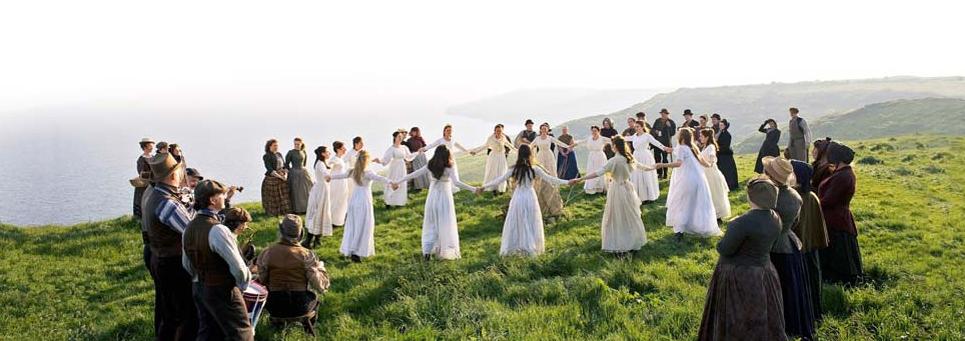 |
| The Mayday dance in the 2008 BBC Tess of the D'Urbervilles, via |
During the Middle Ages whit seems to have been (erroneously) confused with wit or wisdom, one of the seven gifts of the Holy Ghost. Thus:
þis day ys called Whitsonday, for bycause þat þe Holy Gost as þys day broʒt wyt and wysdome ynto all Cristes dyscyples
[this day is called Whitsunday, because the Holy Ghost on this day brought wit and wisdom to all Christ's disciples]
According to some versions of the King Arthur legend, Arthur married Guinevere on the feast of Pentecost, and in Malory's Le Morte d'Arthur it is on the feast of Pentecost that the Knights of the Round Table swear their oath of honour, chivalry and loyalty:
the kynge... charged them never to do outerage nothir morthir, and allwayes to fle treason, and to gyff mercy unto hym that askith mercy... and allwayes to do ladyes, damesels, and jantilwomen [socour] strenthe hem in hir ryghtes, and never to enforce them, upon payne of dethe. Also, that no man take no batayles in a wrongefull quarell for no love ne for no worldis goodis. So unto thys were all knyghtis sworne of the Table Rounde, both olde and yonge, and every yere so were the[y] sworne at the hygh feste of Pentecoste.
[the king... charged them never to do outrage nor murder, and always to flee treason, and to give mercy to those who asked for mercy... and also to give succour to ladies, damsels and gentlewomen, to defend their rights, and never to use force against them, upon pain of death. Also, that no man take go into battle for a wrongful cause, not for love nor for worldly goods. So to this were sworn all the knights of the Round Table, both old and young, and every year so were they sworn at the high feast of Pentecost.]
It is interesting that Malory uses the word Pentecost, not Whitsun, which was the more common term in England at the time. The use of Pentecost is presumably because the King Arthur stories were originally written in French. The French term for the feast is Pentecôte, so Mallory has translated it literally into English.
 |
| The Knights of the Round Table swear their oath at Pentecost, via |
Quote from Thomas Malory taken from Eugene Vinaver, ed., The Works of Sir Thomas Malory (London: Oxford University Press, 1968), 91.
Quote from John Mirk taken from Theodore Erbe, ed., Mirk's Festival: A Collection of Homilies (London: Kegan Paul et al., for the Early English Text Society, 1905), 159.
Veni Sancte Spiritus from the Sequence for the Mass of Pentecost.
Sunday, 24 April 2016
"Words, words, words..."
Since NZ is half a day ahead of England, over there it is still April 23rd, so what better excuse to begin today with some of my favourite Shakespearean speeches (as promised in yesterday's post).
So, without more ado, here we go (in no particular order):
Make me a willow cabin at your gate,
And call upon my soul within the house;
Write loyal cantons of contemnéd love,
And sing them loud even in the dead of night;
Hallow your name to the reverberate hills,
And make the babbling gossip of the air
Cry out 'Olivia!' O you should not rest
Between the elements of air and earth
But you should pity me!
Twelfth Night I.5.223-32
Now cracks a noble heart. Good night, sweet prince,
And flights of angels sing thee to thy rest.
Hamlet V.2.352-3
ORSINO: And what's her history?
VIOLA: A blank, my lord. She never told her love,
But let concealment like a worm i'th'bud
Feed on her damask cheek. She pined in thought,
And with a green and yellow melancholy
She sat like Patience on a monument,
Smiling at grief. Was not this love indeed?
We men may say more, swear more, but indeed
Our shows are more than will: for still we prove
Much in our vows, but little in our love.
Twelfth Night II.4.105-14
What is he whose grief
Bears such an emphasis, whose phrase of sorrow
Conjures the wand'ring stars and makes them stand
Like wonder-wounded hearers? This is I,
Hamlet the Dane.
Hamlet V.1.238-42
His legs bestrid the ocean; his reared arm
Crested the world; his voice was propertied
As all the tunéd spheres, and that to friends;
But when he meant to quail and shake the orb,
He was as rattling thunder. For his bounty,
There was no winter in't; an autumn 'twas
That grew the more by reaping. His delights
Were dolphin-like; they showed his back above
The element they lived in. In his livery
Walked crowns and crownets; realms and islands were
As plates dropped from his pocket.
Antony and Cleopatra V.2.81-91
Come, Antony, and young Octavius, come,
Revenge yourselves alone on Cassius,
For Cassius is a-weary of the world:
Hated by one he loves, brav'd by his brother,
Check'd like a bondman, all his faults observ'd,
Set in a notebook, learn'd, and conn'd by rote,
To cast into my teeth. O, I could weep
My spirit from mine eyes! There is my dagger
And here my naked breast; within, a heart
Dearer than Pluto's mine, richer than gold.
If that thou beest a Roman take it forth,
I that denied thee gold will give my heart:
Strike as thou didst at Caesar. For I know
When thou didst hate him worst thou loved'st him better
Then ever thou lov'd'st Cassius.
Julius Caesar IV.3.93-107
Fight, gentlemen of England! Fight, bold yeomen!
Draw, archers, draw your arrows to the head!
Spur your proud horses hard, and ride in blood!
Amaze the welkin with your broken staves!
Richard III V.4.339-42
Ye elves of hills, brooks, standing lakes, and groves,
And ye that on the sands with printless foot
Do chase the ebbing Neptune, and do fly him
When he comes back; you demi-puppets that
By moonshine do the green sour ringlets make,
Whereof the ewe not bites; and you whose pastime
Is to make midnight mushrooms, that rejoice
To hear the solemn curfew, by whose aid -
Weak masters though ye be - I have bedimm'd
The noontide sun, call'd forth the mutinous winds,
And 'twixt the green sea and the azur'd vault
Set roaring war; to the dread rattling thunder
Have I given fire, and rifted Jove's sout oak
With his own bolt; the strong-bas'd promontory
Have I made shake, and by the spurts pluck'd up
The pine and cedar. Graves at my command
Have wak'd their sleepers, op'd, and let 'em forth
By my so potent art. But this rough magic
I here abjure; and when I have requir'd
Some heavenly music - which even now I do -
To work mine end upon their sense that
This airy charm is for, I'll break my staff,
Bury it certain fathoms in the earth,
And deeper than did ever plummet sound
I'll drown my book.
The Tempest V.1 33-57
Not a whit. We defy augury. There is special providence in the fall of a sparrow. If it be now, 'tis not to come; if it be not to come, it will be now; if it be not now, yet it will come. The readiness is all.
Hamlet V.2.204-7
Wednesday, 20 April 2016
Quiz: How good is your NZ English?
This week on the Oxford Words Blog, this amusing little quiz:
Have fun, Hugh :P
(tell me how many you get right and I'll post it in the comments!)
Tuesday, 23 February 2016
Middle English Collective Nouns
Recently I have been reading Chloe Rhodes' little gem of a book, An Unkindness of Ravens: A Book of Collective Nouns (London: Michael O'Mara Books Ltd, 2014).
Apparently most collective nouns - both those we are familiar with today and many more that have fallen into obscurity - date from the Middle Ages. Like the rest of the Middle English vocabulary, these forgotten collective nouns are often vivid, pithy and downright funny.
Some of my favourite:
a goring of butchers
a gaggle of gossips
a draught of butlers
a rascal of boys
a worship of writers [because they would flatter their rich patrons]
an eloquence of lawyers
a hastiness of cooks
a tabernacle of bakers [tabernacle (original meaning 'tent' or 'little hut') being the stall the backer would set up in the marketplace and from which he would sell his wares]
Apparently most collective nouns - both those we are familiar with today and many more that have fallen into obscurity - date from the Middle Ages. Like the rest of the Middle English vocabulary, these forgotten collective nouns are often vivid, pithy and downright funny.
Some of my favourite:
a goring of butchers
a gaggle of gossips
a draught of butlers
a rascal of boys
a worship of writers [because they would flatter their rich patrons]
an eloquence of lawyers
a hastiness of cooks
a tabernacle of bakers [tabernacle (original meaning 'tent' or 'little hut') being the stall the backer would set up in the marketplace and from which he would sell his wares]
Wednesday, 2 December 2015


Wednesday, 21 October 2015
Naming The Theatre
This piece is adapted from work submitted as part of the assessment for English 783: Studies in English Renaissance Drama, Semester 2, 2014. It represents my contribution to a group assignment whose brief was to write the encyclopedia entry for The Theatre in the Map of Early Modern London (MoEML) Agas Map project (http://mapoflondon.uvic.ca/index.htm). The entry is currently being edited and revised for publication. In June Radio New Zealand ran a brief story on the mapping project, which you can listen to here.
As Elizabethan England’s first purpose-built playhouse, the Theatre could take that name without fear of confusion with other London playhouses - which were always referred to in common speech as ‘playhouses,’ not as ‘theatres.’ To Elizabethans the word ‘theatre’ had a wider and richer connotation than has come down to us today. The owner and builder of the Theatre, James Burbage, must have been aware of this. The decision to name his building the Theatre was bold, perhaps even provocative.
Origin and Etymology
The word theatre comes into English from the Latin theātrum. The Latin word comes in turn from the Greek θέᾱτρον, meaning “a place for viewing.” The Greek noun is related to the verb θεᾶσθαι, “to behold,” and also to θέα “sight, view” and θεατής “spectator.” The English word theatre has been in the lexicon since the Middle Ages (first recorded use c. 1374 in Chaucer’s translation of De Consolatione Philosophiae). It retains the sense of looking, viewing, and spectatorship, although in current usage its meaning is restricted to the performing arts and the physical buildings in which they are performed. At the time the Theatre was constructed, the Latin theātrum was used to mean not only a physical space and the action performed in that space, but also much more generally, indicating something worthy of display and to be looked at.
Roman Theatres in Britain
Origin and Etymology
The word theatre comes into English from the Latin theātrum. The Latin word comes in turn from the Greek θέᾱτρον, meaning “a place for viewing.” The Greek noun is related to the verb θεᾶσθαι, “to behold,” and also to θέα “sight, view” and θεατής “spectator.” The English word theatre has been in the lexicon since the Middle Ages (first recorded use c. 1374 in Chaucer’s translation of De Consolatione Philosophiae). It retains the sense of looking, viewing, and spectatorship, although in current usage its meaning is restricted to the performing arts and the physical buildings in which they are performed. At the time the Theatre was constructed, the Latin theātrum was used to mean not only a physical space and the action performed in that space, but also much more generally, indicating something worthy of display and to be looked at.
Roman Theatres in Britain
Though it was the first permanent Elizabethan theatre, the Theatre was not the first to be built in England. The ruins of twenty Roman amphitheatres have been found scattered throughout Britain by modern archeologists, including one at London. The amphitheatres were used “to stage spectacle:” gladiator fights, beast fights, and criminal executions. Of particular interest is the Roman theatre at Verulamium (now St Albans). It is the only known example of a Roman theatre in Britain with a thrust stage rather than an arena. This indicates that theatrical performances were staged there, although the building could still have been used for fights (both animal and gladiatorial) as well.
An artist’s impression of the Verulamium theatre, based on the excavated groundplan, is strikingly similar to conjectural reconstructions of Elizabethan playhouses. Similarly, we know that several London playhouses also served two functions, being used both for theatrical performances and for bear bating. There is no evidence, however, that the Theatre had such a dual purpose.
By the end of the fourth century AD the Verulamium theatre was no longer in use as a venue for the performing arts (it actually became the town’s rubbish site). The amphitheatres also fell into ruin after the Roman withdrawal from Britain. There is no evidence, or records of any kind, for any amphitheatres surviving to the Elizabethan period. We thus have no way of knowing whether Burbage and his contemporaries would have been aware of their former existence. However, the Elizabethans were devoted to the Greek and Roman classics. Even if they were not aware that Britain had had its own amphitheatres, knowledge of the Roman theatres, their appearance and function probably survived.
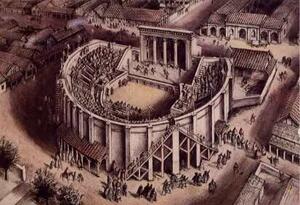 |
| Artist's impression of the Verulamium theatre, via |
The Classical Tradition
Burbage may have wished to evoke the classical Roman tradition of theatre, both in the Theatre’s almost circular shape (clearly comparable to the Roman amphitheatres) and in its name. As Andrew Gurr has put it: “His choice of a Roman name and the circular design suggests that he may have had grandiose ambitions to provide London with a copy of one of Rome’s great inventions. Its name affirms that it was not just another converted innyard” (The Shakespearian Playing Companies 189). But if Burbage hoped that this would lend an aura of respectability to his theatre and the performance of plays in it, he was to be disappointed. The Puritans, following the wake of early church fathers such as Tertullian and Augustine, continued to condemn the practice of theatre going and performance as occasions of gambling, drunkenness, prostitution and general moral degradation.
Theatrum Mundi: books
The word theātrum is of course closely associated with the phrase theātrum mundi (theatre of the world), a concept which is especially associated with the Renaissance and the Baroque style. The concept is most familiar to us today as Shakespeare expresses it in As You Like It:
All the world’s a stage
And all the men and women merely players;
They have their exits and their entrances,
And one man in his time plays many parts... (As You Like It, 3.1.139)
But the concept of theātrum mundi was by no means limited to the stage and a literal theatre. Several book roughly contemporary with the Theatre contain the word theātrum in their titles:
Theatrum Vitae Humanum c. 1565 (an early encyclopedia)
A Theatre for Worldlings 1569 (religious treatise)
Theatrum Orbis Terrarum 1570 (considered to be the first modern atlas)
Gynaeceum, sive Theatrum mulierum 1586 (encyclopedia of women’s national dress)
Theatrum de veneficis 1586 (treatise on black magic)
Theatrum Mundi, et Temporis 1588 (maps of star constellations)
Theatrum artis scribendi 1594 (treatise on handwriting)
The frontispieces of these and other Elizabethan books are highly detailed and richly symbolic. Several include representations of the physical world, many contain some reference to the theatre (such as, famously, Benjamin Jonson’s 1616 folio frontispiece image) and almost all incorporate a physical structure of some kind - usually a stone arch or monument. This last is important, because the purpose of frontispieces was not merely to provide decoration. Instead they were designed to “epitomise the book and glorify its author and his work” (Corbett and Lightbrown, The Comely Frontispiece 46). Burbage may have intended the Theatre to be his monument, a physical testimony to his life and work, more impressive and imposing than a mere page in a book.
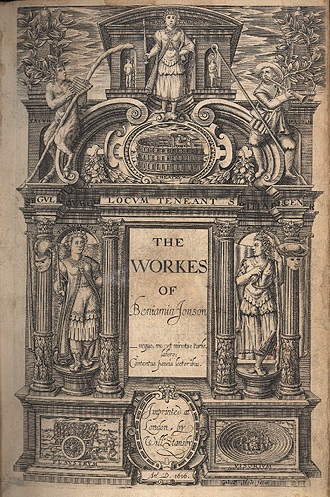 |
| Frontispiece to 1616 Jonson portfolio, via |
Theatrum Mundi: Kunstkammern and ‘Cabinets of Curiosities’
Throughout the sixteenth century the royal Habsburgs compiled miscellaneous objects of value or beauty - jewellry, artifacts, curiosities, relics, paintings, objects from the natural world, carvings and sculptures - and housed them in collections known as Kunstkammern. One of the most important of these collections was that of Archduke Ferdinand II of Tyrol (1529-1595), whose Kunst- und Wunderkammer [chamber of art and natural wonders] was “a reflection of the cosmos and thus of contemporary knowledge about the world” (Haag, “A History of the Kunstkammer Wien”). Kunstkammern and similar collections were described by Samuel Quiccheberg in his 1565 Inscriptiones vel tituli theatri amplissimi as theātri mundi, “theatre[s] conceived in the broadest possible terms, containing genuine materials and accurate reproductions of the whole universe”(Friehs, “Art and Junk”).
Kunnstkammern first appeared in England as ‘cabinets of curiosities’ around the turn of the sixteenth century - slightly later than their European counterparts. The earliest significant English collection is the Tradescant collection, first referred to in 1634. By this time the collection was already “encyclopaedic,” so Tradescant must have been collecting for some time. Consequently, even though the first record of the collection comes considerably later than the construction of the Theatre, it seems not unreasonable to assume that the idea of Kunnstkammern as theātri mundi filtered back to England much earlier. Burbage may well have had this in mind when naming the Theatre.
 |
| Cabinet of Curiosities, via |
Show and Spectacle
So in the Renaissance period the idea of a theātrum, or theatre, extended far beyond a physical space. The underlying concept of a theātrum was to present and showcase the universe in manageable form for study and spectatorship. Whether in the pages of a book or in a Kunnstkammer, the aim was to present “in a small space... an all embracing image of the world” (Haag, “A History of the Kunstkammer Wien”). We still think of the theatre as doing this: for many, one of the purposes of the theatre is how life is reflected in art. For the Elizabethan playgoers, the image of heaven, earth and the cosmos was incorporated into the physical structure of the theatre building. We know that the underside of the tiring-house roof in several of the playhouses was painted to represent the heavens, including depictions of the sun, moon, stars and the signs of the zodiac. The stage represented earth and the hollow area beneath it hell. Thus the whole cosmos was represented in the physical structure of the stage. There is unfortunately no surviving evidence of how the Theatre’s stage looked, but also no reason to assume that it varied greatly from this basic model.
Conclusion
In naming the Theatre, Burbage assigned his playhouse a markedly different status from that of the inn-yards previously used for performances. By evoking the ancient Roman theatres, he claimed for it dignity and prestige. The name also links into contemporary notions of theatre, show and spectacle.
BIBLIOGRAPHY: WORKS CITED OR CONSULTED
Allen, Mia. The Tradescants: Their Plants, Gardens and Museum, 1570 - 1662. London: M. Joseph, 1964.
Corbett, Margery, and Ronald Lightbrown. The Comely Frontispiece: The Emblematic Title Page in England, 1550 - 1660. London; Boston: Routledge and Paul, 1979.
Friehs, Julia Teresa. “Art and Junk: The Habsburgs and Their Cabinets of Art and Curiosities.” The World of the Habsburgs. Accessed August 18, 2014. http://www.habsburger.net/en/stories/art-and-junk-habsburgs-and-their-cabinets-art-and-curiosities
“Frontispiece.” Oxford English Dictionary Online. Accessed August 18, 2014. http://www.oed.com.ezproxy.auckland.ac.nz/view/Entry/74941? rskey=ZX5RJQ&result=1&isAdvanced=false#eid
Gurr, Andrew. The Shakespearian Playing Companies. Oxford: Clarendon Press; New York: Oxford University Press, 1996.
------- The Shakespearean Stage 1574 - 1642. Cambridge: Cambridge University Press, 2013.
Haag, Sabine. “A History of the Kunstkammer Wien.” Kunst Historisches Museum Wien. Accessed August 18, 2014. http://www.kkhm.at/fileadmin/content/KHM/kkhm/Presse/ History_of_the_Kunstkammer.pdf
Kenyon, Kathleen. “The Roman Theatre of Verulamium: Reprinted From the St Albans and Hertfordshire Architectural and Archeological Society’s Transactions, 1934.” Accessed September 10, 2014. http://www.infotextmanuscripts.org/webb/webb_roman_t.pdf
Stern, Tiffany. “‘This Wide and Universal Theatre’: The Theatre As Prop in Shakespeare’s Metadrama.” In Shakespeare’s Theatres and the Effects of Performance, edited by Farah Karim-Cooper and Tiffany Stern, 11-32. London: Arden Shakespeare, 2013.
“Theatre.” Oxford English Dictionary Online. Accessed August 18, 2014. http://www.oed.com.ezproxy.auckland.ac.nz/view/Entry/200227?rskey=2gyziM&result=1&isAdvanced=false#eid
“The Tradescant Collection.” Ashmolean Museum. Accessed August 19, 2014. http://www.ashmolean.org/ash/amulets/tradescant/tradescant03.html
The Roman Theatre of Verulamium. Accessed September 10, 2014. http://www.romantheatre.co.uk
Wilmot, Tony. “Roman Amphitheatres, Theatres and Circuses.” English Heritage. Accessed September 10, 2014. https://www.english-heritage.org.uk/publications/iha-roman-amphitheatres-theatres-circuses/amphitheatres.pdf
Allen, Mia. The Tradescants: Their Plants, Gardens and Museum, 1570 - 1662. London: M. Joseph, 1964.
Corbett, Margery, and Ronald Lightbrown. The Comely Frontispiece: The Emblematic Title Page in England, 1550 - 1660. London; Boston: Routledge and Paul, 1979.
Friehs, Julia Teresa. “Art and Junk: The Habsburgs and Their Cabinets of Art and Curiosities.” The World of the Habsburgs. Accessed August 18, 2014. http://www.habsburger.net/en/stories/art-and-junk-habsburgs-and-their-cabinets-art-and-curiosities
“Frontispiece.” Oxford English Dictionary Online. Accessed August 18, 2014. http://www.oed.com.ezproxy.auckland.ac.nz/view/Entry/74941? rskey=ZX5RJQ&result=1&isAdvanced=false#eid
Gurr, Andrew. The Shakespearian Playing Companies. Oxford: Clarendon Press; New York: Oxford University Press, 1996.
------- The Shakespearean Stage 1574 - 1642. Cambridge: Cambridge University Press, 2013.
Haag, Sabine. “A History of the Kunstkammer Wien.” Kunst Historisches Museum Wien. Accessed August 18, 2014. http://www.kkhm.at/fileadmin/content/KHM/kkhm/Presse/ History_of_the_Kunstkammer.pdf
Kenyon, Kathleen. “The Roman Theatre of Verulamium: Reprinted From the St Albans and Hertfordshire Architectural and Archeological Society’s Transactions, 1934.” Accessed September 10, 2014. http://www.infotextmanuscripts.org/webb/webb_roman_t.pdf
Stern, Tiffany. “‘This Wide and Universal Theatre’: The Theatre As Prop in Shakespeare’s Metadrama.” In Shakespeare’s Theatres and the Effects of Performance, edited by Farah Karim-Cooper and Tiffany Stern, 11-32. London: Arden Shakespeare, 2013.
“Theatre.” Oxford English Dictionary Online. Accessed August 18, 2014. http://www.oed.com.ezproxy.auckland.ac.nz/view/Entry/200227?rskey=2gyziM&result=1&isAdvanced=false#eid
“The Tradescant Collection.” Ashmolean Museum. Accessed August 19, 2014. http://www.ashmolean.org/ash/amulets/tradescant/tradescant03.html
The Roman Theatre of Verulamium. Accessed September 10, 2014. http://www.romantheatre.co.uk
Wilmot, Tony. “Roman Amphitheatres, Theatres and Circuses.” English Heritage. Accessed September 10, 2014. https://www.english-heritage.org.uk/publications/iha-roman-amphitheatres-theatres-circuses/amphitheatres.pdf
Friday, 16 October 2015
Postscript to Pigsney
If you read right to the end of my pigsney post, I am very impressed :D
Quite by chance I recently came across another example of the word, in the anonymous sixteenth-century poem "My Sweet Sweeting:"
She is so proper and so pure,
Full stedfast, stabill and demure,
There is none such, ye may be sure,
As my swete swetyng.
In all thys world, as thynketh me,
Is none so plesaunt to my e'e, [eye]
That I am glad soo ofte to see,
As my swete swetyng.
When I behold my swetyng swete,
Her face, her hands, her minion fete, [little feet]
They seme to me there is none so mete,
As my swete swetyng.
Above all other prayse must I,
And love my pretty pygsnye,
For none I fynd so womanly
As my swete swetyng.
In Come Hither: A Collection of Rhymes & Poems for the Young of All Ages, ed. Walter de la Mare (London: Constable and Co., 1962), 35.
This example is not cited in the OED, which is why I missed it earlier.
But while we're on the topic of the OED, here's a little interesting fact for Tolkien readers: did you know that his first job after serving in WWI was working on the dictionary?
Quite by chance I recently came across another example of the word, in the anonymous sixteenth-century poem "My Sweet Sweeting:"
She is so proper and so pure,
Full stedfast, stabill and demure,
There is none such, ye may be sure,
As my swete swetyng.
In all thys world, as thynketh me,
Is none so plesaunt to my e'e, [eye]
That I am glad soo ofte to see,
As my swete swetyng.
When I behold my swetyng swete,
Her face, her hands, her minion fete, [little feet]
They seme to me there is none so mete,
As my swete swetyng.
Above all other prayse must I,
And love my pretty pygsnye,
For none I fynd so womanly
As my swete swetyng.
In Come Hither: A Collection of Rhymes & Poems for the Young of All Ages, ed. Walter de la Mare (London: Constable and Co., 1962), 35.
This example is not cited in the OED, which is why I missed it earlier.
But while we're on the topic of the OED, here's a little interesting fact for Tolkien readers: did you know that his first job after serving in WWI was working on the dictionary?
Monday, 12 October 2015
Pigsney: pork or plant?
This piece is adapted from work originally submitted as part of the assessment for English 203: English Language to 1900, Semester 2, 2013.
She was a prymerole, a piggesnye.
- Chaucer, “The Miller’s Tale.”
This essay examines the history, etymology and usage of the word pigsney from its early usage in Chaucer's “Miller's Tale” to the present day. Although the word has now dropped out of common usage, a derived phrase (In a pig's eye) still exists in some English-speaking regions. Originally, pigsney was a term of endearment; later the connotation changed and it became a term of abuse.
The literal meaning of pigsney is simply “pig’s eye.” The word, which dates from Middle English, was formed by adding the -s genitive form of pig to nye (a variant of eye). Several variations on the spelling are recorded in the Oxford English Dictionary. The most common variation on pigsney is doubling of the central consonant g and the addition of a final schwa, as in Chaucer’s use of the word. Over time the final schwa has been lost and the double g collapsed to a single one.
The current pronunciation is [pɪɡzni]. In Chaucer’s time, prior to the Great Vowel Shift, the main vowel would have been pronounced [i]. The final schwa would also have been pronounced in Middle English.
The OED suggests that pigsney “originate[d] in children’s talk or as a nursery endearment.” In truth, however, the word’s source and original meaning is now lost. As the OED admits, “[t]he semantic motivation for the compound is uncertain and disputed.” Why the word was ever used to express endearment is also debatable, as the image of a pig’s eye is not a particularly flattering one. Ultimately, most of the discussion around the history and usage of the word, though intriguing, is surmise and guesswork.
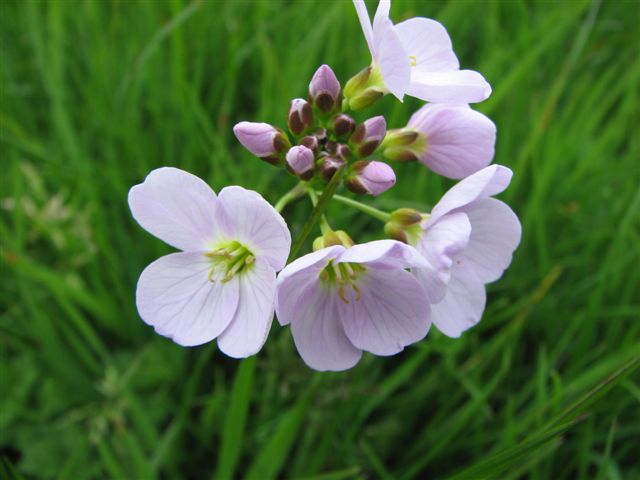
The OED’s earliest given quotation for pigsney is by Geoffrey Chaucer in his “Miller’s Tale,” which dates from around 1390. The explanatory notes to The Riverside Chaucer suggest that the word may have been a colloquial term for the cuckoo flower, also known as pig’s eye. This is a plausible suggestion. Chaucer uses the word to refer to Alison, the arch and pretty heroine of the tale, who is described in terms of robust rusticity:
But of hir song, it was as loude and yerne
As any swalwe sittynge on a berne.
Thereto she koude skippe and make game,
As any kyde or calf folwynge his dame.
Hir mouth was sweete as bragot or the meeth
Wynsynge she was, as is a joly colt.
Inclusion of country flowers would thus be appropriate to this obviously rural description of Alison. The Riverside Chaucer suggests primrose, cowslip or daisy for prymerole and the cuckoo flower for pigsney, and proposes that both words could have been used to mean “poppet.”
Given that the word has no equivalent in modern English, it is interesting to see how present-day editors and translators of Chaucer deal with it. A Cambridge University Press edition for students simply acknowledges the difficulty of translation and does not offer a meaning at all. However, it notes that the alliteration of prymerole with piggesnie “express[es] unreserved admiration for Alison’s sexual attractiveness, in words whose explosive initial letter helps to suggest her exciting effect.” The Norton edition of The Canterbury Tales takes an approach similar to that of the Riverside, glossing prymerole as primrose and piggesnye as cuckooflower, but without the extended explanation the Riverside edition offers. Peter Ackroyd, in his prose translation of The Canterbury Tales, also translates both words as flowers, but for some inexplicable reason uses rose and marigold. Neither of these is the appropriate flower, at least according to The Riverside Chaucer, but Ackroyd’s translation does retain the flavour of the countryside. Rose and marigold, however, suggest a slightly more cultivated countryside than primrose and cuckooflower. As Alison is portrayed as wild and unmanageable, the latter pairing of words is probably more appropriate.
According to the Riverside edition, pigsney “[a]s a term of endearment... is commonly recorded from time of Skelton [a1529] on.” It seems to have been a “‘low,’ or at least a very familiar term of endearment, suitable no doubt for a wenche.” This may be why the word gradually underwent pejoration, in the same way that wench itself did. Originally wench meant simply a young girl or serving woman of fairly humble status, but it later acquired the meaning of mistress, prostitute, or a woman of doubtful morals. Similarly, the connotation of pigsney gradually changed for the worse, so that by 1876 it appears in Dwale Bluth as “a certain ‘Traipsing, hautecking, kerping, pigsnie.’” The English Dialect Dictionary records a nineteenth century use “as a term of contempt for an immodest woman.” The word may also have acquired its negative connotations because of its association with pigs, animals which are popularly perceived to be greedy and unclean.
Mostly pigsney seems to have been applied to a woman, but the OED lists a few examples of it being used towards a man. The same definition is given as when directed towards a woman: one who is “specially cherished or beloved.” There seem to be no instances of it being used pejoratively towards a man. Johnson’s 1755 dictionary relates pigsney to piʒa, which he claims is the Anglo Saxon word for girl. This could explain why the term was used mainly towards women. However, no other evidence for this exists, and piʒa does not appear in Bosworth and Tollier’s An Anglo-Saxon Dictionary, or in any online dictionaries of Anglo-Saxon or Old English.
One other meaning of pigsney is recorded in the OED: the more prosaic one of “[a]n eye, especially a small one.” It was used in this sense by Oliver Goldsmith in his 1775 translation of Comic Romance:
The hostess received such a blow on her little pigs-nyes, that she saw a hundred thousand lights at the same time.
The more usual form for this meaning, however, seems to have been pig’s eyes, as the OED cites many more examples under the entry for this usage.
The OED records this use of pigsney as obsolete, archaic when referring to a man or boy, and rare when referring to a woman or girl. Judging from the quoted examples given in the OED, pigsney seems to have dropped out of usage sometime in the nineteenth or twentieth centuries. The word is now used only as a deliberate archaism or to add verisimilitude to historical fiction, as in Margaret Frazer’s 1993 novel The Servant’s Tale:
Piers lifted his head out of his nest again and asked, “Was Ellis in a fight again?”
“Hush, pigsney,” said Rose.
The vast majority of English speakers, however, will never have heard of the word.
Nevertheless, according to the OED, a derived phrase - in a pig’s eye - still exists as colloquial speech of some parts of the English speaking world, primarily in Australia and North America. It seems to be the only trace of the original pigsney to survive to the present day. The Dictionary of American Slang defines in a pig’s eye as a term of “vehement denial,” similar to the OED’s slightly extended definition of “a derisive retort expressing emphatic disbelief, rejection, or denial.” The Dictionary of American Slang also gives three variant, slightly more vulgar, forms of the expression: in a pig’s ass, in a pig’s asshole, in a pig’s ear. What relation, if any, the expression has to the original word pigsney is now uncertain, although it presumably derives from its abusive use.
Pigsney has had a long and varied history since its early appearance in “The Miller’s Tale.” Chaucer’s use of the word is not quite as a term of endearment, but rather to express appreciative approval of Alison’s sexuality. However, given the extreme and very conscious bawdiness of Chaucer’s tale, and the doubtful morals of all its characters, probably he would not be at all surprised could he see how the word has come to have decidedly negative connotations.
Works Cited
Ackroyd, Peter. The Canterbury Tales. London: Penguin Books, 2009.
“A.Word.A.Day - pigsney.” Wordsmith. Accessed Oct 11, 2013. http:// wordsmith.org/words/pigsney.html
Bosworth, Joseph, T. Northcote Toller, and A. Campbell. An Anglo-Saxon Dictionary, Based on the Manuscript Collections of the Late Joseph Bosworth. Edited and Enlarged by T. Northcote Toller. London: Oxford University Press, 1898.
Chaucer, Geoffrey. “The Miller’s Tale.” In The Riverside Chaucer, edited by F.N. Robinson, 68-77. Oxford: Oxford University Press, 1989.
Kipfer, Barbara Ann, and Robert L. Chapman, eds. Dictionary of American Slang, 4th ed. New York: HarperCollins Publishers, 2007.
Kolve, V.A., and Glending Olson, eds. The Canterbury Tales: Fifteen Tales and the General Prologue. New York: W.N. Norton & Company, 2005.
“Pig.” Oxford English Dictionary. Accessed Oct 11, 2013. http:// www.oed.com.ezproxy.auckland.ac.nz/view/Entry/143654#eid30637618.
“Pig’s eye.” Oxford English Dictionary. Accessed Oct 11, 2013, http:// www.oed.com.ezproxy.auckland.ac.nz/view/Entry/264214?.
“Pigsney.” A Dictionary of the English Language: A Digital Edition of the 1755 Classic by Samuel Johnson. Accessed Oct 11, 2013. http:// johnsonsdictionaryonline.com/?p=9929.
“Pigsney.” Oxford English Dictionary. Accessed Oct 11, 2013. http:// www.oed.com.ezproxy.auckland.ac.nz/view/Entry/143742?redirectedFrom=pigsney#eid.
Robinson R.N. Explanatory notes to The Riverside Chaucer, 795-1116. Oxford: Oxford University Press, 1989.
Winny, James. Explanatory notes to The Miller’s Prologue and Tale, 55-84. Cambridge: Cambridge University Press, 2007.
She was a prymerole, a piggesnye.
- Chaucer, “The Miller’s Tale.”
This essay examines the history, etymology and usage of the word pigsney from its early usage in Chaucer's “Miller's Tale” to the present day. Although the word has now dropped out of common usage, a derived phrase (In a pig's eye) still exists in some English-speaking regions. Originally, pigsney was a term of endearment; later the connotation changed and it became a term of abuse.
The literal meaning of pigsney is simply “pig’s eye.” The word, which dates from Middle English, was formed by adding the -s genitive form of pig to nye (a variant of eye). Several variations on the spelling are recorded in the Oxford English Dictionary. The most common variation on pigsney is doubling of the central consonant g and the addition of a final schwa, as in Chaucer’s use of the word. Over time the final schwa has been lost and the double g collapsed to a single one.
The current pronunciation is [pɪɡzni]. In Chaucer’s time, prior to the Great Vowel Shift, the main vowel would have been pronounced [i]. The final schwa would also have been pronounced in Middle English.
The OED suggests that pigsney “originate[d] in children’s talk or as a nursery endearment.” In truth, however, the word’s source and original meaning is now lost. As the OED admits, “[t]he semantic motivation for the compound is uncertain and disputed.” Why the word was ever used to express endearment is also debatable, as the image of a pig’s eye is not a particularly flattering one. Ultimately, most of the discussion around the history and usage of the word, though intriguing, is surmise and guesswork.
The OED’s earliest given quotation for pigsney is by Geoffrey Chaucer in his “Miller’s Tale,” which dates from around 1390. The explanatory notes to The Riverside Chaucer suggest that the word may have been a colloquial term for the cuckoo flower, also known as pig’s eye. This is a plausible suggestion. Chaucer uses the word to refer to Alison, the arch and pretty heroine of the tale, who is described in terms of robust rusticity:
But of hir song, it was as loude and yerne
As any swalwe sittynge on a berne.
Thereto she koude skippe and make game,
As any kyde or calf folwynge his dame.
Hir mouth was sweete as bragot or the meeth
Wynsynge she was, as is a joly colt.
Inclusion of country flowers would thus be appropriate to this obviously rural description of Alison. The Riverside Chaucer suggests primrose, cowslip or daisy for prymerole and the cuckoo flower for pigsney, and proposes that both words could have been used to mean “poppet.”
Given that the word has no equivalent in modern English, it is interesting to see how present-day editors and translators of Chaucer deal with it. A Cambridge University Press edition for students simply acknowledges the difficulty of translation and does not offer a meaning at all. However, it notes that the alliteration of prymerole with piggesnie “express[es] unreserved admiration for Alison’s sexual attractiveness, in words whose explosive initial letter helps to suggest her exciting effect.” The Norton edition of The Canterbury Tales takes an approach similar to that of the Riverside, glossing prymerole as primrose and piggesnye as cuckooflower, but without the extended explanation the Riverside edition offers. Peter Ackroyd, in his prose translation of The Canterbury Tales, also translates both words as flowers, but for some inexplicable reason uses rose and marigold. Neither of these is the appropriate flower, at least according to The Riverside Chaucer, but Ackroyd’s translation does retain the flavour of the countryside. Rose and marigold, however, suggest a slightly more cultivated countryside than primrose and cuckooflower. As Alison is portrayed as wild and unmanageable, the latter pairing of words is probably more appropriate.
According to the Riverside edition, pigsney “[a]s a term of endearment... is commonly recorded from time of Skelton [a1529] on.” It seems to have been a “‘low,’ or at least a very familiar term of endearment, suitable no doubt for a wenche.” This may be why the word gradually underwent pejoration, in the same way that wench itself did. Originally wench meant simply a young girl or serving woman of fairly humble status, but it later acquired the meaning of mistress, prostitute, or a woman of doubtful morals. Similarly, the connotation of pigsney gradually changed for the worse, so that by 1876 it appears in Dwale Bluth as “a certain ‘Traipsing, hautecking, kerping, pigsnie.’” The English Dialect Dictionary records a nineteenth century use “as a term of contempt for an immodest woman.” The word may also have acquired its negative connotations because of its association with pigs, animals which are popularly perceived to be greedy and unclean.
Mostly pigsney seems to have been applied to a woman, but the OED lists a few examples of it being used towards a man. The same definition is given as when directed towards a woman: one who is “specially cherished or beloved.” There seem to be no instances of it being used pejoratively towards a man. Johnson’s 1755 dictionary relates pigsney to piʒa, which he claims is the Anglo Saxon word for girl. This could explain why the term was used mainly towards women. However, no other evidence for this exists, and piʒa does not appear in Bosworth and Tollier’s An Anglo-Saxon Dictionary, or in any online dictionaries of Anglo-Saxon or Old English.
One other meaning of pigsney is recorded in the OED: the more prosaic one of “[a]n eye, especially a small one.” It was used in this sense by Oliver Goldsmith in his 1775 translation of Comic Romance:
The hostess received such a blow on her little pigs-nyes, that she saw a hundred thousand lights at the same time.
The more usual form for this meaning, however, seems to have been pig’s eyes, as the OED cites many more examples under the entry for this usage.
The OED records this use of pigsney as obsolete, archaic when referring to a man or boy, and rare when referring to a woman or girl. Judging from the quoted examples given in the OED, pigsney seems to have dropped out of usage sometime in the nineteenth or twentieth centuries. The word is now used only as a deliberate archaism or to add verisimilitude to historical fiction, as in Margaret Frazer’s 1993 novel The Servant’s Tale:
Piers lifted his head out of his nest again and asked, “Was Ellis in a fight again?”
“Hush, pigsney,” said Rose.
The vast majority of English speakers, however, will never have heard of the word.
Nevertheless, according to the OED, a derived phrase - in a pig’s eye - still exists as colloquial speech of some parts of the English speaking world, primarily in Australia and North America. It seems to be the only trace of the original pigsney to survive to the present day. The Dictionary of American Slang defines in a pig’s eye as a term of “vehement denial,” similar to the OED’s slightly extended definition of “a derisive retort expressing emphatic disbelief, rejection, or denial.” The Dictionary of American Slang also gives three variant, slightly more vulgar, forms of the expression: in a pig’s ass, in a pig’s asshole, in a pig’s ear. What relation, if any, the expression has to the original word pigsney is now uncertain, although it presumably derives from its abusive use.
Pigsney has had a long and varied history since its early appearance in “The Miller’s Tale.” Chaucer’s use of the word is not quite as a term of endearment, but rather to express appreciative approval of Alison’s sexuality. However, given the extreme and very conscious bawdiness of Chaucer’s tale, and the doubtful morals of all its characters, probably he would not be at all surprised could he see how the word has come to have decidedly negative connotations.
Works Cited
Ackroyd, Peter. The Canterbury Tales. London: Penguin Books, 2009.
“A.Word.A.Day - pigsney.” Wordsmith. Accessed Oct 11, 2013. http:// wordsmith.org/words/pigsney.html
Bosworth, Joseph, T. Northcote Toller, and A. Campbell. An Anglo-Saxon Dictionary, Based on the Manuscript Collections of the Late Joseph Bosworth. Edited and Enlarged by T. Northcote Toller. London: Oxford University Press, 1898.
Chaucer, Geoffrey. “The Miller’s Tale.” In The Riverside Chaucer, edited by F.N. Robinson, 68-77. Oxford: Oxford University Press, 1989.
Kipfer, Barbara Ann, and Robert L. Chapman, eds. Dictionary of American Slang, 4th ed. New York: HarperCollins Publishers, 2007.
Kolve, V.A., and Glending Olson, eds. The Canterbury Tales: Fifteen Tales and the General Prologue. New York: W.N. Norton & Company, 2005.
“Pig.” Oxford English Dictionary. Accessed Oct 11, 2013. http:// www.oed.com.ezproxy.auckland.ac.nz/view/Entry/143654#eid30637618.
“Pig’s eye.” Oxford English Dictionary. Accessed Oct 11, 2013, http:// www.oed.com.ezproxy.auckland.ac.nz/view/Entry/264214?.
“Pigsney.” A Dictionary of the English Language: A Digital Edition of the 1755 Classic by Samuel Johnson. Accessed Oct 11, 2013. http:// johnsonsdictionaryonline.com/?p=9929.
“Pigsney.” Oxford English Dictionary. Accessed Oct 11, 2013. http:// www.oed.com.ezproxy.auckland.ac.nz/view/Entry/143742?redirectedFrom=pigsney#eid.
Robinson R.N. Explanatory notes to The Riverside Chaucer, 795-1116. Oxford: Oxford University Press, 1989.
Winny, James. Explanatory notes to The Miller’s Prologue and Tale, 55-84. Cambridge: Cambridge University Press, 2007.
 |
| via |
.JPG) |
| via |
Wednesday, 23 September 2015
Unpacking Sir Gawain and the Green Knight
Great wonder grew in hall
At his hue most strange to see,
For man and gear and all
At his hue most strange to see,
For man and gear and all
Were green as green could be.
Sir Gawain and the Green Knight (or SGGK as students of the poem abbreviate it) is one of my favourite poems. I love the force, rhythm and richness of the language, the vivid descriptions, and the characters - the mysterious, magical Green Knight and, well, who couldn't like Sir Gawain?
The poem is from the late fourteenth century, written in the dialect of the West Midlands. The author of the poem is, like many medieval authors, unknown. Whoever it was is usually identified as the 'Pearl Poet' because the poem Pearl is thought to have been written by the same person.
Because the poem contains long and quite detailed descriptions of the natural landscape, scholars have tried to map the poem onto the Midland countryside, trying to identify the exact locations described in the poem. This is a fairly hopeless undertaking and every scholar will have their own pet theory. Generally speaking, the poem is set somewhere in the Cheshire/Staffordshire/Derbyshire region, though Gawain's quest also takes him down into North Wales.
The poem is written in the alliterative style, which means that within each line there are at least three, sometimes more, words beginning with the same initial letter:
Ye may be seker bi this braunch that I bere here
That I passe as in pes, and no plycht seche.
Pearl manages to achieve the very difficult task of making the lines both alliterative and rhyming. Sir Gawain's rhyme scheme is much looser, almost to the point of being non-existant. This makes the verse flow much more freely. With alliteration and rhyme, the verse becomes quite stilted. Sir Gawain's verse flows more melodically and litingly than Pearl's.
The poem is divided into four 'fyttes' (usually modernised to 'fitt'), or parts. Within each fitt the verse is further broken up by bob-and-wheel structures. These bring each stanza to a conclusion - the bob-and-wheel is the poetical equivalent of tying the stanza up with a neat bow.
The bob-and-wheel is a set of five lines much shorter than the preceeding lines of the stanza. The bob is a very short line that seems to 'hang' off the rest of the stanza. The wheel is alliterative but also rhymes with the bob:
Such a fole upon folde, ne freke that hym rydes,
Was never sene in that sale wyth syght er that tyme, (last couplet of stanza)
with yye. (bob)
He loked as layt so lyght (wheel)
So sayed al that hym syye;
Hit semed as no mon mught
Under his dynttes dryye.
As far as readability goes, the Middle English of Sir Gawain is reasonably heavy going, although using a well-glossed edition makes it much easier (I have an old 1970 Everyman edition). But there are several translations of the poem available - two of the best are Marie Borroff's and Simon Armitage's. I used the Norton Critical edition of Marie Borroff's version when I was working on the poem last year.
Simon Armitage has also done a very good documentary on the poem:
There is a further host of info on the poem over at the Luminarium website: http://www.luminarium.org/medlit/gawain.htm
And the story of the poem? That is something you will have to find out for yourselves!
Opening quote from Marie Borroff, ed. and trans., Sir Gawain and the Green Knight (New York, London: W.W. Norton, 2010), l.147-50.
Middle English quotes from Pearl, Sir Gawain and the Green Knight, edited by A.C. Cawley (London: Everyman, 1970).
Friday, 18 September 2015
English: a very rough guide
When people ask what my thesis is in and I say 'Middle English,' there are two types of response (discounting the blank stare which is far and away the most common):
1. "Oh... Shakespeare!"
2. "Oh... really old English!"
Not quite. Middle English is neither Shakespearean English nor Old English. Middle English is... well, somewhere in the middle!
This is my own rough guide to the development of English over the last thousand years or so. The period boundaries are fluid - Old English did not become Middle English overnight, for example - and within each period there will be a lot of variation as well. Thirteenth century Middle English is quite different from that of the fifteenth century. Before the invention of the printing press (around 1440), which started the process of standardisation in spelling and vocabulary, there were also huge dialectal variations (northern, southern, midland, and Anglian are the main ones) within the language. The first recorded instance of a southerner making fun of the northern English accent is in Chaucer's Reeve's Tale.
Old English (OE): pre-Norman conquest (1066). To someone unused to it, impossible to read.
Hwæt! We Gar-Dena in gear-dagum
þeod-cyninga, þrym gefrunon,
hu ða æþelingas ellen fremedon!
First three lines of Beowulf. Translated into modern English, they read:
What were we War-Danes in our yore-days?
Tribal-Kings! Truly cast that glory past,
how the counts had courage vast!
Via http://www.csun.edu/~ceh24682/beowulf.html
Middle English (ME): from the Conquest to the end of the Plantagenets (Richard III, died 1485, was the last Plantagenet king). Once you work out that þ (thorn) = th, v = u and ȝ (yogh) = y it is surprisingly easy to read, especially if you use editions in modern spelling.
Al men þat walkis by waye or strete,
Take tente ȝe schalle no trauayle tyne.
Byholdes myn heede, myn handis, and my fete,
And fully feele nowe, or ȝe fyne,
Yf any mournyng may be meete,
Or myscheue mesured vnto myne.
Crucifixio Christi l.253-8, in The York Plays, edited by Richard Beadle (Oxford: Early English Text Society for Oxford University Press, 2009).
All men that walk by way or street,
Take tent ye shall no travail tine.
Behold mine head, mine hands, and my feet,
And fully feel now, ere ye fine,
If any mourning may be meet,
Or mischief measured unto mine.
Crucifixion l.253-8, in York Mystery Plays: A Selection in Modern Spelling, edited by Richard Beadle and Pamela King (Oxford: Oxford University Press. 2009).
All you men who walk by in the street,
Take heed and notice My suffering!
Behold My head, My hands, and My feet,
And consider well, before you pass on,
If any sorrow can match,
Or any misfortune compare to Mine.
The first passage (part of Christ's speech from the cross in the York Crucifixion play) is Middle English in its original spelling, the second is Middle English but in modern spelling, and the third is 'translated' into modern English.
Early Modern English (EME): from the Tudors (Henry VII was the first Tudor king) to the restoration of the monarchy in 1660, thus encompassing the entire Tudor period, the Elizabethans, Jacobeans, and the period of the Civil War. This is the language of Shakespeare.
If music be the food of love, play on;
Give me excess of it, that surfeiting,
The appetite may sicken and so die.
That strain again, it had a dying fall;
O it came o'er my ear like the sweet sound
That breathes upon a bank of violets,
Stealing and giving odour.
William Shakespeare, Twelfth Night I.I.1-7, edited by Rex Gibson (Cambridge: Cambridge University Press, 2007).
Modern English (sometimes New English or NE): from the mid-seventeenth century onwards.
It is a truth universally acknowledged, that a single man in possession of a good fortune, must be in want of a wife.
However little known the feelings or views of such a man may be on his first entering a neighbourhood, this truth is so well fixed in the minds of the surrounding families, that he is considered as the rightful property of some one or other of their daughters.
Jane Austen, Pride and Prejudice [1813], edited by Vivien Jones (London: Penguin Books, 1996), 5.
Present Day English (PDE) is, like, what we speak now, innit? c u l8r!
1. "Oh... Shakespeare!"
2. "Oh... really old English!"
Not quite. Middle English is neither Shakespearean English nor Old English. Middle English is... well, somewhere in the middle!
This is my own rough guide to the development of English over the last thousand years or so. The period boundaries are fluid - Old English did not become Middle English overnight, for example - and within each period there will be a lot of variation as well. Thirteenth century Middle English is quite different from that of the fifteenth century. Before the invention of the printing press (around 1440), which started the process of standardisation in spelling and vocabulary, there were also huge dialectal variations (northern, southern, midland, and Anglian are the main ones) within the language. The first recorded instance of a southerner making fun of the northern English accent is in Chaucer's Reeve's Tale.
Old English (OE): pre-Norman conquest (1066). To someone unused to it, impossible to read.
Hwæt! We Gar-Dena in gear-dagum
þeod-cyninga, þrym gefrunon,
hu ða æþelingas ellen fremedon!
First three lines of Beowulf. Translated into modern English, they read:
What were we War-Danes in our yore-days?
Tribal-Kings! Truly cast that glory past,
how the counts had courage vast!
Via http://www.csun.edu/~ceh24682/beowulf.html
Middle English (ME): from the Conquest to the end of the Plantagenets (Richard III, died 1485, was the last Plantagenet king). Once you work out that þ (thorn) = th, v = u and ȝ (yogh) = y it is surprisingly easy to read, especially if you use editions in modern spelling.
Al men þat walkis by waye or strete,
Take tente ȝe schalle no trauayle tyne.
Byholdes myn heede, myn handis, and my fete,
And fully feele nowe, or ȝe fyne,
Yf any mournyng may be meete,
Or myscheue mesured vnto myne.
Crucifixio Christi l.253-8, in The York Plays, edited by Richard Beadle (Oxford: Early English Text Society for Oxford University Press, 2009).
All men that walk by way or street,
Take tent ye shall no travail tine.
Behold mine head, mine hands, and my feet,
And fully feel now, ere ye fine,
If any mourning may be meet,
Or mischief measured unto mine.
Crucifixion l.253-8, in York Mystery Plays: A Selection in Modern Spelling, edited by Richard Beadle and Pamela King (Oxford: Oxford University Press. 2009).
All you men who walk by in the street,
Take heed and notice My suffering!
Behold My head, My hands, and My feet,
And consider well, before you pass on,
If any sorrow can match,
Or any misfortune compare to Mine.
The first passage (part of Christ's speech from the cross in the York Crucifixion play) is Middle English in its original spelling, the second is Middle English but in modern spelling, and the third is 'translated' into modern English.
Early Modern English (EME): from the Tudors (Henry VII was the first Tudor king) to the restoration of the monarchy in 1660, thus encompassing the entire Tudor period, the Elizabethans, Jacobeans, and the period of the Civil War. This is the language of Shakespeare.
If music be the food of love, play on;
Give me excess of it, that surfeiting,
The appetite may sicken and so die.
That strain again, it had a dying fall;
O it came o'er my ear like the sweet sound
That breathes upon a bank of violets,
Stealing and giving odour.
William Shakespeare, Twelfth Night I.I.1-7, edited by Rex Gibson (Cambridge: Cambridge University Press, 2007).
Modern English (sometimes New English or NE): from the mid-seventeenth century onwards.
It is a truth universally acknowledged, that a single man in possession of a good fortune, must be in want of a wife.
However little known the feelings or views of such a man may be on his first entering a neighbourhood, this truth is so well fixed in the minds of the surrounding families, that he is considered as the rightful property of some one or other of their daughters.
Jane Austen, Pride and Prejudice [1813], edited by Vivien Jones (London: Penguin Books, 1996), 5.
Present Day English (PDE) is, like, what we speak now, innit? c u l8r!
Monday, 22 June 2015
Etymology according to the Telegraph
10 words you didn't know were derived from 'father'
 |
| https://s-media-cache-ak0.pinimg.com/236x/ca/33/17/ca33177bb4fd56d139fc73b906ac0972.jpg |
Making Paternoster (rosary) beads in the Middle Ages
Subscribe to:
Posts (Atom)