Showing posts with label thesis work. Show all posts

Thursday, 26 May 2016

Corpus Christi

                             Laudus thema specialis,                             
Panus vivus et vitalis
Hodie proponitur.
Quem in sacrae mensa caenae,
Turbae fratrum duodenae
Datum non ambigitur.
Sit laus plena, sit sonora,
Sit jucunda, sit decora
Mentis jubilatio.
Dies enim solemnis agitur,
In quae mensae prima recolitur
Hujus institutio.

From Lauda Sion (sequence for Corpus Christi Mass), written by Thomas Aquinas c. 1264.

Today is Corpus Christi, the feast of Christ's Body and Blood. This feast is not a fixed one but varies with the date of Easter; it is celebrated on the Thursday after Trinity Sunday and therefore falls between late May and late June.

During the English Middle Ages this feast was one of the most important on the liturgical calendar, probably because it falls very close to Midsummer, when people are in the mood for festival and celebration. English weather being what it is, this is also most likely why it was the feastday with which the mystery play cycles - performed outdoors and needing sixteen or more hours of daylight - came to be associated. York, Chester and Coventry all had play cycles which were performed every year on, or very close to, the Corpus Christi feast.

Pope Urban IV had established the feast in 1264, but it was first celebrated in England only in the early fourteenth century. When it did arrive, however, the feast seems very quickly to have been incorporated into medieval English religious and even national identity. (Even today the feast is still one of England's traditional Holy Days of Obligation.)

Throughout the Middle Ages, devotion to the body of Christ - both as Eucharist and the human body which suffered on the cross - was intense. This devotion to Christ’s body and the significance which it held as metaphor, symbol and Eucharistic reality in (most of) medieval English society has been well documented by scholars including Miri Rubin, Sarah Beckwith and Tony Corbett. The idea of the body as a metaphor for a unified society goes back to Aristotle, but was enthusiastically adopted by what Beckwith has called “medieval political theorists.”1
This image brings together the two aspects of the Body of Christ that so fascinated the Middle Ages - the Eucharist, consecrated here by the priest at Mass, and the human body of Christ which suffered on the cross. As the priest holds up the Host towards the Crucifix, the two are visually linked, a powerful image which was repeated during every Mass at the Elevation of the Host. At the Elevation, the Lay Folks Mass Book instructs the people to "knelande holde vp both þi handes,/And so þo leuacioun pou be-halde,/for þat is he þat iudas salde,/and sithen was scourged & don on rode"2 - an instruction which explicitly describes the relationship between the Crucifixion and the Host. Image via

The image of the body of Christ was invoked and “presented by the official church of the late Middle Ages as a unifying symbol;”3 Christ Himself was seen as “the bringer of unity.”4 Yet, paradoxically, Christ’s body was at the same time yet a source of conflict and discord, “the arena where social identity was negotiated, where the relationship of self and society, subjectivity and social process found a point of contact and conflict.”5 The metaphor of Christ’s body for the wholeness of society was fractured and splintered by different groups who each sought to claim Christ as their own. The Peasants’ Revolt, for example, “was based around identification with the figura of Christ, seeing in him a poor peasant like them.”6

Throughout the York mystery play cycle, the fracturing of Christ’s body, both metaphorically and literally, happens again and again: the Corpus Christi is the cycle’s overarching concern, holding it together as a united entity, but the different pageants of the various guilds focus on how one particular aspect of it relates to each guild’s own (worldly) identity, interests and concerns. Thus the Mercers’ Doomsday is concerned with buying and selling; in the Bakers’ Last Supper the guild’s commercial product, bread, is linked none-too-subtly with the consecrated bread of the Last Supper and of the Mass; the Pinners’ Crucifixio has the guild members, in their roles as the soldiers nailing Christ to the cross, performing and discussing their own craft, tools and materials. 

Given that the Corpus Christi feast centres on transubstantiation, the most important tenet of Catholic belief and the essential difference between Catholicism and Protestantism, the feast was (unsurprisingly) attacked during the English Reformation. Under Edward IV the feast was abolished in 1548. The York Corpus Christi plays managed to survive until 1569, albeit with censorship; many of the pageants focusing the Virgin Mary were censored or repressed, and those dealing with explicitly Catholic doctrine were also selectively 'edited.' This happened with the York Last Supper pageant - the manuscript leaf containing the play's central episode is now mysteriously missing! With the page gone, there is of course no way of saying with certainty what it contained. But, given the closeness with which the other pageants in the cycle follow their scriptural and liturgical counterparts, it is highly likely that the missing page, which occurs precisely where we would expect Christ’s performance of the transubstantiation to occur in the sequence of the play, ran along the lines of:

... this is My Body which shall be delivered for you; this do for the commemoration of Me... This chalice is the new testament in My blood; this do ye, as often as you shall drink, for the commemoration of Me. For as often as you shall eat this bread, and drink this chalice, you shall show the death of the Lord until He come. Therefore whosoever shall eat this bread, or drink of the chalice of the Lord unworthily, shall be guilty of the body and blood of the Lord

 - which are the words of the Epistle in the Corpus Christi feastday Mass.

Footnotes
1. Sarah Beckwith, Christ’s Body: Identity, Culture, and Society in Late Medieval Writings (London, New York: Routledge, 1993), 27.
2. "Kneeling, hold up both thy hands,/And so behold the elevation,/For that is He that Judus sold,/and after was scourged and died on the cross [rood]."
3. Tony Corbett, The Laity, the Church and the Mystery Plays: A Drama of Belonging (Dublin: Four Courts Press, 2009), 199.
4. Ibid., 201.
5. Beckwith, Christ’s Body, 22.
6. Corbett, The Laity, the Church, and the Mystery Plays, 198.

This post contains material adapted from Chapter 1.2 of my MA thesis.

Tuesday, 22 March 2016

The Lay Folks Mass Book

After spending more than a year working with the university library's well-loved (read: decrepit and dog-eared) copy of the Lay Folks [no, there is no apostrophe] Mass Book, I finally have my own new and beautiful edition, in celebration of having finished my thesis:

 
The Lay Folks Mass Book, usually abbreviated to LFMB, is probably the most well-known of the medieval treatises on the Mass. Several of these treatises were produced in order to help the lay congregation follow the progression of the rite.

The LFMB was most likely translated into English from French in the latter half of the twelfth century. The text is important not only for what it reveals about the devotions of lay people at Mass but because it may have a local connection with York. Thomas Simmons, the original 1879 editor of the LFMB, decided that the text was originally translated into a northern English dialect (then, later, into Midland and Southern forms) and that the "Dan Jeremy" mentioned as author in two of the manuscripts may be the Jeremy who was Archdeacon of Cleveland (in the York diocese) by 1171. Unfortunately this theory can never be proved, but it is not unreasonable.

Unlike modern missals, the LFMB is not a translation or explanation of the Mass prayers and rubrics. Instead it is a set of vernacular prayers which encourage the reader to meditate on the benefits of the Mass and the Crucifixion. The basic structure of the Mass is traceable - I was quite easily able to follow a modern-day Tridentine Mass (the form in which the Mass was celebrated throughout the Middle Ages) using the LFMB as people today use a missal. The Confiteor, Gloria, Creed and Pater Noster are given in the text as (slightly corrupted) translations of their Latin versions, but the other prayers, though their intentions do roughly match those offered by the priest, are not translations of the Latin Mass prayers. Much of the book is taken up with identifying the priest’s actions, which function as cues either for private meditation (usually on the Crucifixion) or for the saying of private prayers, conveniently provided. 


The LFMB tends to become rather repetitive, as it reduces the continuous action of the Mass to specific, easily identifiable points in the liturgy. These serve as triggers for recalling the congregation to contemplation of Christ’s Passion, and as reminders for the people to say the appropriate prayer - nothing more. It does not encourage the people to progress beyond this basic level of response to the liturgy. 

However, that the book exists at all suggests that there was some expectation to involve the congregation with the Mass - to give them a role, or, at the very least, a set of signals through which they could follow what was happening at the altar. It indicates a medieval concern over how to include the congregation - or audience - and how to shape their experience. As these are issues that also concern a playwright, these cues, which do function rather in the manner of stage directions, are what gave me the idea that the Mass rite can be examined from a dramatic viewpoint, and therefore compared and contrasted with conventional drama. Since the Passion plays of the York mystery cycle are very closely aligned (in form, structure and language) with the liturgy and with the Mass, I started to look more closely at where and how the two are linked, and where and how they differ. This was the starting point of my thesis.

Some of the important 'cues' pin-pointed in the LFMB are:
  • the movement of the priest (or deacon) to the left-hand side of the altar for the reading of the Gospel, a signal for the congregation to “speke... noght/bot thenk on him that dere the boght” [speak not,/But think on Him (Christ) that thee dearly bought]
  • the Elevation of the Host, signalled by "a litel belle men oyse to ryng" [a little bell men use to ring]. The correct response to this signal was to "knelande holde vp both þi handes, /And so þo leuacioun þou be-halde" [kneeling, hold up both thy hands,/And so behold the elevation]
  • The priest's "spred[ing] of his arms on brade" [in the form of a cross], recalled not only the Crucifixion but also signified the “tyme to praye for the dede” [the time to pray for the dead]
  • The Pater Noster said by the priest, indicating that the Kiss of Peace was approaching, when the congregation kissed the pax (a little plaque of ivory or metal) handed round to them at the altar rails. [The medieval Kiss of Peace has an interesting and somewhat chequered history, but this shall be saved for another post!] 
One final note: for those of you who use the Father Lasance missal, the LFMB is mentioned in the introduction. See if you can find it!

Sunday, 20 March 2016

Palm Sunday | The Entry Into Jerusalem

via

JESUS:   To me takis tent and giffis gud hede,
My dere discipulis that ben here,
I schall you telle that shal be indede;
My tyme to passe hense, it drawith nere,
And by this skill
Mannys sowle to save fro sorowes sere
That loste was ill.

From heven to erth whan I dyssende
Rawnsom to make I made promys,
The prophicie nowe drawes to ende;
My Fadirs wille forsoth it is
That sente me hedyr.
Petir, Phelippe, I schall you blisse
And go togedir

Unto yone castell that is you agayne,
Gois with gud harte and tarie noght,
My comaundement to do be ye bayne.
Also I you charge loke it be wrought
That schal ye fynde
An asse, this feste als ye had soght,
Ye hir unbynde

With hir foole, and to me hem bring
That I on hir may sitte a space
So the prophicy clere menyng
May be fulfilled here in this place:
“Doghtyr Syon,
Loo, thi Lorde comys rydand on an asse,
Thee to opon.” (The Entry Into Jerusalem l.1-28)


The York play of the Entry into Jerusalem was performed by the Skinners' Guild. The 'yon castell' referred to by Jesus is probably Clifford's Tower, which stands in the centre of the city, providing a well-known landmark. This fleeting moment both brings together historical and present time within the play and also hints at how inextricably the York play cycle as a whole was linked with the geography and architecture of the city.

The play concludes with the citizens of Jerusalem welcoming Christ into their city:

Hayll, domysman dredfull, þat all schall deme,
Hayll, [þat all] quyk and dede schall lowte,
Hayll, whom worschippe moste will seme,
Hayll, whom all thyng schall drede and dowte.
We welcome þe;
Hayll, and welcome of all abouwte,
To owre ceté. (l.538-44)
The structure of the play is, as Beadle and King point out, very close to a medieval royal welcome: 

the tableau at the end [of the play], with its ordered arrangement of formal greetings, suggests that the dramatist had in mind the conventions of the contemporary royal entry into the medieval town. In the last lines of the play, the local audience must have had a strong sense that the King of Heaven was being welcomed as much to medieval York as to the biblical Jerusalem.
(Beadle and King, introduction to The Entry Into Jerusalem, in York Mystery Plays: A Selection in Modern Spelling (Oxford: Oxford University Press, 2009), 106.) 

They also note that "Jesus must have ridden on the ass in the street amongst the audience, who were thus deftly drawn into the illusion of the play, and given a role as the crowd that lined the route into Jerusalem" (ibid.) As with the earlier reference to the castle, Biblical and contemporary time, the sacred (the subjects dealt with in the plays) and the secular (the city of York) are brought together. For the plays' original audiences, Biblical events, happenings and locations were blended with what was for them modern-day York, intertwining them until they became virtually indistinguishable.

Yf any man will you gaynesaye,
Say that youre Lorde has nede of tham
And schall restore thame this same day
Unto what man will tham clayme.
 

Saturday, 20 February 2016

Hubberholme medieval rood screen


This is one of only two surviving medieval rood screens and rood lofts in the north of England (the other is at Flamborough, East Yorkshire). All pre-Reformation churches had a rood screen running across the top of the nave, thus separating the nave (where the congregation gathered) from the chancel (where the altar is). During the Reformation the screens were seen as a barrier preventing the people from participating fully in the rituals occurring on the altar and were all systematically destroyed.

Rood screens are a late medieval development; before the rood screen was the chancel screen, which developed as a form of protection for the Blessed Sacrament after the Fourth Lateran council (1215) declared this to be truly the Body and Blood of Christ. A medieval rood screen

consisted of three levels. The lowest was formed of solid panels, used normally for the exhibition of religious pictures. At Bignor, Cherry Hinton [both in southern England] and elsewhere, the panels were pierced by apertures; these probably allowed kneeling children to view the ritual in the chancel. The middle level was a row of open and usually traceried windows. These, too, afforded parishioners in the nave a sight of the high altar. [...] The uppermost level... supported the rood loft. (Robert Whiting, The Reformation of the English Parish Church (Cambridge: Cambridge University Press, 2010), 9.

'Rood' is simply the Old English word for a crucifix, the most important furnishing in any medieval church. This was originally hung from the chancel arch but over time became incorporated into the chancel screen, which then became known as the rood screen.

Close up view of the rood loft, which would originally have incorporated an full and almost life-size Crucifixion scene

People in the Middle Ages never did anything by halves, so the crucifix would have been almost life-size and usually flanked by the figures of the Sorrowful Mother and St John. The figures at Hubberholme have long been lost, but they would have looked something like this:

This is the 19th-century reconstructed rood screen in All Saints North Street, York
Hubberholme rood loft from the chancel side
The Hubberholme rood loft (medieval equivalent of a choir loft) now lacks its floor boards ('elf and safety would never approve!).

The church, named St Michael and All Angels (not to be confused with the two other churches in the near vicinity unimaginatively named St Michael and All Angels too), is also famous (locally at least) for having the graveyard where JB Priestly's ashes were buried, and for housing some of the handiwork of Robert Thompson, the "Mouseman of Kilburn." He was the wood carver who made the church pews; his 'signature' was a little mouse:


The church now sells little knitted mice; this is my one, named Nicholas, after one of the people in my thesis :D


Photographs of Hubberholme church by Peter and Sebastian.

Church website: http://www.achurchnearyou.com/hubberholme-st-michael-all-angels/

Tuesday, 29 December 2015

Thomas à Becket

              ... from every shires ende
Of Engelond to Canterbury they wende,
The holy blisful martir for to seke,
That hem hath holpen, whan that they were seke. 
      - Canterbury Tales, General Prologue

Canterbury, Canterbury, Thomas à Becket, everybody loves a martyr!
      - Sheriff Vaisey, BBC Robin Hood, 2006.

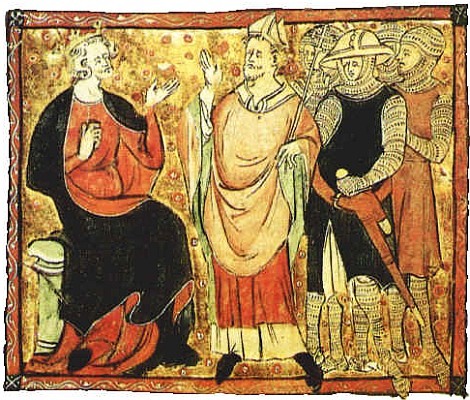
Today is, as every inhabitant of the Middle Ages would have known, the feast day of Thomas à Becket, Archbishop of Canterbury, killed in Canterbury Cathedral on 29th December 1170 by four knights of Henry II. The king and the Archbishop had been at odds as to whether the king had jurisdiction over the church. According to legend, when the Archbishop refused to sign the Constitutions of Clarendon, which would have restricted ecclesiastical powers, Henry cried "Who will rid me of this troublesome priest?" - an invitation which the four knights took literally.

Henry II and Thomas à Becket, via

This is an eyewitness account of the Archbishop's murder, by one Edward Grim, displaying the usual medieval flair for the dramatic:

...The wicked knight leapt suddenly upon [the Archbishop], cutting off the top of the crown which the unction of sacred chrism had dedicated to God. Next he received a second blow on the head, but still he stood firm and immovable. At the third blow he fell on his knees and elbows, offering himself a living sacrifice, and saying in a low voice, 'For the name of Jesus and the protection of the Church, I am ready to embrace death.' But the third knight inflicted a terrible wound as he lay prostrate. By this stroke, the crown of his head was separated from the head in such a way that the blood white with the brain, and the brain no less red from the blood, dyed the floor of the cathedral. The same clerk who had entered with the knights placed his foot on the neck of the holy priest and precious martyr, and, horrible to relate, scattered the brains and blood about the pavements, crying to the others, 'Let us away, knights; this fellow will arise no more...

Thomas was immediately hailed as a martyr and the King was not popular (he later performed public penance - whether out of genuine remorse or political astuteness is debatable...) The Archbishop's tomb quickly became a drawcard for pilgrims (the medieval equivalent of tourists!) - famously, the pilgrims in the Canterbury Tales are all on their way to the shrine of St Thomas.

The site of Becket's murder in Canterbury Cathedral, via

Thanks almost solely to Thomas à Becket, medieval Canterbury became the pilgrimage capital of England. This seems rather to have annoyed its northern counterpart, York; for most of the Middle Ages there was a rather undignified struggle between the two sees, each seeking supremacy and one-upmanship over the other. Rivalry between the north and south of England appears to go a long way back!

If Canterbury's pet saint was Archbishop Thomas, York's was Archbishop William, who died in 1154 (reportedly from poisoned wine in his chalice). Following his burial in York Minster, rumours of miracles abounded, including the miraculous preservation of his body in one of the Minster's many fires (a miracle which was later mirrored almost exactly at Canterbury with St Thomas' body). William's cult, however, only really took off from the 1170s onward - at exactly the time of Thomas à Becket's murder and the outpouring of veneration which followed.

It is probable, however, that the sudden renewed interest in St William at York was not coincidence at all, and that York began to play up its association with William in response to events at Canterbury. The latter, finding itself suddenly the centre of pilgrimages from all over the country, no doubt thought itself immensely important. York must have resented Canterbury and Canterbury's saint being the centre of attention; the sudden blossoming of the cult of St William was surely at least partly an attempt to redress the balance. If this was indeed so it was only partially successful; York did become a popular tourist, sorry, pilgrimage destination, but never to the same degree as Canterbury.

Friday, 6 November 2015

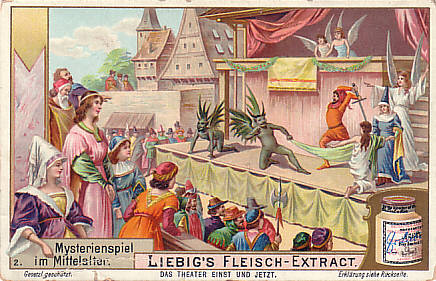
Where did the mystery plays come from?

The short answer is... nobody knows.

The long answer is... very long indeed!

One branch of scholarship suggests that the mystery plays had a strong didactic element - that they were, alongside the churches’ stained glass windows, the means of teaching the illiterate masses their faith. Robert Huntingdon Fletcher’s take on medieval congregations and the development of the mystery plays is gloriously patronising and quite startlingly simplistic:

We must try in the first place to realize clearly the conditions under which the church service, the mass, was conducted during all the medieval centuries. We should picture to ourselves congregations of persons for the most part grossly ignorant, of unquestioning though very superficial faith, and of emotions easily aroused to fever heat. Of the Latin words of the service they understood nothing; and of the Bible story they had only a very general impression. 

(Robert Huntingdon Fletcher, A History of English Literature (Boston: Richard G. Badger, 1916), accessed at http://www.luminarium.org/medlit/medievaldrama.htm.)

For such poor ignorami it was necessary “that the service [the Mass] should be given a strongly spectacular and emotional character,” which led slowly but inevitably to “the process of dramatizing the services.” Two very common forms of liturgical drama were Easter sepulchures (the church crucifix, after it had been venerated on Good Friday, would be 'buried' beneath the altar to symbolise Christ's death, then 'resurrected' on Easter morning and restored to its rightful place, either above the altar or on the rood screen) and the Quem Quaeritis trope (this was a dramatisation of the angel's speech to the three Marys at the empty tomb - 'Quem Quaeritis' means 'whom do you seek?'). Parts of the Christmas liturgy were also dramatised, but the Easter ceremonies were the main ones.

These dramatisations of the liturgy, says Fletcher, morphed gradually into the complete vernacular cycle of Bible stories when “the people... ceased to be patient with the unintelligble Latin." Originally also part of the liturgy and performed inside the churches, eventually

the churches began to seem too small and inconvenient, the excited audiences forgot the proper reverence, and the performances were transferred to the churchyard, and then, when the gravestones proved troublesome, to the market place, the village-green, or any convenient field. [...] Gradually, too, the priests lost their hold even on the plays themselves; skilful actors from among the laymen began to take many of the parts; and at last in some towns the trade-guilds, or unions of the various handicrafts, which had secured control of the town governments, assumed entire charge.

This evolutionary approach, very popular in the early to mid twentieth century, is today seen as somewhat outdated, although it lives on in popular culture (i.e. Wikipedia entries). And Fletcher's over-simplistic take on medieval drama (published in 1916) is, worryingly, still used by the Luminarium website as a general introduction to medieval plays.

Most scholars now suggest that liturgical and vernacular drama developed separately but in tandem, each influenced by the other but each with its own particular purpose and function. Although both were forms of worship, liturgical drama belonged to the church and the mystery plays to the city. The structure of each reflects this. Liturgical drama used only the ecclesiastical Latin and was played by the church hierarchy; suiting the enclosed, sacred space of the church, it was highly ritualised and fairly static. The vernacular mystery plays, whose cast and playing space was the entire city, had far greater scope for colour, movement and theatrical energy. 

And why were the plays called mystery plays? No one really knows that either, but here are the main theories:

  • In Latin - the language of the church - mysterium meant "mystical or religious truth" (OED Online: mystery, n.1). Because religious truths were a main focus of the plays, the Latin may have been anglicized to mystery and associated with the plays. 
  • There is a very similar Latin word, misterium, which originally meant "duty, service, office" (OED Online: mystery, n.2), but which by the Middle Ages meant "occupation, trade" (ibid) in association with the craft guilds. Since the guilds were the primary producers of the plays, this may be why the plays became known as mystery plays. 

 Which is correct? Take your pick!

Mystery plays were not uniquely English; they were widespread throughout Europe. The four main English cycles are those from are York, Chester, Wakefield, and the so-called N-Town; three Cornish plays also survive. On the continent, France, Germany, Spain and Italy all had their own plays.

Friday, 25 September 2015

Looking back: 2014 York Mystery Play Production

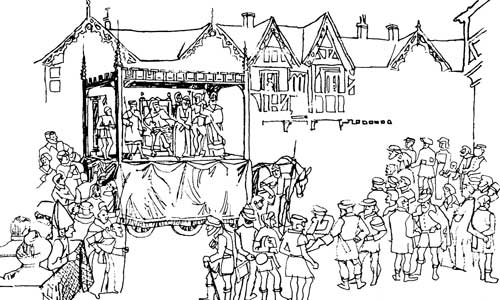
This was a wagon production, with the plays performed on pageant wagons wheeled from place to place along a fixed route. When each wagon stopped at the so-called 'stations,' its play was performed.

The production was pruned down somewhat from what it would have looked like in the Middle Ages - twelve plays were performed at four stations. The original play cycle had forty-eight pageants (or plays) at twelve stations. (Somehow, all forty-eight plays were squeezed into one day, beginning at dawn and ending around midnight.)

Nevertheless, the production gave a good sense of the demands and practicalities of wagon playing (you can read more about this here, although it is from a largely modern perspective instead of a medieval one!)

And there is more background information on the production here.

Much scholarly ink has been expended in wondering whether the medieval wagons were positioned end-on or broadside, and whether they were placed on the left or right side of the street. The latter question is, like many issues surrounding the plays, one that can be argued either way and probably never settled conclusively. But regarding the first question, it seems most likely that the guilds adapted the wagons to whatever best suited the demands of their particular play.

Plays that required a lot of scenery were probably played broadside, allowing the backdrop to be positioned at the back edge of the wagon, on display to the audience:

http://yorkmysteryplays.co.uk/wp-content/uploads/2013/10/agony-in-the-garden-2010.jpg
(This photo, showing the Agony in the Garden, is actually from the 2010 production.)

Those that had little or no scenery could be played end-on, using the wagon as a thrust stage into the audience. This video is of the Crucifixion (played end-on). It shows how the cross was raised from the wagon floor into the upright position, using ropes and the tow-bar of the wagon as a hinge:


 The York Crucifixion play omits the two thieves and after looking at the video it is easy to see why; three crosses could never have fitted onto one wagon and the process of raising even one cross is complicated and somewhat dangerous! Having three crosses would only have trebled the difficulty and the risk.

Friday, 18 September 2015

English: a very rough guide

When people ask what my thesis is in and I say 'Middle English,' there are two types of response (discounting the blank stare which is far and away the most common):

1. "Oh... Shakespeare!"
2. "Oh... really old English!"

Not quite. Middle English is neither Shakespearean English nor Old English. Middle English is... well, somewhere in the middle!

This is my own rough guide to the development of English over the last thousand years or so. The period boundaries are fluid - Old English did not become Middle English overnight, for example - and within each period there will be a lot of variation as well. Thirteenth century Middle English is quite different from that of the fifteenth century. Before the invention of the printing press (around 1440), which started the process of standardisation in spelling and vocabulary, there were also huge dialectal variations (northern, southern, midland, and Anglian are the main ones) within the language. The first recorded instance of a southerner making fun of the northern English accent is in Chaucer's Reeve's Tale.

Old English (OE): pre-Norman conquest (1066). To someone unused to it, impossible to read.


Hwæt! We Gar-Dena   in gear-dagum
þeod-cyninga,   þrym gefrunon,
hu ða æþelingas   ellen fremedon!


First three lines of Beowulf. Translated into modern English, they read:


What were we War-Danes in our yore-days?
Tribal-Kings! Truly cast that glory past,
how the counts had courage vast!
 
Via http://www.csun.edu/~ceh24682/beowulf.html 

Middle English (ME): from the Conquest to the end of the Plantagenets (Richard III, died 1485, was the last Plantagenet king). Once you work out that þ (thorn) = th, v = u and ȝ (yogh) = y it is surprisingly easy to read, especially if you use editions in modern spelling. 

 Al men þat walkis by waye or strete,
Take tente ȝe schalle no trauayle tyne.
Byholdes myn heede, myn handis, and my fete,
And fully feele nowe, or ȝe fyne,
Yf any mournyng may be meete,
Or myscheue mesured vnto myne.

Crucifixio Christi l.253-8, in The York Plays, edited by Richard Beadle (Oxford: Early English Text Society for Oxford University Press, 2009).

All men that walk by way or street,
Take tent ye shall no travail tine.
Behold mine head, mine hands, and my feet,
And fully feel now, ere ye fine,
If any mourning may be meet,
Or mischief measured unto mine.

Crucifixion l.253-8, in York Mystery Plays: A Selection in Modern Spelling, edited by Richard Beadle and Pamela King (Oxford: Oxford University Press. 2009).

All you men who walk by in the street,
Take heed and notice My suffering!
Behold My head, My hands, and My feet,
And consider well, before you pass on,
If any sorrow can match,
Or any misfortune compare to Mine.

The first passage (part of Christ's speech from the cross in the York Crucifixion play) is Middle English in its original spelling, the second is Middle English but in modern spelling, and the third is 'translated' into modern English.

Early Modern English (EME): from the Tudors (Henry VII was the first Tudor king) to the restoration of the monarchy in 1660, thus encompassing the entire Tudor period, the Elizabethans, Jacobeans, and the period of the Civil War. This is the language of Shakespeare.

If music be the food of love, play on;
Give me excess of it, that surfeiting, 
The appetite may sicken and so die.
That strain again, it had a dying fall;
O it came o'er my ear like the sweet sound 
That breathes upon a bank of violets,
Stealing and giving odour.

William Shakespeare, Twelfth Night I.I.1-7, edited by Rex Gibson (Cambridge: Cambridge University Press, 2007).

Modern English (sometimes New English or NE): from the mid-seventeenth century onwards.

It is a truth universally acknowledged, that a single man in possession of a good fortune, must be in want of a wife.
However little known the feelings or views of such a man may be on his first entering a neighbourhood, this truth is so well fixed in the minds of the surrounding families, that he is considered as the rightful property of some one or other of their daughters.

Jane Austen, Pride and Prejudice [1813], edited by Vivien Jones (London: Penguin Books, 1996), 5.
   
Present Day English (PDE) is, like, what we speak now, innit? c u l8r!

Thursday, 17 September 2015

UoA Arts Impact Poster Competition


You can see all the posters in the competition here.

And read about the trials and tribulations of making an academic poster here!

Thankyou to everybody who helped me with the poster, all those who came to see it, and everyone who has said nice things about it!

Tuesday, 8 September 2015

Looking back: 2012 York Mystery Play Production

Some links to video clips used to promote the 2012 production. Like the upcoming 2016 run, this was a 'fixed place' production - instead of using the pageant wagons the plays were performed on one large stage. This was erected in the Museum Gardens, using the ruins of St Mary's Abbey as a backdrop.

The clips give a good sense of the colour, movement, and sheer scale of the mystery plays. One theme that comes up again and again is how important the plays are to York's history, community, and the city itself.

All clips from http://www.yorkmysteryplays-2012.com/page/videos_and_podcasts.php

Cinematic trailer


Teaser trailer


The Artistic Directors talk about the staging

Time lapse of the stage & seating going up


Interviews with God/Jesus (Ferdinand Kingsley) and Satan (Graeme Hawley)


The plays and the community

Monday, 7 September 2015

One's first academic poster

According to the good old UoA, yours truly is now an 'early career academic.' Ha!

Early career academics (and middle and late career academics, for that matter) are expected to engage in the vague and dubious pastime of "getting one's research out there." To this end I have been having a great deal of strife fun lately trying to design a research poster to be entered in the Faculty of Arts Exposure competition. After two weeks of frustration and foot stamping, behold the finished result in all its glory:

The quality isn't great because I had to convert it to a PNG file in order to upload it to the blog. To find out how you can acquire your very own higher-quality copy, read on!

Please also note a couple of do's and don't's I wish someone had pointed out to me before I started. (But then, perhaps it's just as well they didn't, or I never would have started.)

DO NOT make the mistake of thinking that designing a poster is a nice, easy, fun little project taking a couple of days at most. Ha!

DO NOT be so foolish as to assume that the colours of your poster when printed will look anything like the colours on your computer screen.

DO be aware that the process involves endless tweaking, fiddling and frustration as well as umpteen trips to the printer... but also a certain amount of satisfaction at the end of it :)

The poster is printed at A1 size but I have a great many spare half-size (A3) mock-ups (see above re umpteen trips to the printer). I never want to see an A3 mock-up again but they are all really quite pretty and would look lovely adorning your wall. If you would like one, let me know. I'll even autograph it for you :)

Friday, 4 September 2015

2016 staging of York Mystery plays

The York Mystery plays are being wheeled out once again - although for their 2016 staging they will not be performed on the traditional pageant wagons but in the cavernous nave of York Minster. They were first performed here in 2000 to critical acclaim, and next year's production looks set to be just as impressive.

For general info, details, lots of pretty pictures, and even (for English residents!) the chance to get involved, see the production's spanking new website: Mystery plays 2016

Moving the plays inside the church will make for some interesting dynamics, as they were never intended to be staged indoors. The 'stations' or stopping points on the original pageant route were all either in front of or very close to churches (they made handy landmarks), but the plays belonged very much to the streets and their urban setting.

The plays as originally staged can be thought of as turning the churches 'inside out' - turning the action, immediacy and emotional power of the Mass and liturgy into a more accessible form, moving the sacred from the bounds of the church into the secular world of the city. Now we are going the other way - the plays are moving into the church.

A ready-made theatre? The vast nave of York Minster
Holy Trinity Church, the first stop on the pageant route


And the famous octagonal tower of All Saints Pavement, right in the centre of the city, where the pageant route ended.

http://eng.1september.ru/2008/08/img10-1.jpg
Artist's impression of how the mystery plays might have looked as originally staged (this is the Trial of Christ play).


Ego sum Alpha et O: vita, via, veritas, primus et novissimus.
I am gracious and great, God without beginning,
I am maker unmade, all might is in me;
I am life, and way unto wealth-winning,
I am foremost and first, as I bid shall it be.
My blessing of blee shall be blending,
And hielding, from harm to be hiding,
My body in bliss ay abiding,
Unending, without any ending.

This is the beginning of God the Father's speech which opens the first play, The Fall of the Angels, and thus the whole play cycle.

The Fall of the Angels  l.1-9, from York Mystery Plays: a Selection in Modern Spelling, ed. Richard Beadle and Pamela King (Oxford: Oxford University Press, 2009). 

Monday, 24 August 2015

Corporal Acts of Mercy Window


This window is in the north aisle of All Saints North Street, one down from the Pricke of Conscience Window, and like the Pricke of Conscience window it is very famous. It shows the corporal acts (or works) of mercy by which medieval Catholics hoped to get to heaven. Oddly, however, it shows only six of the seven acts. (Perhaps the glazier thought that to show all seven would ruin the window's symmetry!)

The window was donated to the church in about 1410 by Nicholas Blackburn, who seems to have been one of York's most prominent citizens. Certainly he was an extremely wealthy merchant, since he donated not only the Corporal Acts of Mercy Window but also the Great East Window behind the altar.

Reading clockwise from the top left-hand panel, you can see the feeding of the hungry; giving drink to the thirsty; the shelter of the homeless; visiting the imprisoned (here shown in medieval stocks!); visiting the sick; and the clothing of the naked. (The seventh work, not shown, is to bury the dead.)

The man shown performing the works of mercy is probably intended to be Nicholas Blackburn himself. The window thus shows off not only his wealth but also his piety!

The bottom three panels, from left to right, show a kneeling monk or priest (possibly one endowed by Nicholas Blackburn to sing Masses for his soul); a floral (?) decoration; and a kneeling couple, probably Nicholas and his wife Margaret.

Visiting the poor unfortunates in the stock. Is the happy free gentleman on the left Nicholas Blackburn?


Nicholas Blackburn was a Mercer (merchant), but whether he was a member of the York Mercer's Guild is not known. The guild does have a link with the window, however, since their play in the Corpus Christi pageant was Doomsday or the Last Judgement. The corporal works of mercy feature prominently in the play; they are the means by which Christ separates the good souls from the bad. To the good souls He says,

Whenne I was hungery ȝe me fedde;
To slake my thirste youre harte was free;
Whanne I was clotheles ȝe me cledde,
Ȝe wolde no sorowe vpon me see.
In harde presse when I was stedde,
Of my penaunce ȝe hadde pitee.
Full seke when I was brought in bedde,
Kyndely ȝe come to coumforte me.

Whanne I was wille and werieste,
Ȝe herbered me full hartefully;
Full gladde þanne were ȝe of youre geste,
And pleyned my pouerte piteuously.


[When I was hungry you fed me;
To ease my thirst your heart was free;
When I was without clothes you clad me,
You would no sorrow upon me see.
When I was hard pressed,
You had pity on my distress,
When I was sick in bed,
Kindly you came to comfort me.

When I was wandering and weary
You harboured me full generously;
Full glad were you of your guest,
And commiserated with my poverty.]

And to the bad,

Whanne I had mistir of mete and drynke,
Caytiffs, ȝe cacched me fro youre gate.
Whanne ȝe were sette as sirs on benke,
I stode þeroute, werie and wette;
Was none of yowe wolde on me thynke,
Pyté to haue of my poure state,
Þerefore till hell I schall you synke,
Weele are ȝe worthy to go to þat gate.

Whanne I was seke and soriest
Ȝe visitte me noght, for I was poure;
In prisoune faste whan I was feste,
Was none of you loked howe I fore.
Whenne I wiste neuer where for to reste,
With dynts ȝe draffe me fro your dore.


 [When I had need of meat and drink,
Caitiffs, you drove me from your gate
When you were feasting and merrymaking
I stood without, cold and wet;
Not one of you thought of me,
Or had pity on my wretched state,
Therefore I shall sink you into Hell,
Well are you worthy to go to that gate.

When I was sick and sorriest,
You visited me not, for I was poor;
When I was held fast in prison,
None of you looked to see how I fared.
When I knew not where to rest,
With blows you drove me from your door.]

It is not known whether Nicholas was involved with the Mercers' play but his son (confusingly, also called Nicholas) was one of the station holders along the pageant route. This means that he paid for the plays to stop outside his door and was probably another sign of his wealth and prestige.


Maren Donley has produced an interesting, if rather involved, explanation of the links between the window, the Mercers, and Nicholas Blackburn. See Maren L. Donley, “Mercers, Mercantilism and the Maintenance of Power: the York Last Judgement and the York Register, Exemplar 18, no 2 (2006): 343ff.

Passages from the Last Judgement play in Richard Beadle, The York Plays: A Critical Edition of the York Corpus Christi Play as Recorded in British Library Additional MS 35290, volume I (Oxford: Oxford University Press, 2009), l.285-96, 325-38. Modern English translations my own.


Tuesday, 18 August 2015

Arma Christi


Passion scenes are one of the most common topics for medieval stained glass windows. This (click on it to make it bigger!) is a Passion and Resurrection sequence, now forming the West Window in All Saints Pavement, York. The glass, which is from the late 14th century, was originally just across the road in St Saviour's Church, where it formed part of the great East Window behind the altar. 

The glass work is incredibly detailed, especially the small shield on the far right of the window (for a close-up see below). This depicts the Arma Christi - the instruments of the Passion. In the Middle Ages it was common to meditate on the gory and gruesome details of the Passion so that one might be provoked to sorrow for sin and gratitude for Christ's sacrifice. This is known as affective piety and is a hallmark of medieval religious art, literature and drama.


In the centre of the Arma Christi shield is, naturally enough, the cross. The crown of thorns hangs over the crossbar and the three nails used to pin Christ to the cross are in position at the two ends of the crossbar and at the bottom of the downpiece. 

Crossed in front of the downpiece are a pole with the sponge used to give Christ gall and vinegar, and the spear used by the Roman soldier Longinus to pierce the side of Christ. 

To the left of the cross is Christ's seamless garment; underneath and to either side of the support are the three dice used by the soliders to cast lots. Beneath the tip of the lance is a chalice with a host suspended above it.

On the right of the cross is the pillar used for the scourging; wound round it is the cord which bound Christ to it; the scourges are higher up, one on each side of the downpiece of the cross. Also in this right-hand section are a Pinner's (the Pinners made nails and other ironwork) hammer and a pair of Blacksmith's pincers, which would have been used to shape and forge the nails (or pins).

The strange spoon-like object over the left arm of the cross bar I cannot identify. All I can think of is that it is an izmel, or knife of the circumcision, although it doesn't look very knife-like... if anyone has a better idea, please let me know!!

The pattern of one horizontal line with three downward strokes attached which covers the background of the shield represents Christ's wounds and the blood which flowed from them.


Friday, 7 August 2015

Fancy a piece of York Minster?

York Minster is auctioning off various bits and pieces of stone and wood that were removed during recent conservation of the Great East Window: Stone and timber auction


A Green Man - an ancient pagan fertility symbol - in the York Minster Chapter House. Obviously the advent of Christianity did not completely supersede England's pagan traditions! For probably the most famous 'Green Man' in literature, see the fourteenth century poem Sir Gawain and the Green Knight.


Wednesday, 5 August 2015

Pricke of Conscience Window

The Pricke of Conscience Window

 This famous window is in the Lady Chapel of All Saints North Street, York. It dates from around 1410 and is unique for being the only medieval stained glass window in Europe known to include the text of a poem - The Prik of Conscience. As its name implies, the poem is is a devotional work intended to provoke repentance and sorrow for sin. Snippets of text from the poem appear under each of the fifteen window panels.

The window depicts the last fifteen days of the world, in characteristic apocalyptic medieval style. However, to a modern eye the terrible 'roaring' fish look more as if they have toothache and the rocks and trees like overgrown mushrooms!

The fish, roaring with toothache (top); overgrown mushrooms! (bottom)


More overgrown mushrooms (top and bottom). The top panel is supposed to be rocks and stones on fire, while the bottom one is the sea on fire (the things that look like red chilies are presumably the flames!)

Wednesday, 29 July 2015

York Minster fact sheets

The Minster has a collection of helpful factsheets, liberally illustrated with lots of lovely photographs, on its website. See https://www.yorkminster.org/learning/school-visits/activities-amp-resources/york-minster-fact-sheets.html

St William of York

 The Great West Window of York Minster (affectionately known as 'The Heart of Yorkshire'). The bottom row of the window depicts eight archbishops of York, one of which is Saint William.


St William (late 11th century - 1154) is York's patron saint and the city's answer to Canterbury's Thomas a Becket. He was elected Archbishop of York in 1141, though his reign was a rather stormy one. Several miracles were attributed to him (including the miraculous preservation of his body in one of the Minster's fires, which mirrored one of St Thomas' miracles) and quite a cult grew up around his figure, a cult which contributed to York's sense of local identity.

St William was buried in York Minster; his tomb and shrine here became a place of pilgrimage. It is tempting, though perhaps not very edifying, to imagine some competition or rivalry between York and Canterbury. Both were important cities religiously, politically and economically and both seemed to have played up the presence and the merits of their respective local saints. Rivalry between the north and south of England appears to be as old as the hills!

There is some evidence for Whitsuntide plays performed in York in honour of Saint William, which would pre-date the city's much more famous Corpus Christi Mystery cycle.

St William features largely in the stained glass of York Minster; below is a very rare 12th century statue depicting him, now standing in All Saints Church North Street.

For further reading about St William see Ellen K. Rentz, "Castles for St. William: The Late Medieval Commemoration of York's Local Saint," Viator 43, no. 2 (2012), 111 - 129. For a more brief overview of his life, his struggles surrounding his election to the Archbishopric of York, and his stained glass in the Minster, see https://www.yorkminster.org/geisha/assets/files/16%20St%20William.pdf

St William was canonised in 1227 (apparently after some lobbying by the citizens of York). His feast day is 8th June, the day of his death (reportedly by poisoned wine in his chalice).

12th century wooden statue thought to depict St William, All Saint's North Street

Tuesday, 14 July 2015

York Minster

The two west turrets

This dragon head is actually a counterweight, and was used to lever the very heavy font lid on and off.

Looking up the nave towards the quire

Five Sisters window
Climbing the tower (275 steep, winding, narrow steps!)

Looking across the leads

Made it to the top!

The two west turrets again

The quire screen has statues of the kings who reigned while the Minster was being built (William the Conqueror to Henry VI.) This is Richard II.
Roof boss

Stained glass windows of the Chapter House

Ceiling of the chapter house

A sad little fellow who took my fancy

Statue of Virgin and Child decapitated during the Reformation

The 'catherdra' - Bishop's throne

The Pilgrims' Window