Showing posts with label interesting snippets. Show all posts

Monday, 5 December 2016

A new mystery play?

This article, describing a Christmas nativity play performed by an entire English village (Calne, in Wiltshire), caught my eye because the cultural and communal aspects (the whole town involved) and, arguably, the religious one ('bringing the Bible to life') are similar to that of the medieval mystery plays. Since my PhD thesis will focus largely on the York mystery plays in modern performance, looking at the cultural and social need which has looked to revive the play cycle in (and for) the present day, it makes an interesting point for comparison and contrast.

As a footnote, some scholars suggest that the British tradition of the Christmas nativity play is directly descended from the mystery play cycles, the only trace of the original medieval drama to survive in modern-day British culture. The people of York, where the mystery plays are still very much alive and kicking, might take issue with that last point!

Monday, 28 November 2016

Wall paintings in Stratford's Guild Chapel

Recently I came across this article, which describes (and pictures) the wall paintings in the Guild chapel of Stratford-upon-Avon. Like most medieval churches, the chapel's walls were originally covered with murals depicting life, death, heaven, hell, and everything in between. At the Reformation the murals were destroyed, or, as was the case at Stratford, painted over. Recent restoration work in the Guild chapel has uncovered the wall paintings, which, depending on whom you read, are either "some of the finest in Europe" (Daily Mail) or "far from masterpieces, but... show[ing]... medieval England in thrall to devils and death" (The Guardian).

(The Daily Mail gets further carried away, proclaiming that the murals were personally painted over by John Shakespeare, father of the famous William - on the grounds that he was bailiff of Stratford in 1563, when Henry VIII ordered the paintings removed. William Shakespeare was born the following year, 1564, so sadly he never saw the paintings.)

The Daily Mail article has the best images, but here are a few more pages commenting on the wall paintings:


Thursday, 27 October 2016

Telegraph | Authenticity and the Globe

Interesting opinion piece from the Telegraph's Dominic Cavendish about the London Globe theatre:


All the world's a stage, and all the men and women merely players: they have their entrances and their exits; and one man in his time plays many parts, his acts being seven ages.

Monday, 30 May 2016

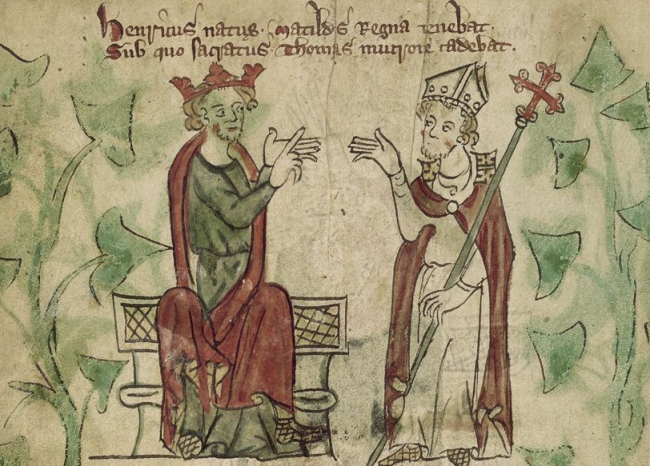
Thomas à Becket returns home to Canterbury

Well, a piece of him. A piece of bone believed to be from the saint's elbow has been visiting England this past week, on loan from Hungary where it usually resides. After being displayed in several London churches (including both Westminster Abbey and Westminster Cathedral) the relic was taken from London to Canterbury, the site of Becket's murder and medieval shrine. The shrine sprang up almost immediately after his death amid numerous reports of miracles and a medieval populace condemning Henry II and calling for Thomas' canonisation. This in fact happened very speedily, in 1173, only three years after his death. The shrine flourished wildly throughout the Middle Ages but was destroyed at the Reformation.

Henry II (left) and Thomas à Becket (right). From a medieval manuscript, via

The London-Canterbury pilgrimage route, and the incredibly popular medieval cult of St Thomas, was imortalised by Chaucer in the Canterbury Tales. Over six hundred years later, history seems to be repeating itself, and St Thomas' cult to be undergoing a temporary revival, if the number of news articles covering the story is anything to go by:

BBC 
Telegraph (also here)

I wonder what the original medieval pilgrims would have made of it all!

And specially, from every shires ende
Of Engelond to Caunterbury they wende,
The holy blisful martir for to seke,
That hem hath holpen, whan that they were seke.
- Canterbury Tales, General Prologue

Monday, 30 November 2015

Public lecture: Why the Arts matter

via

Jonothon Neelands (a professor at Warwick Business School) is giving a public lecture at the University of Auckland on "Culture, Creativity and Growth: Why the Arts matter."

Where: Owen G. Glenn Building lecture theatre 092, Grafton Road, University of Auckland.
When: Monday 7th December, 6pm.

See more: http://www.creativethinkingproject.org/jonothan-neelands-fellow/

via

Sunday, 25 October 2015

St Crispian's Day

    This day is call'd the feast of Crispian.
    He that outlives this day, and comes safe home,
    Will stand a tip-toe when this day is nam'd,
    And rouse him at the name of Crispian.
    He that shall live this day, and see old age,
    Will yearly on the vigil feast his neighbours,
    And say 'To-morrow is Saint Crispian.'
    Then will he strip his sleeve and show his scars,
    And say 'These wounds I had on Crispian's day.'
    Old men forget; yet all shall be forgot,
    But he'll remember, with advantages,
    What feats he did that day. Then shall our names,
    Familiar in his mouth as household words-
    Harry the King, Bedford and Exeter,
    Warwick and Talbot, Salisbury and Gloucester-
    Be in their flowing cups freshly rememb'red.
    This story shall the good man teach his son;
    And Crispin Crispian shall ne'er go by,
    From this day to the ending of the world,
    But we in it shall be remembered-
    We few, we happy few, we band of brothers;
    For he to-day that sheds his blood with me
    Shall be my brother; be he ne'er so vile,
    This day shall gentle his condition;
    And gentlemen in England now-a-bed
    Shall think themselves accurs'd they were not here,
    And hold their manhoods cheap whiles any speaks
    That fought with us upon Saint Crispin's day.


Henry's speech to his men before the Battle of Agincourt, from Henry V IV.2.

Kenneth Branagh's rendition:


Henry's rousing speech is fictional (although jolly good poetry), but the Battle of Agincourt was real enough. It took place as part of the Hundred Years' War on Friday 25th October 1415 - six hundred years ago today. The English, outnumbered by the French, were ultimately victorious.

Legend has it that the rude two-fingered salute originates from the battle. Before it began, the French boasted that they would cut off the two arrow fingers from any captured English archers. After the English won, thanks largely to the range and effectiveness of the longbow, they mockingly waved their intact fingers at the defeated French!

Friday, 16 October 2015

Postscript to Pigsney

If you read right to the end of my pigsney post, I am very impressed :D

Quite by chance I recently came across another example of the word, in the anonymous sixteenth-century poem "My Sweet Sweeting:"

She is so proper and so pure,
Full stedfast, stabill and demure,
There is none such, ye may be sure,
               As my swete swetyng.

In all thys world, as thynketh me,
Is none so plesaunt to my e'e,                     [eye]
That I am glad soo ofte to see,
               As my swete swetyng.

When I behold my swetyng swete,
Her face, her hands, her minion fete,         [little feet] 
They seme to me there is none so mete,
              As my swete swetyng.

Above all other prayse must I,
And love my pretty pygsnye,
For none I fynd so womanly
              As my swete swetyng.

In Come Hither: A Collection of Rhymes & Poems for the Young of All Ages, ed. Walter de la Mare (London: Constable and Co., 1962), 35.

This example is not cited in the OED, which is why I missed it earlier. 

But while we're on the topic of the OED, here's a little interesting fact for Tolkien readers: did you know that his first job after serving in WWI was working on the dictionary? 

Monday, 5 October 2015

RIP English Rugby

In Stuart Lancaster's camp, England, bound in with the triumphant sea
Whose rocky shore beats back the envious siege
Of watery Neptune, is now bound in with shame, which is proof that there is indeed a Shakespearean quote for every occasion.

England's dismal end in their own World Cup is so depressing that a tonic of stirring Shakespearean patriotism is surely necessary :P

via

This royal throne of kings, this scepter'd isle,
This earth of majesty, this seat of Mars,
This other Eden, demi-paradise,
This fortress built by Nature for herself
Against infection and the hand of war,
This happy breed of men, this little world,
This precios stone set in the silver sea,
Which serves in it the office of a wall,
Or as a moat defensive to a house,
Against the envy of less happier lands,
This blessed plot, this earth, this realm, this England!


 All quotes from Richard II Act 2 Scene 1.

Wars of the Roses family tree

While we're on the topic of the white rose and the red, here is a handy family tree. Both sides were remarkably unimaginative in the naming of their offspring, with the result that there is such a proliferation of Annes, Elizabeths, Edwards/Edmunds, Richards and Henrys that a good clear family tree is indispensable!

via
(Click on it to make it bigger)

Tuesday, 29 September 2015

Why do we tell stories?

Distinguished Professor Brian Boyd (University of Auckland) on stories and storytelling:


Friday, 18 September 2015

English: a very rough guide

When people ask what my thesis is in and I say 'Middle English,' there are two types of response (discounting the blank stare which is far and away the most common):

1. "Oh... Shakespeare!"
2. "Oh... really old English!"

Not quite. Middle English is neither Shakespearean English nor Old English. Middle English is... well, somewhere in the middle!

This is my own rough guide to the development of English over the last thousand years or so. The period boundaries are fluid - Old English did not become Middle English overnight, for example - and within each period there will be a lot of variation as well. Thirteenth century Middle English is quite different from that of the fifteenth century. Before the invention of the printing press (around 1440), which started the process of standardisation in spelling and vocabulary, there were also huge dialectal variations (northern, southern, midland, and Anglian are the main ones) within the language. The first recorded instance of a southerner making fun of the northern English accent is in Chaucer's Reeve's Tale.

Old English (OE): pre-Norman conquest (1066). To someone unused to it, impossible to read.


Hwæt! We Gar-Dena   in gear-dagum
þeod-cyninga,   þrym gefrunon,
hu ða æþelingas   ellen fremedon!


First three lines of Beowulf. Translated into modern English, they read:


What were we War-Danes in our yore-days?
Tribal-Kings! Truly cast that glory past,
how the counts had courage vast!
 
Via http://www.csun.edu/~ceh24682/beowulf.html 

Middle English (ME): from the Conquest to the end of the Plantagenets (Richard III, died 1485, was the last Plantagenet king). Once you work out that þ (thorn) = th, v = u and ȝ (yogh) = y it is surprisingly easy to read, especially if you use editions in modern spelling. 

 Al men þat walkis by waye or strete,
Take tente ȝe schalle no trauayle tyne.
Byholdes myn heede, myn handis, and my fete,
And fully feele nowe, or ȝe fyne,
Yf any mournyng may be meete,
Or myscheue mesured vnto myne.

Crucifixio Christi l.253-8, in The York Plays, edited by Richard Beadle (Oxford: Early English Text Society for Oxford University Press, 2009).

All men that walk by way or street,
Take tent ye shall no travail tine.
Behold mine head, mine hands, and my feet,
And fully feel now, ere ye fine,
If any mourning may be meet,
Or mischief measured unto mine.

Crucifixion l.253-8, in York Mystery Plays: A Selection in Modern Spelling, edited by Richard Beadle and Pamela King (Oxford: Oxford University Press. 2009).

All you men who walk by in the street,
Take heed and notice My suffering!
Behold My head, My hands, and My feet,
And consider well, before you pass on,
If any sorrow can match,
Or any misfortune compare to Mine.

The first passage (part of Christ's speech from the cross in the York Crucifixion play) is Middle English in its original spelling, the second is Middle English but in modern spelling, and the third is 'translated' into modern English.

Early Modern English (EME): from the Tudors (Henry VII was the first Tudor king) to the restoration of the monarchy in 1660, thus encompassing the entire Tudor period, the Elizabethans, Jacobeans, and the period of the Civil War. This is the language of Shakespeare.

If music be the food of love, play on;
Give me excess of it, that surfeiting, 
The appetite may sicken and so die.
That strain again, it had a dying fall;
O it came o'er my ear like the sweet sound 
That breathes upon a bank of violets,
Stealing and giving odour.

William Shakespeare, Twelfth Night I.I.1-7, edited by Rex Gibson (Cambridge: Cambridge University Press, 2007).

Modern English (sometimes New English or NE): from the mid-seventeenth century onwards.

It is a truth universally acknowledged, that a single man in possession of a good fortune, must be in want of a wife.
However little known the feelings or views of such a man may be on his first entering a neighbourhood, this truth is so well fixed in the minds of the surrounding families, that he is considered as the rightful property of some one or other of their daughters.

Jane Austen, Pride and Prejudice [1813], edited by Vivien Jones (London: Penguin Books, 1996), 5.
   
Present Day English (PDE) is, like, what we speak now, innit? c u l8r!

Friday, 11 September 2015

Springtime in Auckland

Spring is sprung,
The grass has ris,
If you want to know where the birdies is...
... they're all up in the blossom trees getting drunk and disorderly on the nectar!


Thursday, 10 September 2015

The many bookshelves of an English student


Work bookshelf:


Thesis books...


more thesis books...


... and yet more thesis books. The Middle English section of the university library has found a new home :P


Organised (yes really) chaos


Old friends


Penguin Classics: the hallmark of English students


What to do when one runs out of room for more thesis books? Stack them on the floor, of course :)


Tuesday, 18 August 2015

St Helen

Today is the feast day of St Helen (c. 250 - 330), most famous for finding the True Cross and for being the mother of the Emperor Constantine... and marginally less famous for being the patron saint of yours truly!!

Christ and Cross - York Minster


Monday, 10 August 2015

Kiwis Abroad


Spotted this at York railway station and couldn't stop smiling!

(Click on it to make it bigger and see it in its full glory)

Friday, 7 August 2015

Fancy a piece of York Minster?

York Minster is auctioning off various bits and pieces of stone and wood that were removed during recent conservation of the Great East Window: Stone and timber auction


A Green Man - an ancient pagan fertility symbol - in the York Minster Chapter House. Obviously the advent of Christianity did not completely supersede England's pagan traditions! For probably the most famous 'Green Man' in literature, see the fourteenth century poem Sir Gawain and the Green Knight.


Wednesday, 5 August 2015

Did you know...?

... that the word 'gossip' in late medieval and Tudor English meant 'godmother'?