

Showing posts with label mystery plays. Show all posts
Showing posts with label mystery plays. Show all posts
Tuesday, 20 March 2018

Monday, 5 February 2018

Wednesday, 18 October 2017
Have you seen the York Mystery Plays?
Just received university ethics clearance for interviewing people involved with the York Mystery Plays. Now I need people to talk to! Please get in touch or help spread the word!
Eleanor Bloomfield, a PhD candidate at the University of Auckland, is researching modern revivals of the York mystery play cycle and is seeking first-hand accounts of the plays. Anyone who has seen, or been involved with, any performances of the York plays from 1951 to the present day, and is willing to be interviewed regarding their memories, impressions and experiences, please contact e.bloomfield@auckland.ac.nz or write to Eleanor Bloomfield, The University of Auckland (English, Drama and Writing Studies), 14A Symonds St, 206-646, Auckland 1010, New Zealand. Confidential interviews will be held in Britain between March and September 2018. Approved by the University of Auckland Human Participants Ethics Committee on 10th October 2017 for three years. Reference Number 020006.
YORK EVOLVING: CHANGE AND PERMANENCE IN THE
YORK MYSTERY PLAY CYCLE
CALL FOR INFORMATION
Eleanor Bloomfield, a PhD candidate at the University of Auckland, is researching modern revivals of the York mystery play cycle and is seeking first-hand accounts of the plays. Anyone who has seen, or been involved with, any performances of the York plays from 1951 to the present day, and is willing to be interviewed regarding their memories, impressions and experiences, please contact e.bloomfield@auckland.ac.nz or write to Eleanor Bloomfield, The University of Auckland (English, Drama and Writing Studies), 14A Symonds St, 206-646, Auckland 1010, New Zealand. Confidential interviews will be held in Britain between March and September 2018. Approved by the University of Auckland Human Participants Ethics Committee on 10th October 2017 for three years. Reference Number 020006.
Sunday, 29 January 2017
PhD thesis | Preliminary research proposal
Having explored the performance of piety in medieval York for my MA thesis, my doctoral research will expand on this by examining how and why the city’s cycle of medieval mystery plays has been revived in (and for) the present day, becoming an integral part of modern-day York’s identity and culture. I aim to identify the cultural need which has looked to revive and sustain the York play cycle for modern and local purposes, working towards a fuller understanding of the enduring attraction of the mystery plays, and their apparent resilience, or adaptability, to huge changes in culture, language and religious belief.
An important aspect of modern revivals is dealing with the cycle’s overt Christianity. In a multi-cultural, increasingly secular society, the medieval idea of ‘the plays as piety’ no longer holds true. Nor does the cycle’s medieval function as a vehicle for religious expression and a medium for working through religious and theological tensions and concerns. Why, then, do the plays continue to capture the imaginations of both directors and audiences? Modern productions of the plays typically place emphasis on the cycle’s communal and social aspect as well as its importance to York’s cultural and social heritage. Arguably, these were roles also performed by the plays in the Middle Ages. Nevertheless, the cycle’s religious heritage is undeniable; directors must find a way to balance this with the beliefs (or lack thereof) and expectations of modern audiences.
Paying particular attention to the 1951 Festival of Britain revival (the first large-scale production of the plays since the Middle Ages) and subsequent productions, consideration will also be given to the logistics of staging modern productions of the play cycle and the many decisions any director must make - which text or script should be used? Should the language be modernised or the Middle English retained? Which sections of the cycle should be included and which left out, or should a performance of the entire cycle be attempted? How can these medieval religious plays be presented in a way that makes them accessible and relatable to a modern audience? Should the plays be staged in the ‘traditional’ manner on pageant wagons, or on a fixed-place stage? To what extent should the audience be involved in the performance?
Watch this space...
Monday, 5 December 2016
A new mystery play?
This article, describing a Christmas nativity play performed by an entire English village (Calne, in Wiltshire), caught my eye because the cultural and communal aspects (the whole town involved) and, arguably, the religious one ('bringing the Bible to life') are similar to that of the medieval mystery plays. Since my PhD thesis will focus largely on the York mystery plays in modern performance, looking at the cultural and social need which has looked to revive the play cycle in (and for) the present day, it makes an interesting point for comparison and contrast.
As a footnote, some scholars suggest that the British tradition of the Christmas nativity play is directly descended from the mystery play cycles, the only trace of the original medieval drama to survive in modern-day British culture. The people of York, where the mystery plays are still very much alive and kicking, might take issue with that last point!
Thursday, 17 November 2016
The Soundscapes of the York Mystery Plays
This project (led by the University of York and part of the Being Human Festival of the Humanities) seeks to recreate the soundscapes of the medieval mystery plays. It also incorporates audio material from modern productions of the plays. For more information see:
Friday, 9 September 2016
All in a day's work...
Yesterday I wrote a letter to Dame Judi Dench:


You may (or may not) know that Dame Judi took part in the earliest modern revivals of the York mystery plays throughout the 1950s. She was an angel in the 1951 Festival of Britain revival and played the Virgin Mary (one of her first professional roles) in 1957.
So on the off-chance that she might reply, I wrote asking what it was like to be part of those early performances, how the play cycle fitted into a post-war society, and how it was viewed by the people of York at the time.
Tuesday, 6 September 2016
York Minster Mystery Plays June 2016

'Have you come far?'
- York Minster Mystery Plays volunteer to me
This post is rather late, given that we saw the plays on the 22nd June and it is now the beginning of September... still, better late than never! The reason for the delay is that I have been writing up a review of the plays as an academic paper, and my little brain does not like working on two things at once. Academia comes before blogging, so there you are. However, now that I have finished my paper, which is currently languishing in a long-suffering editor's inbox awaiting review, it is time to turn my attention to my rather neglected blog.
The Minster production of the mystery plays was the original inspiration for this year's English trip - their timing, just a few of months after handing in my MA thesis, was happily fortuitous and an excellent excuse for another trip back to Blighty. So back to Blighty I went, or more specifically back to York - this time with both my Grandmas, which made it even more special.
Despite being born a Lancashire rose I am very fond of the white rose county and of York in particular, which despite visiting only twice I have quite fallen in love with. So it was very nice to be back!
We went to a matinee performance of the plays, which turned out to be a good thing as the running time, billed at three and a half hours, ended up being nearer four. Thanks to jetlag, if we had gone in the evening I would probably have been gently snoozing long before Doomsday. On second thoughts, perhaps I wouldn't, as the Minster - all stone and shadow - was distinctly chilly.
By happy forethought, we had front row seats. It was a full house - testament to the popularity of the plays and this production in particular, which does seem to have been a fairly resounding success both with the critics and the general public. The Minster's nave had been converted into seating for around a thousand people - the third nearest the stage was flat but the back two-thirds was raked scaffolding, soaring up and back towards the West Window.
The stage and set were huge, spread over four playing levels and linked by a series of wide, broad steps. Like the seating, the set reached upwards and backwards, almost to the top of the organ atop the quire screen. This kind of scale was of course the complete antithesis to the original performances of the play cycle, which were staged on small, mobile pageant wagons, but it worked well. Firstly, it evoked the scale and sweep of the cycle, which spans Biblical history from Creation to Doom, and secondly, well, such a big stage was necessary to accommodate the huge cast! This numbered roughly a hundred and forty, all except one (Philip McGinley, playing Christ) unpaid volunteers and many of them from the local community who have been performing in various productions of the plays for years (sometimes decades).
Out of so many characters, it is hard to pick favourites, but Philip McGinley was very good as Christ - though he puzzled me somewhat by making his first entrance clad rather incongruously in jeans and T-shirt but appearing thereafter in more conventional whitey-grey robes. Toby Gordon, as Lucifer, was (perhaps worryingly...) even better, but he reminded me of Dominic Cooper and once this thought had popped into my head it wouldn't pop out again. Ruby Baker as Mary and Mark Comer (one of the recurring devotees of the mystery plays) as Joseph were also excellent. Abraham I remember chiefly for the fact that he had to read his lines off a piece of paper hidden under his cloak (clearly someone was ill and he gamely stepped into the breach), Noah and Mrs Noah for their comic sparring, and Herod for his massive golden cape which spread over the entire stage and required an army of minions to manoeuver.
This version presented eighteen pageants (the original medieval play cycle has about forty-seven), though several of these consisted of two or three of the original short pageants run together into a longer section. The Middle English script had been 'lightly modernised,' retaining the alliterative rhythm of the original while introducing a few modern touches, such as Noah's 'Don't touch - the paint's not dry!' (said to God, inspecting the ark) and Lucifer's wail of 'It's not fair!' while being thrown into hell.
My two favourite episodes were the Creation and the Passion - the former for its colour, light and incredibly lifelike animal puppets, and the latter (which is really the heart of the entire cycle) for its solemn grandeur. Runners-up were the Nativity, for its tableaux effect, and the Entry into Jerusalem, for its movement and momentum.
No photographs of the actual performance - alas, this was not the free and easy Pop-Up Globe. But there are quite a few on the production's website, here.
Tuesday, 14 June 2016
Behind the scenes of the York Mystery plays
 |
| via |
Interview with Joseph (Mark Comer)
Interview with Young Mary (Ruby Barker)
Interview with the designer, Max Jones
Props department
Much more here: https://yorkminster.org/mysteryplays2016/behind-the-scenes.html
And a couple more reviews:
The Guardian (again)
Next week... I shall be seeing the plays for myself!
Friday, 3 June 2016
2016 York Mystery Plays: reviews
 |
| via |
The Guardian
York Press
Yorkshire Post
The Reviews Hub
York Mix
One & Other Creative: Theatre Review
... and am looking forward to writing my own review after seeing the plays on the 22nd June :)
Wednesday, 25 May 2016
'Firste when I this worlde hadde wroght' | Opening of the York Mystery Plays
The York Mystery Plays open tomorrow (Thursday 26th May), the feast of Corpus Christi - the day on which they were originally performed back in the Middle Ages.
This is a time-lapse video of the stage and seating being built inside York Minster:
Ego sum Alpha et O: vita, via, veritas, primus et novissimus.
I am gracious and great, God without beginning,
I am maker unmade, all might is in me;
I am life, and way unto wealth-winning,
I am foremost and first, as I bid shall it be.
My blessing of blee shall be blending,
And hielding, from harm to be hiding,
My body in bliss ay abiding,
Unending, without any ending.
Opening of The Fall of the Angels [the first pageant in the play cycle], from York Mystery Plays: A Selection in Modern Spelling, edited by Richard Beadle and Pamela King (Oxford: Oxford University Press, 2009).
This is a time-lapse video of the stage and seating being built inside York Minster:
Ego sum Alpha et O: vita, via, veritas, primus et novissimus.
I am gracious and great, God without beginning,
I am maker unmade, all might is in me;
I am life, and way unto wealth-winning,
I am foremost and first, as I bid shall it be.
My blessing of blee shall be blending,
And hielding, from harm to be hiding,
My body in bliss ay abiding,
Unending, without any ending.
Opening of The Fall of the Angels [the first pageant in the play cycle], from York Mystery Plays: A Selection in Modern Spelling, edited by Richard Beadle and Pamela King (Oxford: Oxford University Press, 2009).
Sunday, 20 March 2016
Palm Sunday | The Entry Into Jerusalem
 |
| via |
| JESUS: To me takis tent and giffis gud hede, My dere discipulis that ben here, I schall you telle that shal be indede; My tyme to passe hense, it drawith nere, And by this skill Mannys sowle to save fro sorowes sere That loste was ill. From heven to erth whan I dyssende Rawnsom to make I made promys, The prophicie nowe drawes to ende; My Fadirs wille forsoth it is That sente me hedyr. Petir, Phelippe, I schall you blisse And go togedir Unto yone castell that is you agayne, Gois with gud harte and tarie noght, My comaundement to do be ye bayne. Also I you charge loke it be wrought That schal ye fynde An asse, this feste als ye had soght, Ye hir unbynde With hir foole, and to me hem bring That I on hir may sitte a space So the prophicy clere menyng May be fulfilled here in this place: “Doghtyr Syon, Loo, thi Lorde comys rydand on an asse, Thee to opon.” (The Entry Into Jerusalem l.1-28) |
The York play of the Entry into Jerusalem was performed by the Skinners' Guild. The 'yon castell' referred to by Jesus is probably Clifford's Tower, which stands in the centre of the city, providing a well-known landmark. This fleeting moment both brings together historical and present time within the play and also hints at how inextricably the York play cycle as a whole was linked with the geography and architecture of the city.
The play concludes with the citizens of Jerusalem welcoming Christ into their city:
Hayll, domysman dredfull, þat all schall deme,
Hayll, [þat all] quyk and dede schall lowte,
Hayll, whom worschippe moste will seme,
Hayll, whom all thyng schall drede and dowte.
We welcome þe;
Hayll, and welcome of all abouwte,
To owre ceté. (l.538-44)
Hayll, domysman dredfull, þat all schall deme,
Hayll, [þat all] quyk and dede schall lowte,
Hayll, whom worschippe moste will seme,
Hayll, whom all thyng schall drede and dowte.
We welcome þe;
Hayll, and welcome of all abouwte,
To owre ceté. (l.538-44)
The structure of the play is, as Beadle and King point out, very close to a medieval royal welcome:
the tableau at the end [of the play], with its ordered arrangement of formal greetings, suggests that the dramatist had in mind the conventions of the contemporary royal entry into the medieval town. In the last lines of the play, the local audience must have had a strong sense that the King of Heaven was being welcomed as much to medieval York as to the biblical Jerusalem.
the tableau at the end [of the play], with its ordered arrangement of formal greetings, suggests that the dramatist had in mind the conventions of the contemporary royal entry into the medieval town. In the last lines of the play, the local audience must have had a strong sense that the King of Heaven was being welcomed as much to medieval York as to the biblical Jerusalem.
(Beadle and King, introduction to The Entry Into Jerusalem, in York Mystery Plays: A Selection in Modern Spelling (Oxford: Oxford University Press, 2009), 106.)
They also note that "Jesus must have ridden on the ass in the street amongst the audience, who were thus deftly drawn into the illusion of the play, and given a role as the crowd that lined the route into Jerusalem" (ibid.) As with the earlier reference to the castle, Biblical and contemporary time, the sacred (the subjects dealt with in the plays) and the secular (the city of York) are brought together. For the plays' original audiences, Biblical events, happenings and locations were blended with what was for them modern-day York, intertwining them until they became virtually indistinguishable.
Wednesday, 3 February 2016
Monday, 28 December 2015
Feast of the Holy Innocents: Coventry Carol
Many people know the Coventry Carol, but most do not realise that it comes from one of the Middle English mystery play cycles - not the York cycle, but a now-lost Coventry cycle (not to be confused with the Ludus Coventriae cycle, which is now thought to come from East Anglia). It appears in the play known as the Shearmen and Tailors' pageant - one of the only two plays from the cycle to survive (the other is the Weavers').
The Shearmen and Tailors' play tells the story of the nativity, but this song is not a joyful carol welcoming the birth of Christ; instead it is a lament for the innocent children killed by Herod.
When sung today the words are modernised, but the Middle English words to the carol are:
Lulla, lulla, thow littell tine child,
By, by, lully, lullay, thow littell tyne child,
 |
| via |
By, by, lully, lullay!
O sisters too, how may we do
For to preserve this day
This pore yongling for whom we do singe
By, by, lully, lullay?
Herod, the king, in his raging,
Chargid he hath this day
His men of might in his owne sight
All yonge children to slay, -
That wo is me, pore child, for thee,
And ever morne and may
For thi parting nether say nor singe,
By, by, lully, lullay.
The part of Herod seems to have been played as a raving, maniacal bully; there is a stage direction in the York Slaughter of the Innocents play to the effect of now shall Herod descend [from the pageant wagon] and rage in the streets. When Shakespeare was writing Hamlet, by which time the mystery cycles had long been banned for being too Catholic, the part of Herod was still a by-word for blustering, over-theatrical behaviour: "O, it offends me to the soul," laments the Melancholy Dane, "to hear a robustious periwig-pated fellow tear a passion to tatters, to very rags, to split the ears of the groundlings, who for the most part are capable of nothing but inexplicable dumbshows and noise: I would have such a fellow whipped for o'erdoing Termagant; it out-herods Herod: pray you, avoid it."
Coventry is not very far from Stratford-Upon-Avon so several scholars have suggested that Shakespeare may have seen the mystery plays when a boy.
.JPG) | |||
| Rubens' Massacre of the Innocents, via |

Wednesday, 9 December 2015
The origins of the Christmas tree: a mystery?
 |
| via |
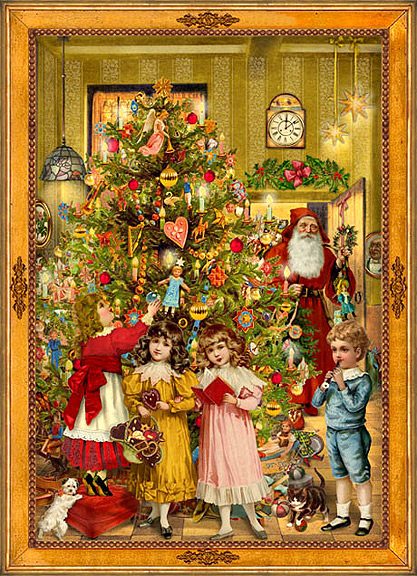
Most people regard the Christmas tree as a German tradition, brought to the English-speaking world in the 1840s by Prince Albert, the German prince who married Queen Victoria. The German custom seems to date from the Middle Ages, but what are its origins and the reasoning behind it?
As usual when dealing with the Middle Ages, there are lots of suggestions and no definite answer. But one theory is that the Christmas tree comes from the German mystery plays - not, as one might reasonably expect, from the Nativity plays, but from those dramatising the Fall of Adam and Eve.
These plays seem to have been staged on Christmas Eve and their props would have included a tree of some kind, representing the Tree of Knowledge and hung with apples symbolising the forbidden fruit. Over time, scholars suggest, the trees moved inside homes, where they remain today - and the traditional round baubles are what remain of the original 'fruits.' (In Germany and Austria some still do decorate their trees with dried fruit.)
A nice little story, but unfortunately one hard to prove. (There is an alternative tradition that the Christmas tree is neither Germanic nor Christian, but an adaption of a very old pagan custom Christianised by St Boniface.) Still, it deserves to be made known, if only because very few realise they may have the mystery plays to thank for their Christmas trees. Told you the mystery plays were still relevant :D
NB I must confess that despite being thoroughly acquainted with the English mystery plays and reasonably aware of the German and French ones I had never heard this story until last Sunday's sermon... which shows, firstly, that one can never know everything; secondly, that a good grounding in medieval literature comes in handy when writing sermons.
And thirdly, it proves that I was listening to the sermon ;)
Friday, 6 November 2015
Where did the mystery plays come from?
The short answer is... nobody knows.
The long answer is... very long indeed!
One branch of scholarship suggests that the mystery plays had a strong didactic element - that they were, alongside the churches’ stained glass windows, the means of teaching the illiterate masses their faith. Robert Huntingdon Fletcher’s take on medieval congregations and the development of the mystery plays is gloriously patronising and quite startlingly simplistic:
We must try in the first place to realize clearly the conditions under which the church service, the mass, was conducted during all the medieval centuries. We should picture to ourselves congregations of persons for the most part grossly ignorant, of unquestioning though very superficial faith, and of emotions easily aroused to fever heat. Of the Latin words of the service they understood nothing; and of the Bible story they had only a very general impression.
We must try in the first place to realize clearly the conditions under which the church service, the mass, was conducted during all the medieval centuries. We should picture to ourselves congregations of persons for the most part grossly ignorant, of unquestioning though very superficial faith, and of emotions easily aroused to fever heat. Of the Latin words of the service they understood nothing; and of the Bible story they had only a very general impression.
(Robert Huntingdon Fletcher, A History of English Literature (Boston: Richard G. Badger, 1916), accessed at http://www.luminarium.org/medlit/medievaldrama.htm.)
For such poor ignorami it was necessary “that the service [the Mass] should be given a strongly spectacular and emotional character,” which led slowly but inevitably to “the process of dramatizing the services.” Two very common forms of liturgical drama were Easter sepulchures (the church crucifix, after it had been venerated on Good Friday, would be 'buried' beneath the altar to symbolise Christ's death, then 'resurrected' on Easter morning and restored to its rightful place, either above the altar or on the rood screen) and the Quem Quaeritis trope (this was a dramatisation of the angel's speech to the three Marys at the empty tomb - 'Quem Quaeritis' means 'whom do you seek?'). Parts of the Christmas liturgy were also dramatised, but the Easter ceremonies were the main ones.
For such poor ignorami it was necessary “that the service [the Mass] should be given a strongly spectacular and emotional character,” which led slowly but inevitably to “the process of dramatizing the services.” Two very common forms of liturgical drama were Easter sepulchures (the church crucifix, after it had been venerated on Good Friday, would be 'buried' beneath the altar to symbolise Christ's death, then 'resurrected' on Easter morning and restored to its rightful place, either above the altar or on the rood screen) and the Quem Quaeritis trope (this was a dramatisation of the angel's speech to the three Marys at the empty tomb - 'Quem Quaeritis' means 'whom do you seek?'). Parts of the Christmas liturgy were also dramatised, but the Easter ceremonies were the main ones.
These dramatisations of the liturgy, says Fletcher, morphed gradually into the complete vernacular cycle of Bible stories when “the people... ceased to be patient with the unintelligble Latin." Originally also part of the liturgy and performed inside the churches, eventually
the churches began to seem too small and inconvenient, the excited audiences forgot the proper reverence, and the performances were transferred to the churchyard, and then, when the gravestones proved troublesome, to the market place, the village-green, or any convenient field. [...] Gradually, too, the priests lost their hold even on the plays themselves; skilful actors from among the laymen began to take many of the parts; and at last in some towns the trade-guilds, or unions of the various handicrafts, which had secured control of the town governments, assumed entire charge.
This evolutionary approach, very popular in the early to mid twentieth century, is today seen as somewhat outdated, although it lives on in popular culture (i.e. Wikipedia entries). And Fletcher's over-simplistic take on medieval drama (published in 1916) is, worryingly, still used by the Luminarium website as a general introduction to medieval plays.
the churches began to seem too small and inconvenient, the excited audiences forgot the proper reverence, and the performances were transferred to the churchyard, and then, when the gravestones proved troublesome, to the market place, the village-green, or any convenient field. [...] Gradually, too, the priests lost their hold even on the plays themselves; skilful actors from among the laymen began to take many of the parts; and at last in some towns the trade-guilds, or unions of the various handicrafts, which had secured control of the town governments, assumed entire charge.
This evolutionary approach, very popular in the early to mid twentieth century, is today seen as somewhat outdated, although it lives on in popular culture (i.e. Wikipedia entries). And Fletcher's over-simplistic take on medieval drama (published in 1916) is, worryingly, still used by the Luminarium website as a general introduction to medieval plays.
Most scholars now suggest that liturgical and vernacular drama developed separately but in tandem, each influenced by the other but each with its own particular purpose and function. Although both were forms of worship, liturgical drama belonged to the church and the mystery plays to the city. The structure of each reflects this. Liturgical drama used only the ecclesiastical Latin and was played by the church hierarchy; suiting the enclosed, sacred space of the church, it was highly ritualised and fairly static. The vernacular mystery plays, whose cast and playing space was the entire city, had far greater scope for colour, movement and theatrical energy.
And why were the plays called mystery plays? No one really knows that either, but here are the main theories:
- In Latin - the language of the church - mysterium meant "mystical or religious truth" (OED Online: mystery, n.1). Because religious truths were a main focus of the plays, the Latin may have been anglicized to mystery and associated with the plays.
- There is a very similar Latin word, misterium, which originally meant "duty, service, office" (OED Online: mystery, n.2), but which by the Middle Ages meant "occupation, trade" (ibid) in association with the craft guilds. Since the guilds were the primary producers of the plays, this may be why the plays became known as mystery plays.
Which is correct? Take your pick!
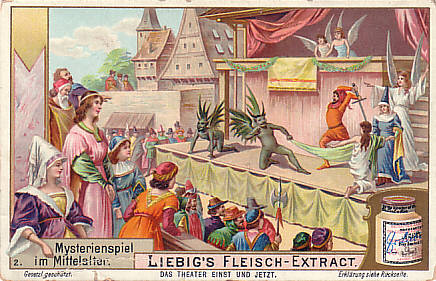 |
| Mystery plays were not uniquely English; they were widespread throughout Europe. The four main English cycles are those from are York, Chester, Wakefield, and the so-called N-Town; three Cornish plays also survive. On the continent, France, Germany, Spain and Italy all had their own plays. |
Tuesday, 8 September 2015
Looking back: 2012 York Mystery Play Production
Some links to video clips used to promote the 2012 production. Like the upcoming 2016 run, this was a 'fixed place' production - instead of using the pageant wagons the plays were performed on one large stage. This was erected in the Museum Gardens, using the ruins of St Mary's Abbey as a backdrop.
The clips give a good sense of the colour, movement, and sheer scale of the mystery plays. One theme that comes up again and again is how important the plays are to York's history, community, and the city itself.
All clips from http://www.yorkmysteryplays-2012.com/page/videos_and_podcasts.php
Cinematic trailer
Teaser trailer
The Artistic Directors talk about the staging
Time lapse of the stage & seating going up
Interviews with God/Jesus (Ferdinand Kingsley) and Satan (Graeme Hawley)
The plays and the community
The clips give a good sense of the colour, movement, and sheer scale of the mystery plays. One theme that comes up again and again is how important the plays are to York's history, community, and the city itself.
All clips from http://www.yorkmysteryplays-2012.com/page/videos_and_podcasts.php
Friday, 4 September 2015
2016 staging of York Mystery plays
The York Mystery plays are being wheeled out once again - although for their 2016 staging they will not be performed on the traditional pageant wagons but in the cavernous nave of York Minster. They were first performed here in 2000 to critical acclaim, and next year's production looks set to be just as impressive.
For general info, details, lots of pretty pictures, and even (for English residents!) the chance to get involved, see the production's spanking new website: Mystery plays 2016
Moving the plays inside the church will make for some interesting dynamics, as they were never intended to be staged indoors. The 'stations' or stopping points on the original pageant route were all either in front of or very close to churches (they made handy landmarks), but the plays belonged very much to the streets and their urban setting.
The plays as originally staged can be thought of as turning the churches 'inside out' - turning the action, immediacy and emotional power of the Mass and liturgy into a more accessible form, moving the sacred from the bounds of the church into the secular world of the city. Now we are going the other way - the plays are moving into the church.
For general info, details, lots of pretty pictures, and even (for English residents!) the chance to get involved, see the production's spanking new website: Mystery plays 2016
Moving the plays inside the church will make for some interesting dynamics, as they were never intended to be staged indoors. The 'stations' or stopping points on the original pageant route were all either in front of or very close to churches (they made handy landmarks), but the plays belonged very much to the streets and their urban setting.
The plays as originally staged can be thought of as turning the churches 'inside out' - turning the action, immediacy and emotional power of the Mass and liturgy into a more accessible form, moving the sacred from the bounds of the church into the secular world of the city. Now we are going the other way - the plays are moving into the church.
 |
| A ready-made theatre? The vast nave of York Minster |
 | ||
| Holy Trinity Church, the first stop on the pageant route |
 |
| And the famous octagonal tower of All Saints Pavement, right in the centre of the city, where the pageant route ended. |
 |
| http://eng.1september.ru/2008/08/img10-1.jpg |
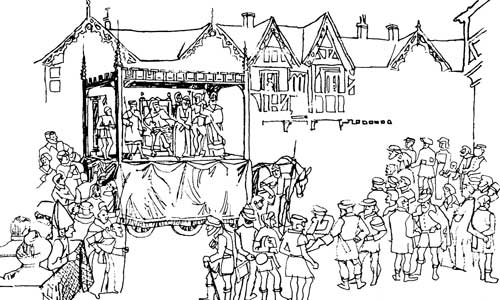
Artist's impression of how the mystery plays might have looked as originally staged (this is the Trial of Christ play).
Ego sum Alpha et O: vita, via, veritas, primus et novissimus.
I am gracious and great, God without beginning,
I am maker unmade, all might is in me;
I am life, and way unto wealth-winning,
I am foremost and first, as I bid shall it be.
My blessing of blee shall be blending,
And hielding, from harm to be hiding,
My body in bliss ay abiding,
Unending, without any ending.
This is the beginning of God the Father's speech which opens the first play, The Fall of the Angels, and thus the whole play cycle.
The Fall of the Angels l.1-9, from York Mystery Plays: a Selection in Modern Spelling, ed. Richard Beadle and Pamela King (Oxford: Oxford University Press, 2009).
Subscribe to:
Posts (Atom)