Showing posts with label English Adventures. Show all posts

Tuesday, 6 September 2016

York Minster Mystery Plays June 2016


'Have you come far?' 
- York Minster Mystery Plays volunteer to me

This post is rather late, given that we saw the plays on the 22nd June and it is now the beginning of September... still, better late than never! The reason for the delay is that I have been writing up a review of the plays as an academic paper, and my little brain does not like working on two things at once. Academia comes before blogging, so there you are. However, now that I have finished my paper, which is currently languishing in a long-suffering editor's inbox awaiting review, it is time to turn my attention to my rather neglected blog.

The Minster production of the mystery plays was the original inspiration for this year's English trip - their timing, just a few of months after handing in my MA thesis, was happily fortuitous and an excellent excuse for another trip back to Blighty. So back to Blighty I went, or more specifically back to York - this time with both my Grandmas, which made it even more special.

Despite being born a Lancashire rose I am very fond of the white rose county and of York in particular, which despite visiting only twice I have quite fallen in love with. So it was very nice to be back!

We went to a matinee performance of the plays, which turned out to be a good thing as the running time, billed at three and a half hours, ended up being nearer four. Thanks to jetlag, if we had gone in the evening I would probably have been gently snoozing long before Doomsday. On second thoughts, perhaps I wouldn't, as the Minster - all stone and shadow - was distinctly chilly.

By happy forethought, we had front row seats. It was a full house - testament to the popularity of the plays and this production in particular, which does seem to have been a fairly resounding success both with the critics and the general public. The Minster's nave had been converted into seating for around a thousand people - the third nearest the stage was flat but the back two-thirds was raked scaffolding, soaring up and back towards the West Window. 

The stage and set were huge, spread over four playing levels and linked by a series of wide, broad steps. Like the seating, the set reached upwards and backwards, almost to the top of the organ atop the quire screen. This kind of scale was of course the complete antithesis to the original performances of the play cycle, which were staged on small, mobile pageant wagons, but it worked well. Firstly, it evoked the scale and sweep of the cycle, which spans Biblical history from Creation to Doom, and secondly, well, such a big stage was necessary to accommodate the huge cast! This numbered roughly a hundred and forty, all except one (Philip McGinley, playing Christ) unpaid volunteers and many of them from the local community who have been performing in various productions of the plays for years (sometimes decades).

Out of so many characters, it is hard to pick favourites, but Philip McGinley was very good as Christ - though he puzzled me somewhat by making his first entrance clad rather incongruously in jeans and T-shirt but appearing thereafter in more conventional whitey-grey robes. Toby Gordon, as Lucifer, was (perhaps worryingly...) even better, but he reminded me of Dominic Cooper and once this thought had popped into my head it wouldn't pop out again. Ruby Baker as Mary and Mark Comer (one of the recurring devotees of the mystery plays) as Joseph were also excellent. Abraham I remember chiefly for the fact that he had to read his lines off a piece of paper hidden under his cloak (clearly someone was ill and he gamely stepped into the breach), Noah and Mrs Noah for their comic sparring, and Herod for his massive golden cape which spread over the entire stage and required an army of minions to manoeuver.

This version presented eighteen pageants (the original medieval play cycle has about forty-seven), though several of these consisted of two or three of the original short pageants run together into a longer section. The Middle English script had been 'lightly modernised,' retaining the alliterative rhythm of the original while introducing a few modern touches, such as Noah's 'Don't touch - the paint's not dry!' (said to God, inspecting the ark) and Lucifer's wail of 'It's not fair!' while being thrown into hell.

My two favourite episodes were the Creation and the Passion - the former for its colour, light and incredibly lifelike animal puppets, and the latter (which is really the heart of the entire cycle) for its solemn grandeur. Runners-up were the Nativity, for its tableaux effect, and the Entry into Jerusalem, for its movement and momentum.

No photographs of the actual performance - alas, this was not the free and easy Pop-Up Globe. But there are quite a few on the production's website, here.

Friday, 19 August 2016

On the trail of the Blackburns

While in York this past June I went back to the church of All Saints North Street, the parish church of the Blackburn family, to photograph the windows they donated to the church. They donated two windows, the Corporal Acts of Mercy Window and the St Anne Window (also known as the Blackburn Family Window, for fairly obvious reasons). These medieval windows are among the most famous in York and provide some of the best evidence we have about the Blackburn family. From them we can work out that:

  • the Blackburns were a wealthy family - very much so 
  • they were not averse to having this wealth displayed - probably quite the opposite
  • they were probably a genuinely pious family, but they made jolly sure that this piety was of the visible kind. In this they are a typical medieval upper-middle-class citizens, practising what I call 'practical piety.'  
  • their favourite saints were St Anne, St Christopher and St John the Baptist
  • the Blackburn women were probably literate (though this was not as uncommon as is popularly thought) and wanted this to be known
  • they were important people in their local parish and in the wider city 

Stained glass and practical piety

The Blackburns' motivation for donating the windows was, at least primarily, a charitable one. But, from a worldly point of view, the windows ensured that their significant wealth and their substantial largesse were on public and very visible display. From a spiritual standpoint, the Blackburns would almost certainly have viewed their donation as helping to cement them in God's good graces - an attitude that was typical of the pre-Reformation mindset. Moreover, by having themselves depicted in the windows, the Blackburns ensured that they would be remembered after death. This was not so much from worldly vanity (though no doubt that came into it too) but rather so that people looking at the windows would be reminded to pray for the repose of the Blackburns' souls. Preoccupation with purgatory and the state of the soul after death is another medieval trait.

The windows

The Corporal Acts of Mercy Window I have already written about here. But here it is again, because the reds and blues in the glass are so pretty:


This is the St Anne Window. Currently this window forms the church's East Window, which, as it is directly behind the altar, is a church's most prominent and most important window. However, this is almost certainly not the original positioning of the window; probably it was initially in the Lady Chapel, in the north aisle of the quire. At some point it was moved to the altar, which unfortunately means that the altar candles and crucifix get in the way of a good photograph:

St Anne is in the centre light; on her left (the right as you look at the window) is St Christopher carrying the Christ Child, and on her right St John the Baptist. Directly below St Anne sits the risen Christ enthroned in glory, flanked on either side by Nicholas and Margaret Blackburn senior (to the right as you look at the window) and their son and heir Nicholas junior with his wife, also a Margaret, on the left.

Here is a better view of the saints in the three main lights:


And here are the Blackburns themselves, kneeling piously and reading diligently in the bottom corners of the window. These are the senior Blackburns; Nicholas is shown in armour, possibly a reference to his position as King's Admiral of the North. Note the shield with 'B' (for Blackburn) in the centre. The lettering along the bottom originally read 'Orate pro animabus Nicholai Blakeburn senoris quondam maioris civitatis Ebor. et Margarete uxoris eius' [Pray for the soul of Nicholas Blackburn, former mayor of the city of York, and for Margaret his wife].


And here are Nicholas and Margaret junior:


The Blackburn shield is repeated, as is the lettering along the bottom, which seems to be the same as that under the senior Blackburns except that the word senoris is replaced with junioris. The fact that both Margarets are shown reading from the Psalms (Margaret junior reads Psalm 6 [Vulgate numbeing] and Margaret senior Psalm 50) is probably intended to draw attention to their literacy as well as their piety. As mentioned above, women's literacy was not as uncommon as is sometimes thought, but did presuppose a certain level of familial wealth and prestige.

The Blackburns in Blackburn

The Blackburns were not originally a York family. They came from Lancashire, almost certainly from the area around what is now the city of Blackburn. Whether the Blackburns were named after the city or the city after the Blackburns is not clear.

On my last Sunday in England I visited Lancashire's Samlesbury Hall, and what did greet me in the Great Hall but - 

The Blackburn coat of arms is the second from the right.

- lo and behold, a Blackburn coat of arms, complete with helpful date. 

I know next to nothing of heraldry (clearly a deficiency in my education :D). But some preliminary research suggests that the black wavy line through the centre of the shield represents the stream or river, known as the Black Brook or Black Water, on the banks of which the town was built. The white background possibly refers to wool or cloth; the manufacture of this was the town's chief industry and one which we know the Blackburn family to have been involved in. The stars, which apparently are correctly termed mullets, are interesting because as far as I can make out they were quite rare in the Middle Ages. Apparently they signify something along the lines of 'favoured by God' - which would fit neatly with the family's evident desire to claim, and proclaim, piety and prosperity.

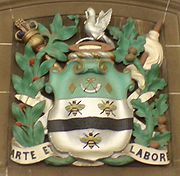
Looking at the Blackburn Borough Council coat of arms I think it is possible to trace the much older Blackburn family coat of arms in the design:

image in public domain, via


The design has obviously been added to over the years, but the central elements are strikingly similar to the medieval Blackburn coat of arms: the white background, the black wavy line, and the three stars or bees - two above the line and one below. The bees apparently signify industry and perseverance; their initial letter, 'B', is also the initial letter of the town.

Heraldic sources:

Tuesday, 9 August 2016

Richard III, the HandleBards, and Shakeshafte

This was one of the funniest things I have ever seen. I haven't laughed so much since Twelfth Night at the Pop-Up Globe.

The HandleBards tour the UK on bicycles, playing Shakespeare (usually outdoors) at various points along the route. They carry with them whatever props, costume and scenery they can squeeze onto their bikes (i.e. not much). There is a girls' group and a boys' group, each only four strong, and it was 'The Boys' we saw, performing Richard III in the grass courtyard of Lancashire's Hoghton Tower.

Richard III has a cast of forty-two. One of the HandleBards played Richard, and the other three took the remaining forty-one between them. As they helpfully pointed out, that is an average of 13.6 characters each. Needless to say, delightful chaos ensued; The Tragedy of King Richard III became The Farce of Richard and III Other Actors. What Shakespeare would have thought one can only guess, but one has a sneaking suspicion he might approve. It was fast, rowdy and fun.

Paring Shakespeare back to this extent, and treating the text and characters with a cheerful and reckless abandon, is brave, but it clearly paid off with a vengeance. The endless character swapping (done mostly by donning and doffing different hats) meant that the audience (and quite possibly the actors) was never quite sure who was playing whom at any given moment, and for those not familiar with the original play it probably boarded on the completely confusing (I know it reasonably well, and it was confusing enough to me). The whole thing was quite barmy and yet utterly hilarious. Only in England!

Richard III is Shakespeare's second-longest play (only Hamlet is longer) but they managed to squeeze it into about two hours. This was something of a mercy because it was open-air, and Lancashire's evening air, even in the height of summer, is apt to be rather parky. However, at least it didn't rain.

Hoghton Tower, via
Seeing Shakespeare at Hoghton Tower was particularly special because there is a local story that Shakespeare's so-called 'lost years' were spent in Lancashire, and that he lived for a while at Hoghton Tower as well as the homes of other prominent local families. The reasoning behind begins with the premise that Shakespeare was a Catholic and runs thus: several of the teachers at Shakespeare's Stratford school were Jesuit priests from Lancashire, which was a recusant stronghold during the Reformation; since he had connections in the area or at the very least people of his own faith, Shakespeare may therefore have headed up there when facing trouble at home (there is a story that he poached Thomas Lucy's deer, earning the wrath of that local lord). Once oop north, the story is that he lay low (Lancashire, surrounded by hills, is sometimes known as the 'hidden county;' the difficulty of passing the hills made the county a relatively safe one for Catholics during the Reformation) and tutored the children of the local Catholic gentry. 

The 1581 will of Alexander de Hoghton mentions a William Shakeshafte 'now dwelling with me,' requiring a Sir Thomas Hesketh either to take Shakeshafte into his service or to find him another 'master.' What kind of master is not specified, but the mention of Shakeshafte comes just after one of players, 'play clothes' [presumably costumes] and musical instruments, so the theory is that de Hoghton was seeking for the young actor Shakespeare the security of a patron. Shakespeare, the story goes, began his acting career in Lancashire, performing in the halls of the great houses there (apart from Hoghton Tower, Rufford Old Hall, the home of Sir Thomas Hesketh, also lays claim to harbouring Shakespeare). And the Shakeshafte bit? That was an alias, of course, because Thomas Lucy was still thirsting for William's blood. (It has been suggested that Shakeshafte was a variant of the family name used by William's grandfather.)

As with so many of the stories surrounding Shakespeare, this one is impossible to prove or disprove (many Shakespearean scholars would pooh-pooh it), but it makes for a jolly good yarn. One rather surprising subscriber to the story is the ex-Archbishop of Canterbury, Dr Rowan Williams, who has concluded that Shakespeare 'probably was Catholic!' (Wonders will never cease.) Furthermore, Dr Williams has actually written a play based on an imagined meeting between the Jesuit martyr Edmund Campion, who is known to have spent time in Lancashire, and William Shakespeare. If Shakespeare is Shakeshafte, then it is indeed possible that they may have met.

The historian Michael Wood also believes that Shakespeare spent time in Lancashire. The second episode of his series In Search of Shakespeare, which you can view here, examines the Lancashire connection and Alexander de Hoghton's will.

Other useful links:

 
Is this Shakespeare country?

Thursday, 4 August 2016

Shakespeare at the George | The Tempest

This, which was the opening night of the run, took place, literally, in a tempest! But as forlorn theatre-goers huddled in the George dining room, hoping the inclement weather would pass over, one lady cheerfully said, "If we always waited for the rain to stop, we'd never do anything at all." Quite so - this is the only attitude with which one can approach any outdoor event in England, even at the height of summer. When the rain calmly and relentlessly pours down, the only thing that one can do is keep calm and carry on.

The stage crew delayed the start by about fifteen minutes, which allowed for the worst of the rain to pass off but ensured that the seats were still very wet. However, no true Englishwoman was ever deterred by a little damp:

All rugged up and ready to go at The Tempest*
The courtyard of the George is a brilliant place for Shakespeare; it dates back to the 1600s and still has the upper gallery across the far end. It is thought that the touring companies of players would perform in such inns when they were on the road; they could knock up a trestle stage on one side of the yard and make use of the gallery above. The plebs stood in the yard and the well-heeled could watch from the bedroom windows opening onto the courtyard:

Somebody did watch from one of these windows (presumably in dry and toasty comfort), but about a third of the way through they got bored and disappeared!

I will always have a soft spot for the George, however hard it rains, because this was where I saw my very first Shakespeare play, way back when I was a little twinkie of eight. In a pleasing symmetry, that production was also The Tempest; and no, it didn't rain then - in fact it was a perfect evening, thankyou for asking.

I still have the bookmark which my parents bought for me at that first Tempest (left). Sadly, they are no longer sold, so my souvenir this time was a Shakespeare at the George keyfob (right).

But the play, you ask? Well, it was colourful, lively, good humoured, and the scenes with Trinculo and Stephano were genuinely funny. Prospero was very strong, Miranda soldiered bravely on after acquring a wet derrière early on in the piece (she had to perch decoratively on a green bank which was, of course, soaking wet), and Ariel was peculiarly annoying. She tried to turn her role into a ballet dance, which should not have annoyed me so much as she was no doubt trying to capture Ariel's intangible airiness. But the fact remains that it did annoy me! The musicians were excellent and the gallery, festooned with flowers and leaves, looked very pretty - and a nice contrast to the grey sky and lowering clouds above!

The gallery. NB the clock is wrong.
But the crowning glory of The Tempest will always be the language:

Be not afeared, the isle is full of noises, 
Sounds and sweet airs, that give delight and hurt not.
Sometimes a thousand twanging instruments
Will hum about mine ears, and sometimes voices
That, if then I had waked after long sleep,
Will make me sleep again: and then, in dreaming,
The clouds methought would open** and show riches***
Ready to drop upon me**** that, when I waked,
I cried to dream again.

All in all - I wouldn't have missed it for the world :D Thankyou, Grandma!


Website for Shakespeare at the George: http://satg.org.uk/

* Photos from my phone so please excuse the poor quality.
** Too right!
*** rain 
**** this is why we have raincoats nowadays

Friday, 29 July 2016

Colour and light: English stained glass

York Minster

When I was in York last year this was all that could be seen of the Minster's Great East Window...
But happily, conservation work on it is now almost completed and the window is once again on display.
The window, one of the largest surviving medieval windows in the country, tells the story of the beginning and end of the world, as well as incorporating various clerical figures connected with York and the north of England.

This is the St William window in York Minster, depicting William's rather eventful life and some of the miracles attributed to him. There is are more detailed pictures, and an article about the restoration of the window, here.
All Saints North Street

The St Anne window in All Saints North Street, donated by the Blackburn family. This window is now the East Window behind the altar, although this is probably not its original positioning. St Anne, to whom the Blackburns seem to have had a special devotion, is in the centre light, flanked by St John the Baptist on the left and St Christopher (also a favourite saint of the Blackburns) on the right.

And here are the junior Nicholas and Margaret Blackburn, kneeling piously in the bottom left corner of the window. Opposite them, in the bottom right corner [not shown here] are Nicholas and Margaret senior.

Church of St Mary Magdalene, Brampton
(Detailed historical and architectural information about this church, which dates back to the 13th century, can be found here.)

This window (not medieval!) shows, from left to right, St Fidelia, St Peter, St Stephen and St Perpetua (all early martyrs). The small bottom lights are memorials to the soldiers of World War I (detail below).

Ruth - who took my fancy because of the lovely red colouring of her dress, and because I have never seen her in any other window.
This is a tiny little window set low down into the chancel wall.
The West Window, above the West Door.

Monday, 25 July 2016

Plantagenet Rose's roses

Long time no blog! As most of you already know, I have been away for the past month, in England, indulging in walking, swimming, sightseeing, raspberries, strawberries, and Pimm's; rejoicing in the British 'summer;' marvelling at Brexit; attempting to drive a manual; taking far too many photographs of medieval stained glass; and smelling the roses.

The most famous medieval roses are of course the white rose of the Yorkists and the red rose of the Lancastrians:
via
The Wars of the Roses may have officially ended in 1485 with the triumph of the Earl of Richmond (who became Henry VII, the first Tudor king), but modern-day Lancashire and Yorkshire remain jealously proud of their respective roses. Both counties use the rose on their road signs (the brown ones pointing to sites of historical significance) and the roses are also a pretty common sight on flags, fluttering over the doorways of authentic olde worlde tourist shops!

Digging around for information on roses in the Middle Ages I came across a very interesting article in the gloriously-named Economic Botany journal, to which I refer the curious for further reference:

Mia Touw, "Roses in the Middle Ages," Economic Botany 36 no. 2 (1982): 71-83.

But now for some real roses (names are my own, not botanical!):

Rambling roses (Stonegarth)

Morning glory rose (Stonegarth)

Fiery rose (Stonegarth)

Wild rose - the sweetest of all roses (Hinchingbrooke County Park, Huntingdon)

One of the loveliest sights in all England is roses growing wild in the hedgerow... (Hinchinbrooke County Park, Huntingdon)

Austrian roses

Roses in the priest's cemetery at Stift Sankt Florian (Austria)

Beatrix Potter's roses (Hill Top, Lake District)
Sunset roses: perfect imperfection (Stonegarth)

I am the queen whom everybody knows:
I am the English Rose;
As light and free as any Jenny Wren,
As dear to Englishmen;
As joyous as a Robin Redbreast's tune,
I scent the air of June;
My buds are rosy as a baby's cheek;
I have one word to speak,
One word which is my secret and my song,
'Tis "England, England, England" all day long.

(Cicely Mary Barker, The Song of the Wild Rose Fairy)