... from every shires ende Of Engelond to Canterbury they wende, The holy blisful martir for to seke, That hem hath holpen, whan that they were seke. - Canterbury Tales, General Prologue
Canterbury, Canterbury, Thomas à Becket, everybody loves a martyr!
- Sheriff Vaisey, BBC Robin Hood, 2006.
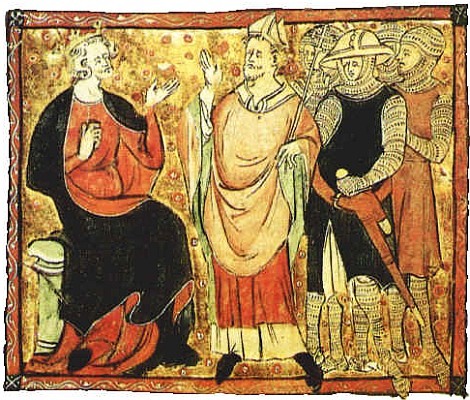
Today is, as every inhabitant of the Middle Ages would have known, the feast day of Thomas à Becket, Archbishop of Canterbury, killed in Canterbury Cathedral on 29th December 1170 by four knights of Henry II. The king and the Archbishop had been at odds as to whether the king had jurisdiction over the church. According to legend, when the Archbishop refused to sign the Constitutions of Clarendon, which would have restricted ecclesiastical powers, Henry cried "Who will rid me of this troublesome priest?" - an invitation which the four knights took literally.
This is an eyewitness account of the Archbishop's murder, by one Edward Grim, displaying the usual medieval flair for the dramatic:
...The wicked knight leapt suddenly upon [the Archbishop], cutting off the top of the
crown which the unction of sacred chrism had dedicated to God. Next he
received a second blow on the head, but still he stood firm and
immovable. At the third blow he fell on his knees and elbows, offering
himself a living sacrifice, and saying in a low voice, 'For the name of
Jesus and the protection of the Church, I am ready to embrace death.'
But the third knight inflicted a terrible wound as he lay prostrate. By
this stroke, the crown of his head was separated from the head in such a
way that the blood white with the brain, and the brain no less red from
the blood, dyed the floor of the cathedral. The same clerk who had
entered with the knights placed his foot on the neck of the holy priest
and precious martyr, and, horrible to relate, scattered the brains and
blood about the pavements, crying to the others, 'Let us away, knights;
this fellow will arise no more...
Thomas was immediately hailed as a martyr and the King was not popular (he later performed public penance - whether out of genuine remorse or political astuteness is debatable...) The Archbishop's tomb quickly became a drawcard for pilgrims (the medieval equivalent of tourists!) - famously, the pilgrims in the Canterbury Tales are all on their way to the shrine of St Thomas.
The site of Becket's murder in Canterbury Cathedral, via
Thanks almost solely to Thomas à Becket, medieval Canterbury became the pilgrimage capital of England. This seems rather to have annoyed its northern counterpart, York; for most of the Middle Ages there was a rather undignified struggle between the two sees, each seeking supremacy and one-upmanship over the other. Rivalry between the north and south of England appears to go a long way back!
If Canterbury's pet saint was Archbishop Thomas, York's was Archbishop William, who died in 1154 (reportedly from poisoned wine in his chalice). Following his burial in York Minster, rumours of miracles abounded, including the miraculous preservation of his body in one of the Minster's many fires (a miracle which was later mirrored almost exactly at Canterbury with St Thomas' body). William's cult, however, only really took off from the 1170s onward - at exactly the time of Thomas à Becket's murder and the outpouring of veneration which followed.
It is probable, however, that the sudden renewed interest in St William at York was not coincidence at all, and that York began to play up its association with William in response to events at Canterbury. The latter, finding itself suddenly the centre of pilgrimages from all over the country, no doubt thought itself immensely important. York must have resented Canterbury and Canterbury's saint being the centre of attention; the sudden blossoming of the cult of St William was surely at least partly an attempt to redress the balance. If this was indeed so it was only partially successful; York did become a popular tourist, sorry, pilgrimage destination, but never to the same degree as Canterbury.
Many people know the Coventry Carol, but most do not realise that it comes from one of the Middle English mystery play cycles - not the York cycle, but a now-lost Coventry cycle (not to be confused with the Ludus Coventriae cycle, which is now thought to come from East Anglia). It appears in the play known as the Shearmen and Tailors' pageant - one of the only two plays from the cycle to survive (the other is the Weavers').
The Shearmen and Tailors' play tells the story of the nativity, but this song is not a joyful carol welcoming the birth of Christ; instead it is a lament for the innocent children killed by Herod.
When sung today the words are modernised, but the Middle English words to the carol are:
O sisters too, how may we do For to preserve this day This pore yongling for whom we do singe By, by, lully, lullay?
Herod, the king, in his raging, Chargid he hath this day His men of might in his owne sight All yonge children to slay, -
That wo is me, pore child, for thee, And ever morne and may For thi parting nether say nor singe, By, by, lully, lullay.
The part of Herod seems to have been played as a raving, maniacal bully; there is a stage direction in the York Slaughter of the Innocents play to the effect of now shall Herod descend [from the pageant wagon] and rage in the streets. When Shakespeare was writing Hamlet, by which time the mystery cycles had long been banned for being too Catholic, the part of Herod was still a by-word for blustering, over-theatrical behaviour: "O, it offends me to the soul," laments the Melancholy Dane, "to hear a robustious periwig-pated fellow tear a passion to tatters, to very rags, to split the ears of the groundlings, who for the most part are capable of nothing but inexplicable dumbshows and noise: I would have such a fellow whipped for o'erdoing Termagant; it out-herods Herod: pray you, avoid it."
Coventry is not very far from Stratford-Upon-Avon so several scholars have suggested that Shakespeare may have seen the mystery plays when a boy.
MARY: This has he ordained of his grace,
My son so young,
A star to be shining a space
At his bearing.
For Balaam told full long before
How that a star should rise full high,
And of a maiden should be born
A son that shall our saving be
From cares keen.
Forsooth, it is my son so free
By whom Balaam gan mean.
JOSEPH: Now welcome, flower fairest of hue,
I shall thee mensk [worship] with main and might.
Hail, my maker, hail Christ Jesu,
Hail, royal king, root of all right,
Hail, saviour.
Hail, my Lord, learner of light,
Hail, blessed flower.
MARY: Now, Lord, that all this world shll win,
To thee, my son is that I say,
Here is no bed to lay thee in.
Therefore, my dear son, I thee pray,
Since it is so,
Here in this crib I might thee lay
Between these beasts two.
And I shall hap thee, mine own dear child,
With such clothes as we have here.
JOSEPH: Oh, Mary, behold these beasts mild,
They make lofing in their manner
As they were men.
Forsooth, it seems well by their cheer
Their Lord they ken.
From The Nativity, l.95-126, in York Mystery Plays: A Selection in Modern Spelling, edited by Richard Beadle and Pamela King (Oxford: Oxford University Press, 2009).
This card was sitting on a shelf in the university bookshop just begging to be bought for my supervisor, so I duly obliged :) It is a Mike Williams cartoon.
I'm dreaming of... not a white Christmas, but of getting my thesis finished sometime before Doomsday :D
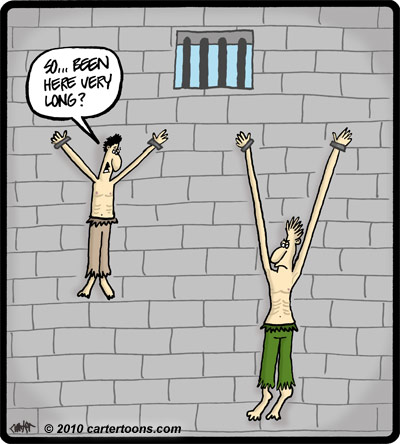
I have the required number of words - 40,000 (well actually a few more than that by now...) Whether they make sense or not is another matter. Currently I am trying to determine the sense or otherwise of my many words, a process also known as editing (colloquially termed tearing one's hair out). This delightful little procedure shall be finished by the end of February, because it has to be, otherwise this is what the university will do to me:
Working title number... well, I can't remember, but it's very many, is currently Faith and the City: Piety, Place and the Passion in Fifteenth-Century York. The thesis is in two parts, the first looking at the nature and character of the York Mass and the York mystery plays, the second re-imagining or re-creating the medieval experience of Mass and and plays. This gives me opportunity liberally to illustrate Part II with lots of my lovely photographs of the lovely York churches.
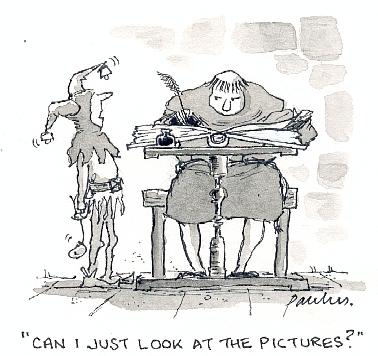
This is what my future examiner will ask when confronted with my thesis. Via
MA students discuss their work in the University of Auckland Arts Computer Lab, which is so dark, dingy and grey as to pass for a very fair imitation of a medieval dungeon. (This is why I work mostly from home.) via
The Pop-Up Globe is looking for volunteers to act as ushers during its Auckland run, February to April 2016. Join ze fun and see Shakespeare for free :D
As in a theatre, the eyes of men, After a well-grac'd actor leaves the stage, Are idly bent on him that enters next, Thinking his prattle to be tedious. Richard II V.2.




.JPG)